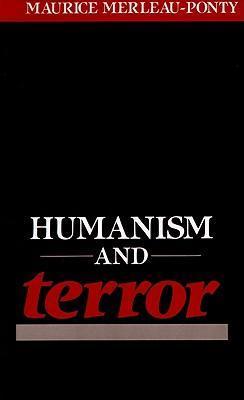



First published in France In 1947, Merleau-Ponty's essay was in part a response to Arthur Koestler's novel, Darkness at Noon, and in a larger sense a contribution to the political and moral debates of a postwar world suddenly divided into two armed camps. For Merleau-Ponty, the basic question was: given the violence in Communism, is Communism still equal to its humanist intentions? Starting with the assumption that a society is not a "temple of value-idols that figure on the front of its monuments or in its constitutional scrolls; the value of a society is the value It places upon man's relation to man," Merleau-ponty examines not only the Moscow trials of the late thirties but also Koestler's re-creation of them. And Merleau-Ponty makes it clear that the Moscow trials—and violence in general in the Communist world—can be understood only In the context of revolutionary violence. He demonstrates that it is pointless to begin an examination of Communist violence by asking whether Communism respects the rules of liberal thought; it is evident that Communism does not. The question that should be asked is whether the violence Communism exercises is revolutionary violence, capable of building humane relations among men. At a time when many are addressing similar questions to societies both in the East and in the West, Merleau-Ponty's investigations and speculations are of prime importance; they stand as a major and provocative contribution to the argument surrounding the use of violence.
Author

French phenomenological philosopher, strongly influenced by Edmund Husserl and Martin Heidegger in addition to being closely associated with Jean-Paul Sartre and Simone de Beauvoir. At the core of Merleau-Ponty's philosophy is a sustained argument for the foundational role that perception plays in understanding the world as well as engaging with the world. Like the other major phenomenologists Merleau-Ponty expressed his philosophical insights in writings on art, literature, and politics; however Merleau-Ponty was the only major phenomenologist of the first half of the Twentieth Century to engage extensively with the sciences, and especially with descriptive psychology. Because of this engagement, his writings have become influential with the recent project of naturalizing phenomenology in which phenomenologists utilize the results of psychology and cognitive science. Merleau-Ponty was born in Rochefort-sur-Mer, Charente-Maritime. His father was killed in World War 1 when Merleau-Ponty was 3. After secondary schooling at the lycée Louis-le-Grand in Paris, Maurice Merleau-Ponty became a student at the École Normale Supérieure, where he studied alongside Sartre, Simone de Beauvoir, and Simone Weil. He passed the agrégation in philosophy in 1930. Merleau-Ponty first taught at Chartres, then became a tutor at the École Normale Supérieure, where he was awarded his doctorate on the basis of two important books: La structure du comportement (1942) and Phénoménologie de la Perception (1945). After teaching at the University of Lyon from 1945 to 1948, Merleau-Ponty lectured on child psychology and education at the Sorbonne from 1949 to 1952. He was awarded the Chair of Philosophy at the Collège de France from 1952 until his death in 1961, making him the youngest person to have been elected to a Chair. Besides his teaching, Merleau-Ponty was also political editor for Les Temps Modernes from the founding of the journal in October 1945 until December 1952. Aged 53, he died suddenly of a stroke in 1961, apparently while preparing for a class on Descartes. He was buried in Le Père Lachaise Cemetery in Paris.