Margins
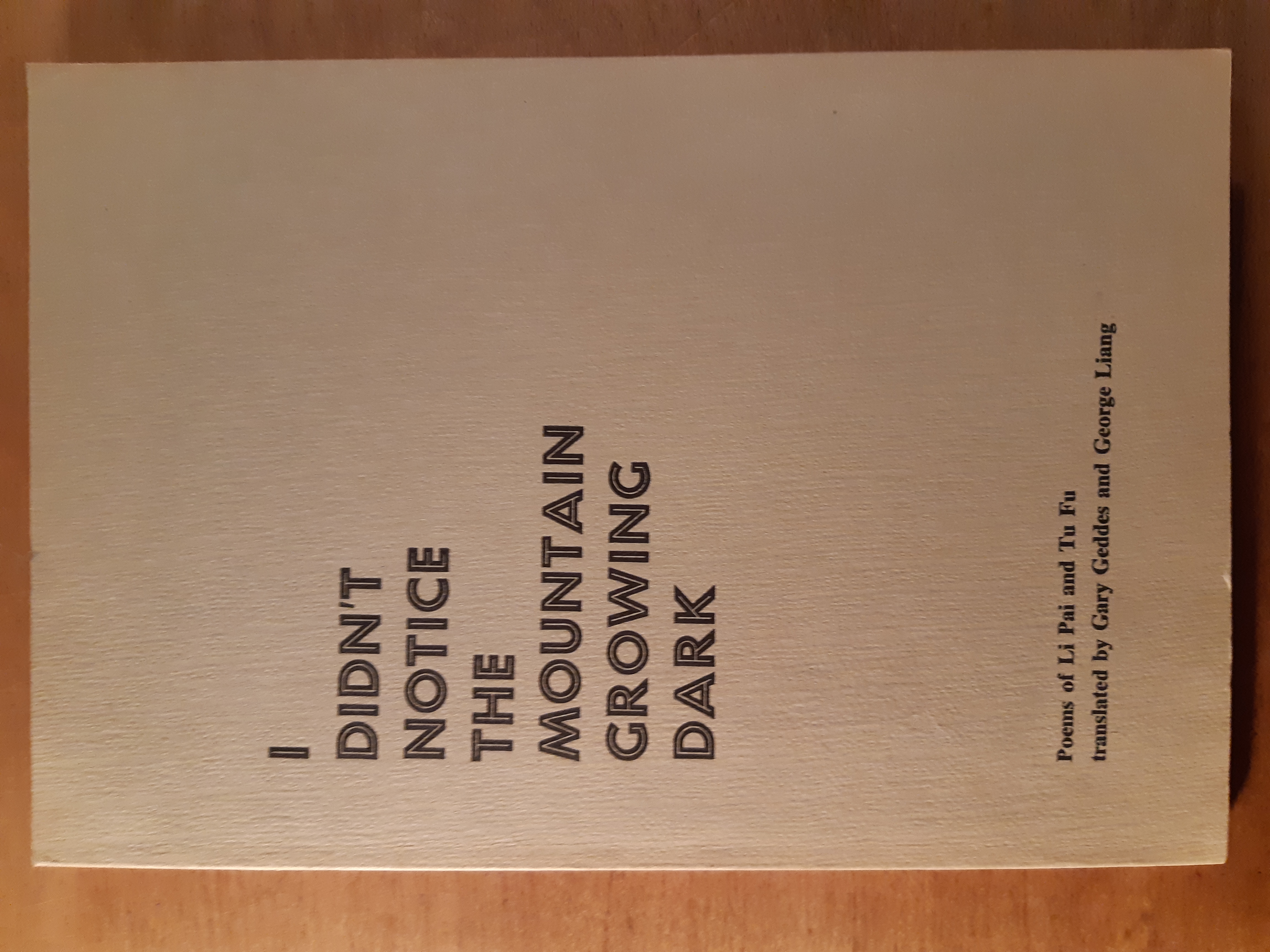
I Didn't Notice the Mountain Growing Dark book cover
I Didn't Notice the Mountain Growing Dark
1988
First Published
4.33
Average Rating
53
Number of Pages
English (translation)Original Chinese
Avg Rating
4.33
Number of Ratings
6
5 STARS
50%
4 STARS
33%
3 STARS
17%
2 STARS
0%
1 STARS
0%
goodreads

Authors

Li Bai
Li Bai
Author · 10 books

Date of Birth: ca. 701 A.D. Date of Death: ca. 762 A.D. This is a Chinese name. The family name is Li. Li Bai (Li Pai; Chinese: 李白; pinyin: Lǐ Bái; Wade–Giles: Li Pai), also known as Li Bo (or Li Po; pinyin: Lǐ Bó; Wade–Giles: Li Po) was a Chinese poet. He was part of the group of Chinese scholars called the "Eight Immortals of the Wine Cup" in a poem by fellow poet Du Fu. Li Po is often regarded, along with Du Fu, as one of the two greatest poets in China's literary history. Approximately 1,100 of his poems remain today. The first translations in a Western language were published in 1862 by Marquis d'Hervey de Saint-Denys in his Poésies de l'Époque des Thang. The English-speaking world was introduced to Li Po's works by a Herbert Allen Giles publication History of Chinese Literature (1901) and through the liberal, but poetically influential, translations of Japanese versions of his poems made by Ezra Pound. Li Po is best known for the extravagant imagination and striking Taoist imagery in his poetry, as well as for his great love for liquor. Like Du Fu, he spent much of his life travelling, although in his case it was because his wealth allowed him to, rather than because his poverty forced him. He is said, famously but untruly, to have drowned in the Yangtze River, having fallen from his boat while drunkenly trying to embrace the reflection of the moon.

Du Fu
Du Fu
Author · 10 books

Du Fu (Chinese: 杜甫; pinyin: Du Fu; Wade-Giles: Tu Fu, 712–770) was a prominent Chinese poet of the Tang Dynasty. Along with Li Bai (Li Po), he is frequently called the greatest of the Chinese poets. His own greatest ambition was to help his country by becoming a successful civil servant, but he proved unable to make the necessary accommodations. His life, like the whole country, was devastated by the An Lushan Rebellion of 755, and the last 15 years of his life were a time of almost constant unrest. Initially little known, his works came to be hugely influential in both Chinese and Japanese culture. Of his poetic writing, nearly fifteen hundred poems written by Du Fu have been handed down over the ages. He has been called Poet-Historian and the Poet-Sage by Chinese critics, while the range of his work has allowed him to be introduced to Western readers as "the Chinese Virgil, Horace, Ovid, Shakespeare, Milton, Burns, Wordsworth, Béranger, Hugo or Baudelaire".

548 Market St PMB 65688, San Francisco California 94104-5401 USA
© 2026 Paratext Inc. All rights reserved