Margins
I Tatti Studies in Italian Renaissance History book cover 1
I Tatti Studies in Italian Renaissance History book cover 2
I Tatti Studies in Italian Renaissance History book cover 3
I Tatti Studies in Italian Renaissance History
Series · 15
books · 2013-2021

Books in series

Cultures of Charity book cover
#7

Cultures of Charity

Women, Politics, and the Reform of Poor Relief in Renaissance Italy

2013

Renaissance Italians pioneered radical changes in ways of helping the poor, including orphanages, workhouses, pawnshops, and women s shelters. Nicholas Terpstra shows that gender was the key factor driving innovation. Most of the recipients of charity were women. The most creative new plans focused on features of women s poverty like illegitimate births, hunger, unemployment, and domestic violence. Signal features of the reforms, from forced labor to new instruments of saving and lending, were devised specifically to help young women get a start in life. "Cultures of Charity" is the first book to see women s poverty as the key factor driving changes to poor relief. These changes generated intense political debates as proponents of republican democracy challenged more elitist and authoritarian forms of government emerging at the time. Should taxes fund poor relief? Could forced labor help build local industry? Focusing on Bologna, Terpstra looks at how these fights around politics and gender generated pioneering forms of poor relief, including early examples of maternity benefits, unemployment insurance, food stamps, and credit union savings plans."
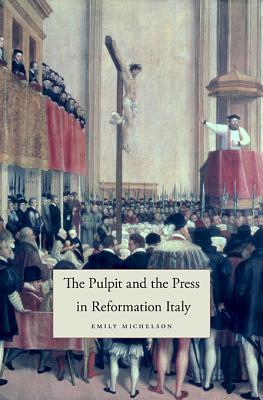
The Pulpit and the Press in Reformation Italy book cover
#8

The Pulpit and the Press in Reformation Italy

2013

Italian preachers during the Reformation era found themselves in the trenches of a more desperate war than anything they had ever imagined. This war―the splintering of western Christendom into conflicting sects―was physically but also spiritually violent. In an era of tremendous religious convolution, fluidity, and danger, preachers of all kinds spoke from the pulpit daily, weekly, or seasonally to confront the hottest controversies of their time. Preachers also turned to the printing press in unprecedented numbers to spread their messages. Emily Michelson challenges the stereotype that Protestants succeeded in converting Catholics through superior preaching and printing. Catholic preachers were not simply reactionary and uncreative mouthpieces of a monolithic church. Rather, they deftly and imaginatively grappled with the question of how to preserve the orthodoxy of their flock and maintain the authority of the Roman church while also confronting new, undeniable lay demands for inclusion and participation. These sermons―almost unknown in English until now―tell a new story of the Reformation that credits preachers with keeping Italy Catholic when the region’s religious future seemed uncertain, and with fashioning the post-Reformation Catholicism that thrived into the modern era. By deploying the pulpit, pen, and printing press, preachers in Italy created a new religious culture that would survive in an unprecedented atmosphere of competition and religious choice.
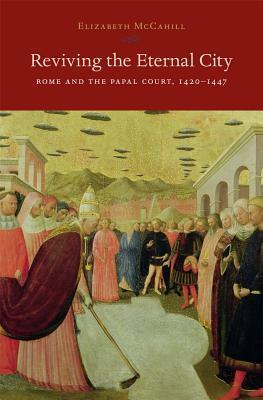
Reviving the Eternal City book cover
#9

Reviving the Eternal City

Rome and the Papal Court, 1420-1447

2013

In 1420, after more than one hundred years of the Avignon Exile and the Western Schism, the papal court returned to Rome, which had become depopulated, dangerous, and impoverished in the papacy's absence. Reviving the Eternal City examines the culture of Rome and the papal court during the first half of the fifteenth century, a crucial transitional period before the city's rebirth. As Elizabeth McCahill explains, during these decades Rome and the Curia were caught between conflicting realities—between the Middle Ages and the Renaissance, between conciliarism and papalism, between an image of Rome as a restored republic and a dream of the city as a papal capital. Through the testimony of humanists' rhetorical texts and surviving archival materials, McCahill reconstructs the niche that scholars carved for themselves as they penned vivid descriptions of Rome and offered remedies for contemporary social, economic, religious, and political problems. In addition to analyzing the humanists' intellectual and professional program, McCahill investigates the different agendas that popes Martin V (1417-1431) and Eugenius IV (1431-1447) and their cardinals had for the post-Schism pontificate. Reviving the Eternal City illuminates an urban environment in transition and explores the ways in which curialists collaborated and competed to develop Rome's ancient legacy into a potent cultural myth.
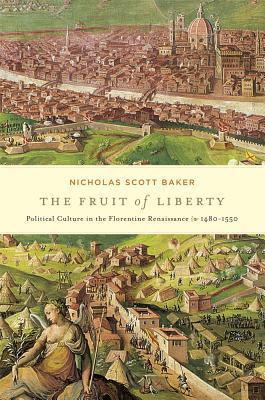
The Fruit of Liberty book cover
#10

The Fruit of Liberty

Political Culture in the Florentine Renaissance, 1480-1550

2013

In the middle decades of the sixteenth century, the republican city-state of Florence—birthplace of the Renaissance—failed. In its place the Medici family created a principality, becoming first dukes of Florence and then grand dukes of Tuscany. The Fruit of Liberty examines how this transition occurred from the perspective of the Florentine patricians who had dominated and controlled the republic. The book analyzes the long, slow social and cultural transformations that predated, accompanied, and facilitated the institutional shift from republic to principality, from citizen to subject. More than a chronological narrative, this analysis covers a wide range of contributing factors to this transition, from attitudes toward office holding, clothing, and the patronage of artists and architects to notions of self, family, and gender. Using a wide variety of sources including private letters, diaries, and art works, Nicholas Baker explores how the language, images, and values of the republic were reconceptualized to aid the shift from citizen to subject. He argues that the creation of Medici principality did not occur by a radical break with the past but with the adoption and adaptation of the political culture of Renaissance republicanism.
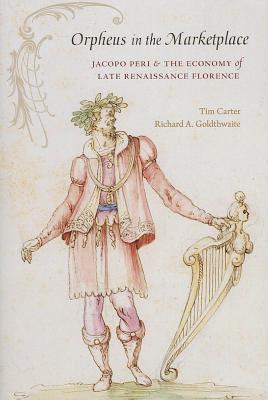
Orpheus in the Marketplace book cover
#11

Orpheus in the Marketplace

Jacopo Peri and the Economy of Late Renaissance Florence

2013

The Florentine musician Jacopo Peri (1561-1633) is known as the composer of the first operas—they include the earliest to survive complete, "Euridice "(1600), in which Peri sang the role of Orpheus. The recent discovery of a large number of private account books belonging to him and his family allows for a greater exploration of Peri's professional and personal life. Richard Goldthwaite, an economic historian, and Tim Carter, a musicologist, have done much more, however, than write a biography: their investigation exposes the remarkable value of such financial documents as a primary source for an entire period. This record of Peri's wide-ranging investments and activities in the marketplace enables the first detailed account of the Florentine economy in the late sixteenth and early seventeenth centuries, and also opens a completely new perspective on one of Europe's principal centers of capitalism. His economic circumstances reflect continuities and transformations in Florentine society, and the strategies for negotiating them, under the Medici grand dukes. At the same time they allow a reevaluation of Peri the singer and composer that elucidates the cultural life of a major artistic center even in changing times, providing a quite different view of what it meant to be a musician in late Renaissance Italy.
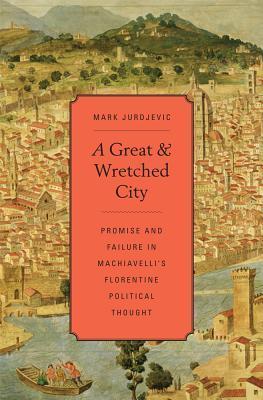
A Great and Wretched City book cover
#12

A Great and Wretched City

Promise and Failure in Machiavelli’s Florentine Political Thought

2014

Like many inhabitants of booming metropolises, Machiavelli alternated between love and hate for his native city. He often wrote scathing remarks about Florentine political myopia, corruption, and servitude, but also wrote about Florence with pride, patriotism, and confident hope of better times. Despite the alternating tones of sarcasm and despair he used to describe Florentine affairs, Machiavelli provided a stubbornly persistent sense that his city had all the materials and potential necessary for a wholesale, triumphant, and epochal political renewal. As he memorably put it, Florence was "truly a great and wretched city." Mark Jurdjevic focuses on the Florentine dimension of Machiavelli's political thought, revealing new aspects of his republican convictions. Through The Prince, Discourses, correspondence, and, most substantially, Florentine Histories, Jurdjevic examines Machiavelli's political career and relationships to the republic and the Medici. He shows that significant and as yet unrecognized aspects of Machiavelli's political thought were distinctly Florentine in inspiration, content, and purpose. From a new perspective and armed with new arguments, A Great and Wretched City reengages the venerable debate about Machiavelli's relationship to Renaissance republicanism. Dispelling the myth that Florentine politics offered Machiavelli only negative lessons, Jurdjevic argues that his contempt for the city's shortcomings was a direct function of his considerable estimation of its unrealized political potential.
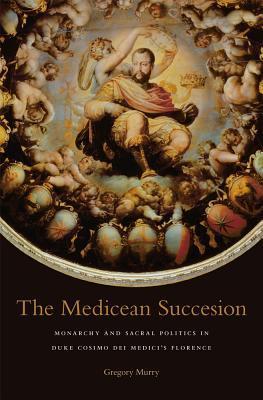
The Medicean Succession book cover
#14

The Medicean Succession

Monarchy and Sacral Politics in Duke Cosimo dei Medici’s Florence

2014

In 1537, Florentine Duke Alessandro dei Medici was murdered by his cousin and would-be successor, Lorenzino dei Medici. Lorenzino's treachery forced him into exile, however, and the Florentine senate accepted a compromise candidate, seventeen-year-old Cosimo dei Medici. The senate hoped Cosimo would act as figurehead, leaving the senate to manage political affairs. But Cosimo never acted as a puppet. Instead, by the time of his death in 1574, he had stabilized ducal finances, secured his borders while doubling his territory, attracted an array of scholars and artists to his court, academy, and universities, and, most importantly, dissipated the perennially fractious politics of Florentine life. Gregory Murry argues that these triumphs were far from a foregone conclusion. Drawing on a wide variety of archival and published sources, he examines how Cosimo and his propagandists successfully crafted an image of Cosimo as a legitimate sacral monarch. Murry posits that both the propaganda and practice of sacral monarchy in Cosimo's Florence channeled preexisting local religious assumptions as a way to establish continuities with the city's republican and renaissance past. In The Medicean Succession, Murry elucidates the models of sacral monarchy that Cosimo chose to utilize as he deftly balanced his ambition with the political sensitivities arising from existing religious and secular traditions.
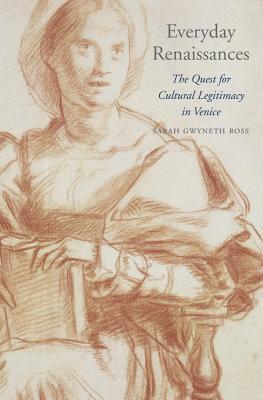
Everyday Renaissances book cover
#18

Everyday Renaissances

The Quest for Cultural Legitimacy in Venice

2016

The world of wealth and patronage that we associate with sixteenth- and early seventeenth-century Italy can make the Renaissance seem the exclusive domain of artists and aristocrats. Revealing a Renaissance beyond Michelangelo and the Medici, Sarah Gwyneth Ross recovers the experiences of everyday men and women who were inspired to pursue literature and learning. Ross draws on a trove of original unpublished sources―wills, diaries, household inventories, account books, and other miscellany―to reconstruct the lives of over one hundred artisans, merchants, and others on the middle rung of Venetian society who embraced the ennobling virtues of a humanistic education. These men and women sought out the latest knowledge, amassed personal libraries, and passed both their books and their hard-earned wisdom on to their families and heirs. Physicians were often the most avid―and the most anxious―of professionals seeking cultural legitimacy. Ross examines the lives of three Nicolò Massa (1485–1569), Francesco Longo (1506–1576), and Alberto Rini (d. 1599). Though they had received university training, these self-made men of letters were not patricians but members of a social group that still yearned for credibility. Unlike priests or lawyers, physicians had not yet rid themselves of the taint of artisanal labor, and they were thus indicative of a middle class that sought to earn the respect of their peers and betters, protect and advance their families, and secure honorable remembrance after death.
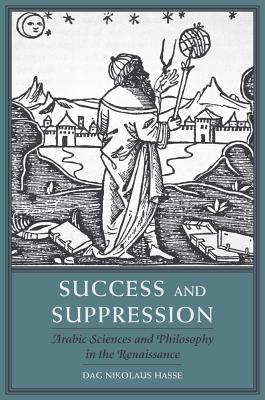
Success and Suppression book cover
#19

Success and Suppression

Arabic Sciences and Philosophy in the Renaissance

2016

The Renaissance marked a turning point in Europe's relationship to Arabic thought. On the one hand, Dag Nikolaus Hasse argues, it was the period in which important Arabic traditions reached the peak of their influence in Europe. On the other hand, it is the time when the West began to forget, and even actively suppress, its debt to Arabic culture. Success and Suppression traces the complex story of Arabic influence on Renaissance thought. It is often assumed that the Renaissance had little interest in Arabic sciences and philosophy, because humanist polemics from the period attacked Arabic learning and championed Greek civilization. Yet Hasse shows that Renaissance denials of Arabic influence emerged not because scholars of the time rejected that intellectual tradition altogether but because a small group of anti-Arab hard-liners strove to suppress its powerful and persuasive influence. The period witnessed a boom in new translations and multivolume editions of Arabic authors, and European philosophers and scientists incorporated—and often celebrated—Arabic thought in their work, especially in medicine, philosophy, and astrology. But the famous Arabic authorities were a prominent obstacle to the Renaissance project of renewing European academic culture through Greece and Rome, and radical reformers accused Arabic science of linguistic corruption, plagiarism, or irreligion. Hasse shows how a mixture of ideological and scientific motives led to the decline of some Arabic traditions in important areas of European culture, while others continued to flourish.
Clerical Households in Late Medieval Italy book cover
#20

Clerical Households in Late Medieval Italy

2017

Roisin Cossar brings a new perspective to the history of the Christian church in fourteenth century Italy by examining how clerics managed efforts to reform their domestic lives in the decades after the arrival of the Black Death. Priests at the end of the Middle Ages resembled their lay contemporaries as they entered into domestic relationships with women, fathered children, and took responsibility for managing households, or familiae. Cossar limns a complex portrait of daily life in the medieval clerical familia that traces the phases of its development. Many priests began their vocation as apprentices in the households of older clerics. In middle age, priests fully embraced the traditional role of paterfamilias\—patriarchs with authority over their households, including servants and, especially in Venice, slaves. As fathers they endeavored to establish their illegitimate sons in a clerical family trade. They also used their legal knowledge to protect their female companions and children against a church that frowned on such domestic arrangements and actively sought to stamp them out. Clerical Households in Late Medieval Italy refutes the longstanding charge that the late medieval clergy were corrupt, living licentious lives that failed to uphold priestly obligations. In fashioning a domestic culture that responded flexibly to their own needs, priests tempered the often unrealistic expectations of their superiors. Their response to the rigid demands of church reform allowed the church to maintain itself during a period of crisis and transition in European history.
The Avignon Papacy Contested book cover
#21

The Avignon Papacy Contested

An Intellectual History from Dante to Catherine of Siena

2017

The Avignon papacy (1309–1377) represented the zenith of papal power in Europe. The Roman curia’s move to southern France enlarged its bureaucracy, centralized its authority, and initiated closer contact with secular institutions. The pope’s presence also attracted leading minds to Avignon, transforming a modest city into a cosmopolitan center of learning. But a crisis of legitimacy was brewing among leading thinkers of the day. The Avignon Papacy Contested considers the work of six fourteenth-century writers who waged literary war against the Catholic Church’s increasing claims of supremacy over secular rulers―a conflict that engaged contemporary critics from every corner of Europe. Unn Falkeid uncovers the dispute’s origins in Dante’s Paradiso and Monarchia, where she identifies a sophisticated argument for the separation of church and state. In Petrarch’s writings she traces growing concern about papal authority, precipitated by the curia’s exile from Rome. Marsilius of Padua’s theory of citizen agency indicates a resistance to the pope’s encroaching power, which finds richer expression in William of Ockham’s philosophy of individual liberty. Both men were branded as heretics. The mystical writings of Birgitta of Sweden and Catherine of Siena, in Falkeid’s reading, contain cloaked confrontations over papal ethics and church governance even though these women were later canonized. While each of the six writers responded creatively to the implications of the Avignon papacy, they shared a concern for the breakdown of secular order implied by the expansion of papal power and a willingness to speak their minds.
A Convert’s Tale book cover
#23

A Convert’s Tale

Art, Crime, and Jewish Apostasy in Renaissance Italy

2019

An intimate portrait, based on newly discovered archival sources, of one of the most famous Jewish artists of the Italian Renaissance who, charged with a scandalous crime, renounced his faith and converted to Catholicism. In 1491 the renowned goldsmith Salomone da Sesso converted to Catholicism. Born in the mid-fifteenth century to a Jewish family in Florence, Salomone later settled in Ferrara, where he was regarded as a virtuoso artist whose exquisite jewelry and lavishly engraved swords were prized by Italy’s ruling elite. But rumors circulated about Salomone’s behavior, scandalizing the Jewish community, who turned him over to the civil authorities. Charged with sodomy, Salomone was sentenced to die but agreed to renounce Judaism to save his life. He was baptized, taking the name Ercole “de’ Fedeli” (“One of the Faithful”). With the help of powerful patrons like Duchess Eleonora of Aragon and Duke Ercole d’Este, his namesake, Ercole lived as a practicing Catholic for three more decades. Drawing on newly discovered archival sources, Tamar Herzig traces the dramatic story of his life, half a century before ecclesiastical authorities made Jewish conversion a priority of the Catholic Church. A Convert’s Tale explores the Jewish world in which Salomone was born and raised; the glittering objects he crafted, and their status as courtly hallmarks; and Ercole’s relations with his wealthy patrons. Herzig also examines homosexuality in Renaissance Italy, the response of Jewish communities and Christian authorities to allegations of sexual crimes, and attitudes toward homosexual acts among Christians and Jews. In Salomone/Ercole’s story we see how precarious life was for converts from Judaism, and how contested was the meaning of conversion for both the apostates’ former coreligionists and those tasked with welcoming them to their new faith.
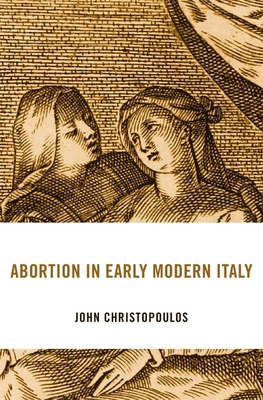
Abortion in Early Modern Italy book cover
#25

Abortion in Early Modern Italy

2021

A comprehensive history of abortion in Renaissance Italy. In this authoritative history, John Christopoulos provides a provocative and far-reaching account of abortion in sixteenth- and seventeenth-century Italy. His poignant portraits of women who terminated or were forced to terminate pregnancies offer a corrective to longstanding views: he finds that Italians maintained a fundamental ambivalence about abortion. Italians from all levels of society sought, had, and participated in abortions. Early modern Italy was not an absolute anti-abortion culture, an exemplary Catholic society centered on the "traditional family." Rather, Christopoulos shows, Italians held many views on abortion, and their responses to its practice varied. Bringing together medical, religious, and legal perspectives alongside a social and cultural history of sexuality, reproduction, and the family, Christopoulos offers a nuanced and convincing account of the meanings Italians ascribed to abortion and shows how prevailing ideas about the practice were spread, modified, and challenged. Christopoulos begins by introducing readers to prevailing ideas about abortion and women's bodies, describing the widely available purgative medicines and surgeries that various healers and women themselves employed to terminate pregnancies. He then explores how these ideas and practices ran up against and shaped theology, medicine, and law. Catholic understanding of abortion was changing amid religious, legal, and scientific debates concerning the nature of human life, women's bodies, and sexual politics. Christopoulos examines how ecclesiastical, secular, and medical authorities sought to regulate abortion, and how tribunals investigated and punished its procurers—or did not, even when they could have. Abortion in Early Modern Italy offers a compelling and sensitive study of abortion in a time of dramatic religious, scientific, and social change.

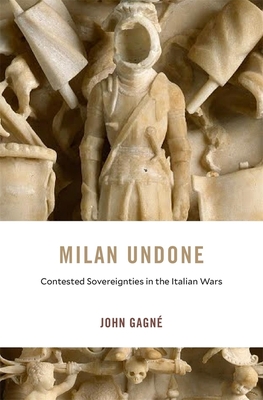
Milan Undone book cover
#26

Milan Undone

Contested Sovereignties in the Italian Wars

2021

A new history of how one of the Renaissance's preeminent cities lost its independence in the Italian Wars. In 1499, the duchy of Milan had known independence for one hundred years. But the turn of the sixteenth century saw the city battered by the Italian Wars. As the major powers of Europe battled for supremacy, Milan, viewed by contemporaries as the "key to Italy," found itself wracked by a tug-of-war between French claimants and its ruling Sforza family. In just thirty years, the city endured nine changes of government before falling under three centuries of Habsburg dominion. John Gagn� offers a new history of Milan's demise as a sovereign state. His focus is not on the successive wars themselves but on the social disruption that resulted. Amid the political whiplash, the structures of not only government but also daily life broke down. The very meanings of time, space, and dynasty—and their importance to political authority—were rewritten. While the feudal relationships that formed the basis of property rights and the rule of law were shattered, refugees spread across the region. Exiles plotted to claw back what they had lost. Milan Undone is a rich and detailed story of harrowing events, but it is more than that. Gagn� asks us to rethink the political legacy of the Renaissance: the cradle of the modern nation-state was also the deathbed of one of its most sophisticated precursors. In its wake came a kind of reversion—not self-rule but chaos and empire.
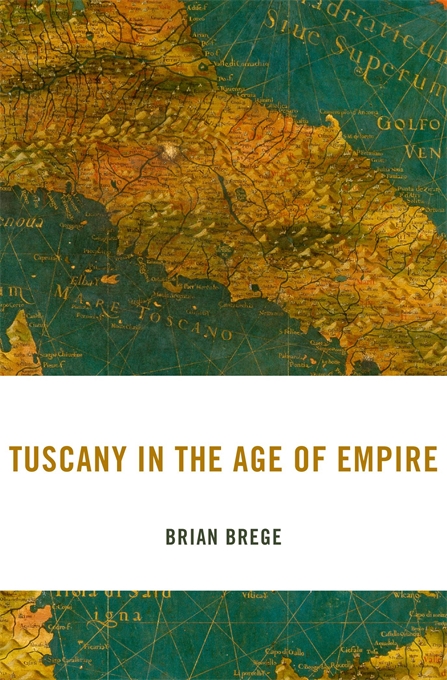
Tuscany in the Age of Empire book cover
#29

Tuscany in the Age of Empire

2021

A new history explores how one of Renaissance Italy’s leading cities maintained its influence in an era of global exploration, trade, and empire. The Grand Duchy of Tuscany was not an imperial power, but it did harbor global ambitions. After abortive attempts at overseas colonization and direct commercial expansion, as Brian Brege shows, Tuscany followed a different path, one that allowed it to participate in Europe’s new age of empire without establishing an empire of its own. The first history of its kind, Tuscany in the Age of Empire offers a fresh appraisal of one of the foremost cities of the Italian Renaissance, as it sought knowledge, fortune, and power throughout Asia, the Americas, and beyond. How did Tuscany, which could not compete directly with the growing empires of other European states, establish a global presence? First, Brege shows, Tuscany partnered with larger European powers. The duchy sought to obtain trade rights within their empires and even manage portions of other states’ overseas territories. Second, Tuscans invested in cultural, intellectual, and commercial institutions at home, which attracted the knowledge and wealth generated by Europe’s imperial expansions. Finally, Tuscans built effective coalitions with other regional powers in the Mediterranean and the Islamic world, which secured the duchy’s access to global products and empowered the Tuscan monarchy in foreign affairs. These strategies allowed Tuscany to punch well above its weight in a world where power was equated with the sort of imperial possessions it lacked. By finding areas of common interest with stronger neighbors and forming alliances with other marginal polities, a small state was able to protect its own security while carving out a space as a diplomatic and intellectual hub in a globalizing Europe.

Authors

Brian Brege
Author · 1 book
Brian Brege is Assistant Professor of History at Syracuse University and a past Fellow at Villa I Tatti, the Harvard University Center for Italian Renaissance Studies.
Dag Nikolaus Hasse
Dag Nikolaus Hasse
Author · 2 books
Dag Nikolaus Hasse (1969) is a German Arabist, historian of philosophy, Graeco-Arabist and Middle Latin philologist.
Nicholas Terpstra
Author · 4 books
Nicholas Terpstra (University of Toronto) is author of Lay Confraternities and Civic Religion in Renaissance Bologna (1995), which won the Howard K. Marraro Prize of the Society for Italian Historical Studies, and the editor of The Politics of Ritual Kinship: Confraternities and Social Order in Early Modern Italy (2000).
548 Market St PMB 65688, San Francisco California 94104-5401 USA
© 2026 Paratext Inc. All rights reserved
I Tatti Studies in Italian Renaissance History