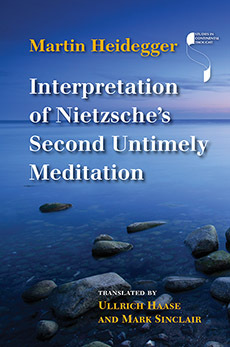
Interpretation of Nietzsche's Second Untimely Meditation
2003
First Published
4.00
Average Rating
351
Number of Pages
Martin Heidegger's Nietzsche's Second Untimely Meditation presents crucial elements for understanding Heidegger's thinking from 1936 to 1940. Heidegger offers a radically different reading of a text that he had read decades earlier, showing how his relationship with Nietzche's has changed, as well as how his understandings of the differences between animals and humans, temporality and history, and the Western philosophical tradition developed. With his new reading, Heidegger delineates three Nietzschean modes of history, which should be understood as grounded in the structure of temporality or historicity and also offers a metaphysical determination of life and the essence of humankind. Ullrich Hasse and Mark Sinclair offer a clear and accessible translation despite the fragmentary and disjointed quality of the original lecture notes that comprise this text.

Avg Rating
4.00
Number of Ratings
5
5 STARS
60%
4 STARS
20%
3 STARS
0%
2 STARS
0%
1 STARS
20%
goodreads
Author

Martin Heidegger
Author · 91 books
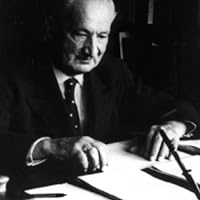
Martin Heidegger (1889-1976) was a German philosopher whose work is perhaps most readily associated with phenomenology and existentialism, although his thinking should be identified as part of such philosophical movements only with extreme care and qualification. His ideas have exerted a seminal influence on the development of contemporary European philosophy. They have also had an impact far beyond philosophy, for example in architectural theory (see e.g., Sharr 2007), literary criticism (see e.g., Ziarek 1989), theology (see e.g., Caputo 1993), psychotherapy (see e.g., Binswanger 1943/1964, Guignon 1993) and cognitive science (see e.g., Dreyfus 1992, 2008; Wheeler 2005; Kiverstein and Wheeler forthcoming).