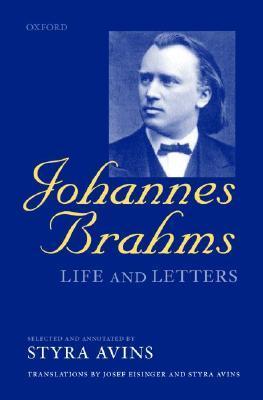
This book is the first comprehensive collection of the letters of Johannes Brahms ever to appear in English. Over 550 are included, virtually all uncut, and there are over a dozen published here for the first time in any language. Although he corresponded throughout his life with some of the great performers, composers, musicologists, writers, scientists, and artists of the day, and although thousands of his letters have survived, English readers have until now had scant opportunity to meet Brahms in person, through his words, and in his own voice. The letters in this volume range from 1848 to just before his death. They include most of Brahm's letters to Robert Schumann, over a hundred letters to Clara Schumann, and the complete Brahms-Wagner correspondence. They are joined by a running commentary to form an absorbing narrative, documented with scholarly care, provided with comprehensive notes, but written for the general music lover—the result is a lively biography. The work is generously illustrated, and contains several detailed appendices and an index.
Author

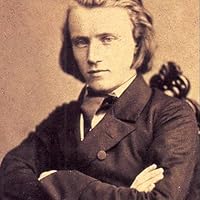
In 1833, Johannes Brahms was born in Germany. As a teenager playing for drunken sailors in a Hamburg bar, Brahms would prop up books of poetry to read as a diversion. His favorite poet was the anticlerical G.F. Daumer, described by the Catholic Encyclopedia as "an enemy of Christianity". Brahms' works were influenced by such writers as Hoffman, Friedrich Schiller and Robert Burns. He was well-read in philosophy and science, and was an avid hiker who took inspiration from nature. When asked by a conductor to add additional sectarian text to his German Requiem, Brahms responded, "As far as the text is concerned, I confess that I would gladly omit even the word German and instead use Human; also with my best knowledge and will I would dispense with passages like John 3:16." (Jan Swafford, Johannes Brahms: A Biography). A liberal, Brahms ardently opposed anti-Semitism, was approachable even at the height of his fame, and was always generous with his time and charity. Biographer Swafford writes of the young composer: "Though he was to be a freethinker in religion, Johannes pored over the Bible beyond the requirements for his Protestant confirmation." From then on, "Music was Brahms' religion." According to Swafford, Brahms was "a humanist and an agnostic." After nearly 64 years of near perfect health, never even enduring a headache, Brahms succumbed quickly to liver cancer. There was no deathbed conversion. D. 1897. In his lifetime, Brahms' popularity and influence were considerable; following a comment by the nineteenth-century conductor Hans von Bülow, he is sometimes grouped with Johann Sebastian Bach and Ludwig van Beethoven as one of the "Three Bs". The diligent, highly constructed nature of Brahms' works was a starting point and an inspiration for a generation of composers. More: http://en.wikipedia.org/wiki/Johannes... http://www.johannesbrahms.org/ http://www.biography.com/people/johan... http://www.bach-cantatas.com/Lib/Brah... http://www.ipl.org/div/mushist/rom/br... http://www.naxos.com/person/Johannes\_... http://www.last.fm/music/Johannes+Brahms http://www.classicalarchives.com/brah... http://www.allmusic.com/artist/johann... http://www.pbs.org/wnet/gperf/educati...