Authors

Yevgeny Zamyatin (Russian: Евгений Замятин, sometimes also seen spelled Eugene Zamiatin) Russian novelist, playwright, short story writer, and essayist, whose famous anti-utopia (1924, We) prefigured Aldous Huxley's Brave New World (1932), and inspired George Orwell's 1984 (1949). The book was considered a "malicious slander on socialism" in the Soviet Union, and it was not until 1988 when Zamyatin was rehabilitated. In the English-speaking world We has appeared in several translations. "And then, just the way it was this morning in the hangar, I saw again, as though right then for the first time in my life, I saw everything: the unalterably straight streets, the sparkling glass of the sidewalks, the divine parallelepipeds of the transparent dwellings, the squared harmony of our gray-blue ranks. And so I felt that I - not generations of people, but I myself - I had conquered the old God and the old life, I myself had created all this, and I'm like a tower, I'm afraid to move my elbow for fear of shattering the walls, the cupolas, the machines..." (from We, trans. by Clarence Brown) Yevgeny Ivanovich Zamyatin was born in the provincial town of Lebedian, some two hundred miles south of Moscow. His father was an Orthodox priest and schoolmaster, and his mother a musician. He attended Progymnasium in Lebedian and gymnasium in Voronezh. From 1902 to 1908 he studied naval engineering at St. Petersburg Polytechnic Institute. While still a student, he joined the Bolshevik Party. In 1905 he made a study trip in the Near East. Due to his revolutionary activities Zamyatin was arrested in 1905 and exiled. His first short story, 'Odin' (1908), was drew on his experiences in prison. Zamyatin applied to Stalin for permission to emigrate in 1931 and lived in Paris until his death.

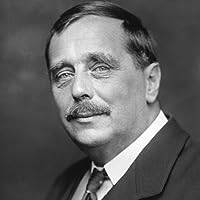
Herbert George Wells was born to a working class family in Kent, England. Young Wells received a spotty education, interrupted by several illnesses and family difficulties, and became a draper's apprentice as a teenager. The headmaster of Midhurst Grammar School, where he had spent a year, arranged for him to return as an "usher," or student teacher. Wells earned a government scholarship in 1884, to study biology under Thomas Henry Huxley at the Normal School of Science. Wells earned his bachelor of science and doctor of science degrees at the University of London. After marrying his cousin, Isabel, Wells began to supplement his teaching salary with short stories and freelance articles, then books, including The Time Machine (1895), The Island of Dr. Moreau (1896), The Invisible Man (1897), and The War of the Worlds (1898). Wells created a mild scandal when he divorced his cousin to marry one of his best students, Amy Catherine Robbins. Although his second marriage was lasting and produced two sons, Wells was an unabashed advocate of free (as opposed to "indiscriminate") love. He continued to openly have extra-marital liaisons, most famously with Margaret Sanger, and a ten-year relationship with the author Rebecca West, who had one of his two out-of-wedlock children. A one-time member of the Fabian Society, Wells sought active change. His 100 books included many novels, as well as nonfiction, such as A Modern Utopia (1905), The Outline of History (1920), A Short History of the World (1922), The Shape of Things to Come (1933), and The Work, Wealth and Happiness of Mankind (1932). One of his booklets was Crux Ansata, An Indictment of the Roman Catholic Church. Although Wells toyed briefly with the idea of a "divine will" in his book, God the Invisible King (1917), it was a temporary aberration. Wells used his international fame to promote his favorite causes, including the prevention of war, and was received by government officials around the world. He is best-remembered as an early writer of science fiction and futurism. He was also an outspoken socialist. Wells and Jules Verne are each sometimes referred to as "The Fathers of Science Fiction". D. 1946. More: http://philosopedia.org/index.php/H.\_... http://www.online-literature.com/well... http://www.hgwellsusa.50megs.com/ http://www.britannica.com/EBchecked/t... http://en.wikipedia.org/wiki/H.\_G.\_Wells