Margins
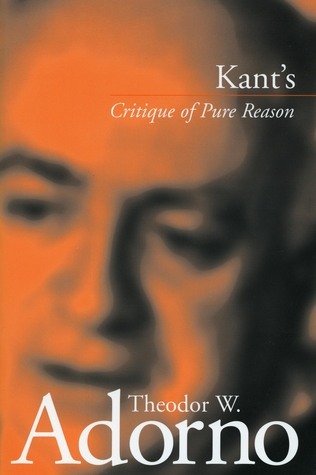
Kant's 'Critique of Pure Reason' book cover
Kant's 'Critique of Pure Reason'
1991
First Published
4.04
Average Rating
312
Number of Pages
Kant is a pivotal thinker in Adorno's intellectual world. Although he wrote monographs on Hegel, Husserl, and Kierkegaard, the closest Adorno came to an extended discussion of Kant are two lecture courses, one concentrating on the Critique of Pure Reason and the other on the Critique of Practical Reason . This new volume by Adorno comprises his lectures on the former. Adorno attempts to make Kant's thought comprehensible to students by focusing on what he regards as problematic aspects of Kant's philosophy. Adorno examines Kant's dualism and what he calls the Kantian "block": the contradictions arising from Kant's resistance to the idealism that his successors—Fichte, Schelling, and Hegel—saw as the inevitable outcome of his ideas. These lectures also provide an accessible introduction to and rationale for Adorno's own philosophy as expounded in Negative Dialectics and his other major writings. Adorno's view of Kant forms an integral part of his own philosophy, since he argues that the way out of the Kantian contradictions is to show the necessity of the dialectical thinking that Kant himself spurned. This in turn enables Adorno to criticize Anglo-Saxon scientistic or positivist thought, as well as the philosophy of existentialism. This book will be of great interest to those working in philosophy and in social and political thought, and it will be essential reading for anyone interested in the foundations of Adorno's own work.

Avg Rating
4.04
Number of Ratings
141
5 STARS
37%
4 STARS
36%
3 STARS
23%
2 STARS
3%
1 STARS
1%
goodreads

Author

Theodor W. Adorno
Theodor W. Adorno
Author · 51 books

Theodor Wiesengrund Adorno was one of the most important philosophers and social critics in Germany after World War II. Although less well known among anglophone philosophers than his contemporary Hans-Georg Gadamer, Adorno had even greater influence on scholars and intellectuals in postwar Germany. In the 1960s he was the most prominent challenger to both Sir Karl Popper's philosophy of science and Martin Heidegger's philosophy of existence. Jürgen Habermas, Germany's foremost social philosopher after 1970, was Adorno's student and assistant. The scope of Adorno's influence stems from the interdisciplinary character of his research and of the Frankfurt School to which he belonged. It also stems from the thoroughness with which he examined Western philosophical traditions, especially from Kant onward, and the radicalness to his critique of contemporary Western society. He was a seminal social philosopher and a leading member of the first generation of Critical Theory. Unreliable translations hampered the initial reception of Adorno's published work in English speaking countries. Since the 1990s, however, better translations have appeared, along with newly translated lectures and other posthumous works that are still being published. These materials not only facilitate an emerging assessment of his work in epistemology and ethics but also strengthen an already advanced reception of his work in aesthetics and cultural theory.

548 Market St PMB 65688, San Francisco California 94104-5401 USA
© 2026 Paratext Inc. All rights reserved