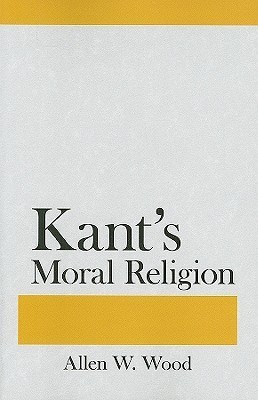



In Kant's Moral Religion, A.W. Wood argues that his doctrine of religious belief is consistent with his best critical thinking & that the moral arguments—along with the faith they justify—are an integral part of the critical philosophy. He shows that Kant's sensitive religious outlook on the world ought be counted among his greatest philosophical contributions. In setting forth his interpretation, he provides a clear statement of what the philosopher reveals in his reasoning for belief in God & immortality. He reexamines Kant's conception of moral volition & defends his doctrine of the "highest good." He discusses Kant's use of moral faith as a rational criterion for religion in relation to ecclesiastical faith, religious experience & claims to divine revelation. Finally, he discusses the philosopher's idea of radical evil in human nature & develops Kant's theory of divine grace as it's foreshadowed in 1793's Religion Within the Limits of Reason Alone. Kant's thoughts about religion are a solution to difficult problems confronted by everyone & can serve as a guide in efforts to deal rationally with questions of religion. Preface Introduction Kant's moral arguments Finite rational volition The highest good The practical postulates Moral faith & rational religion Radical evil & divine grace Conclusion Notes Bibliography Index
Author
Allen Wood's interests are in the history of modern philosophy, especially Kant and German idealism, and in ethics and social philosophy. He was born and grew up in Seattle, Washington. His B. A. is from Reed College in Portland, Oregon, his Ph.D. at Yale University. Wood has held regular professorships at Cornell University, Yale University, and Stanford University, where he is Ward W. and Priscilla B. Woods Professor emeritus. He has also held visiting appointments at the University of Michigan, University of California at San Diego and Oxford University, where he was Isaiah Berlin Visiting Professor in 2005. During year-long periods of research, he has been affiliated with the Freie Universität Berlin in 1983-84 and the Rheinische-Friedrich-Wilhelms-Universität Bonn in 1991-1992. He is a member of the American Academy of Arts and Sciences. Allen Wood is author of many articles and chapters in philosophical journals and anthologies. The book-length publications he has authored include: Kant's Moral Religion (1970, reissued 2009), Kant's Rational Theology (1978, reissued 2009), Karl Marx (1981, second expanded edition 2004), Hegel's Ethical Thought (1990), Kant's Ethical Thought (1999), Unsettling Obligations (2002), Kant (2004) and Kantian Ethics (2008), The Free Development of Each: (2014), and co-authored with Dieter Schönecker, Kant's Groundwork for the Metaphysics of Morals: A Commentary (Harvard University Press, 2015). (A German language version of this commentary has gone through four editions since 2002.) His most recent book is Fichte's Ethical Thought (Oxford University Press, 2016). Books by Wood have appeared in Hebrew, Turkish, Portuguese, Iranian and Chinese translation. With Paul Guyer, Wood is co-general editor of the Cambridge Edition of Kant's Writings, for which he has edited, translated or otherwise contributed to six volumes. Among the other books Wood has edited are Self and Nature in Kant's Philosophy (1984), Hegel: Elements of the Philosophy of Right (1991), Kant: Groundwork for the Metaphysics of Morals (2002), Fichte: Attempt at a Critique of All Revelation (2010), and, with Songsuk Susan Hahn, the Cambridge History of Philosophy in the Nineteenth Century (1790-1870) (2012). He is on the editorial board of eight philosophy journals, six book series and the Stanford Encyclopedia of Philosophy. At Indiana University Allen Wood has taught courses on the history of modern philosophy, modern political philosophy, Kant, Fichte and existentialism.