Books in series

#1
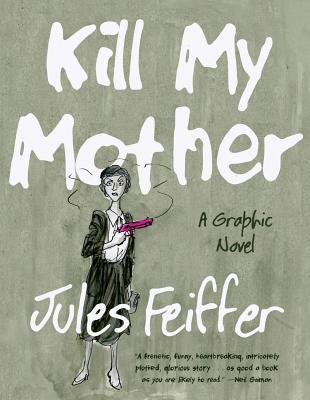
Kill My Mother
2014
Adding to a legendary career that includes a Pulitzer Prize, an Academy Award, Obie Awards, and Lifetime Achievement Awards from the National Cartoonist Society and the Writers Guild of America, Jules Feiffer now presents his first noir graphic novel. Kill My Mother is a loving homage to the pulp-inspired films and comic strips of his youth. Channeling Eisner's The Spirit, along with the likes of Hammett, Chandler, Cain, John Huston, and Billy Wilder, and spiced with the deft humor for which Feiffer is renowned, Kill My Mother centers on five formidable women from two unrelated families, linked fatefully and fatally by a has-been, hard-drinking private detective.
As our story begins, we meet Annie Hannigan, an out-of-control teenager, jitterbugging in the 1930s. Annie dreams of offing her mother, Elsie, whom she blames for abandoning her for a job soon after her husband, a cop, is shot and killed. Now, employed by her husband’s best friend—an over-the-hill and perpetually soused private eye—Elsie finds herself covering up his missteps as she is drawn into a case of a mysterious client, who leads her into a decade-long drama of deception and dual identities sprawling from the Depression era to World War II Hollywood and the jungles of the South Pacific.
Along with three femme fatales, an obsessed daughter, and a loner heroine, Kill My Mother features a fighter turned tap dancer, a small-time thug who dreams of being a hit man, a name-dropping cab driver, a communist liquor store owner, and a hunky movie star with a mind-boggling secret. Culminating in a U.S.O. tour on a war-torn Pacific island, this disparate band of old enemies congregate to settle scores.
In a drawing style derived from Steve Canyon and The Spirit, Feiffer combines his long-honed skills as cartoonist, playwright, and screenwriter to draw us into this seductively menacing world where streets are black with soot and rain, and base motives and betrayal are served on the rocks in bars unsafe to enter. Bluesy, fast-moving, and funny, Kill My Mother is a trip to Hammett-Chandler-Cain Land: a noir-graphic novel like the movies they don’t make anymore.


#2
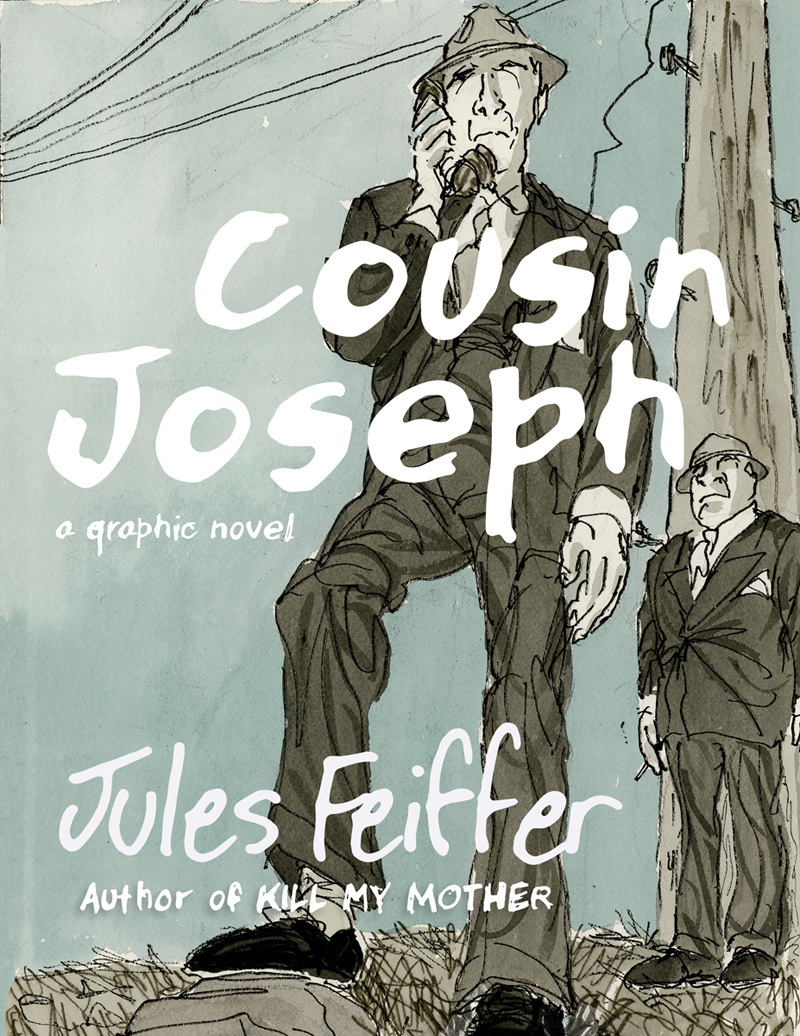
Cousin Joseph
2016
With the New York Times bestseller Kill My Mother, legendary cartoonist Jules Feiffer began an epic saga of American noir fiction. With Cousin Joseph, a prequel that introduces us to bare-knuckled Detective Sam Hannigan, head of the Bay City's Red Squad and patriarch of the Hannigan family featured in Kill My Mother, Feiffer brings us the second installment in this highly anticipated graphic trilogy.
Our story opens in Bay City in 1931 in the midst of the Great Depression. Big Sam sees himself as a righteous, truth-seeking patriot, defending the American way, as his Irish immigrant father would have wanted, against a rising tide of left-wing unionism, strikes, and disruption that plague his home town. At the same time he makes monthly, secret overnight trips on behalf of Cousin Joseph, a mysterious man on the phone he has never laid eyes on, to pay off Hollywood producers to ensure that they will film only upbeat films that idealize a mythic America: no warts, no injustice uncorrected, only happy endings.
But Sam, himself, is not in for a happy ending, as step by step the secret of his unseen mentor's duplicity is revealed to him. Fast-moving action, violence, and murder in the noir style of pulps and forties films are melded in the satiric, sociopolitical Feifferian style to dig up the buried fearmongering of the past and expose how closely it matches the headlines, happenings, and violence of today.
With Cousin Joseph, Feiffer builds on his late-life conversion to cinematic noir, bowing, as ever, to youthful heroes Will Eisner and Milton Caniff, but ultimately creating a masterpiece that through his unique perspective and comic-strip noir style illuminates the very origins of Hollywood and its role in creating the bipolar nation we've become.

#3
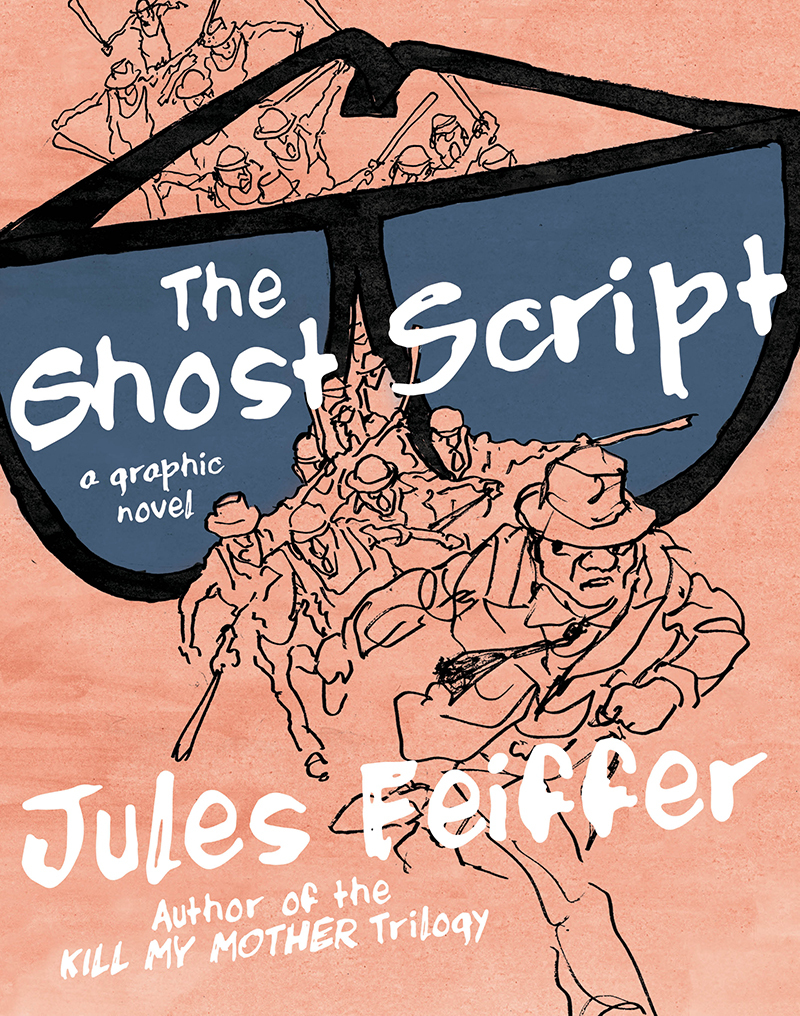
The Ghost Script
2018
Hollywood is haunted. 1953. Ghosts abound. In particular, the ghost of Detective Sam Hannigan—murdered in Bay City twenty-two years earlier by Addie Perl, the hired assassin who then bought a Hollywood nightclub with her blood money. Among the nightclub’s favored clientele is Sam’s widow, Elsie. Blinded by a Japanese bullet while on a USO tour in the South Pacific, Elsie has been reinvented into “Miss Know-It-All,” a Hollywood gossip columnist. But blind Elsie is haunted by the ghost of her husband, Sam, who asks her accusingly: “If Miss Know-It-All knows so much, why can’t she find Cousin Joseph, the man who had me killed?”
Hollywood is haunted. Spooks abound. Agents Shoen and Kline, investigators for the House Un-American Activities Committee, manipulate the blacklisted, buxom, over-the-hill starlet-turned-hooker Lola Burns into working for them and naming the names she had once refused to betray.
Hollywood is haunted. Communist screenwriters Oz McCay and Faye Bloom are noisily plotting, boozing, and laughing their way toward their impending disaster.
Hollywood is haunted. As an inside joke, writer-director Annie Hannigan—Sam and Elsie’s daughter—comes up with the idea of a “Ghost Script” that may or may not exist but is rumored to expose the inside story of the Hollywood blacklist and the names of its undercover masterminds, most notably the reclusive philanthropist Lyman Murchison, a superpatriot with a dirty secret.
Hollywood is haunted. Stumbling his way through this maze is private eye Archie Goldman, a tough-talking, nebbishy good guy who’s never been in a fight he didn’t lose. Archie’s single aim is to live up to the memory of the ghost who haunts him: Detective Sam Hannigan. Trail along with Archie into the middle of this muddle, as he tracks the arc of history and finds that it has rounded itself off into a circular firing squad.
In this antic and brilliant assault on our past and present, Jules Feiffer shows us, once and for all, that if there’s one thing Americans hate, it’s learning from past mistakes. Every twenty years or so, a new generation must address new biases and injustices that are virtually identical to past biases and injustices. But who remembers? Exposing the tragically cyclical path of American history, Jules Feiffer pens the final installment to a noir masterpiece.