


Margins
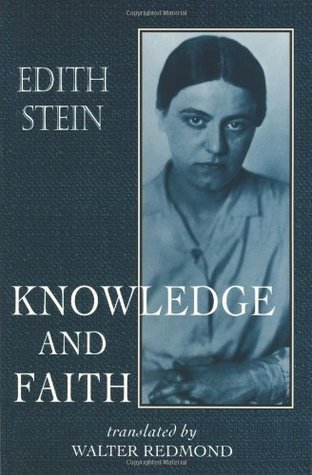
Knowledge and Faith (The Collected Works of Edith Stein, vol. 8) book cover
Knowledge and Faith (The Collected Works of Edith Stein, vol. 8)
2000
First Published
4.17
Average Rating
203
Number of Pages

This book contains five contributions on the title themes, including two of Stein's most famous a comparison of Husserl and Aquinas, and an examination of the 'Ways to Know God' according to Pseudo-Dionysius. The articles and notes in this new anthology come from the final twelve years of Edith Stein's life, and reveal her efforts to integrate the Christian faith she had embraced at the time of her baptism with her rigorous training as a phenomenologist. Included here for the first time are both versions of her famous comparison between the thought-systems of Edmund Husserl (her philosophical mentor) and Thomas Aquinas (representing the Catholic tradition), written first in dialogue form and then reworked as an essay in Husserl's honor. The final entry, 'Ways to Know God,' a study of the famed fifth or sixth century author who wrote under the name of Dionysius the Areopagite, was originally published in The Thomist and intended for an American audience. One of the last works that Edith Stein completed before her arrest and deportation to Auschwitz, it is presented here in a fresh new translation, amplified with previously deleted sections that deal with such important topics as atheism and the nature of symbols. In his recent encyclical, Fides et Ratio, Pope John Paul II recommends attention to Edith Stein as one of the great modern figures who 'offer significant examples of a process of philosophical enquiry which was enriched by engaging the data of faith' (para. 74). This book provides readers interested in Edith Stein with an accessible introduction to major themes in her later thought.
Avg Rating
4.17
Number of Ratings
47
5 STARS
47%
4 STARS
28%
3 STARS
21%
2 STARS
4%
1 STARS
0%
goodreads

Author

Edith Stein
Edith Stein
Author · 13 books

Edith Stein, also known as St. Teresa Benedicta of the Cross, OCD, (German: Teresia Benedicta vom Kreuz, Latin: Teresia Benedicta a Cruce) (12 October 1891 – 9 August 1942), was a German Jewish philosopher who converted to the Roman Catholic Church and became a Discalced Carmelite nun. She is a martyr and saint of the Catholic Church. She was born into an observant Jewish family, but was an atheist by her teenage years. Moved by the tragedies of World War I, in 1915 she took lessons to become a nursing assistant and worked in a hospital for the prevention of disease outbreaks. After completing her doctoral thesis in 1916 from the University of Göttingen, she obtained an assistantship at the University of Freiburg. From reading the works of the reformer of the Carmelite Order, St. Teresa of Jesus, OCD, she was drawn to the Catholic Faith. She was baptized on 1 January 1922 into the Roman Catholic Church. At that point she wanted to become a Discalced Carmelite nun, but was dissuaded by her spiritual mentors. She then taught at a Catholic school of education in Speyer. As a result of the requirement of an "Aryan certificate" for civil servants promulgated by the Nazi government in April 1933 as part of its Law for the Restoration of the Professional Civil Service, she had to quit her teaching position. She was admitted to the Discalced Carmelite monastery in Cologne the following October. She received the religious habit of the Order as a novice in April 1934, taking the religious name Teresa Benedicta of the Cross ("Teresa blessed by the Cross"). In 1938 she and her sister Rosa, by then also a convert and an extern Sister of the monastery, were sent to the Carmelite monastery in Echt, Netherlands for their safety. Despite the Nazi invasion of that state in 1940, they remained undisturbed until they were arrested by the Nazis on 2 August 1942 and sent to the Auschwitz concentration camp, where they died in the gas chamber on 9 August 1942.

548 Market St PMB 65688, San Francisco California 94104-5401 USA
© 2026 Paratext Inc. All rights reserved