Margins
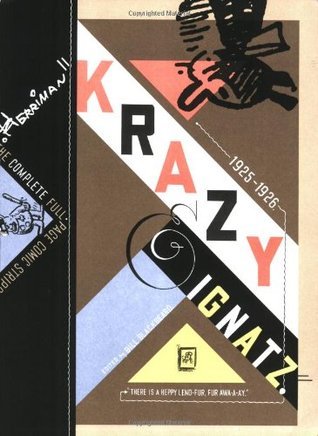
Krazy and Ignatz, 1925-1926 book cover
Krazy and Ignatz, 1925-1926
There is a Heppy Land Furfur A-waay
2002
First Published
4.44
Average Rating
120
Number of Pages

Part of Series

This volume reprints what many consider to be Herriman's prime: his Sunday strips from 1925 and 1926, two full years of strips printed full-page in their original black and white, plus material never collected before. Fantagraphics is proud to re-present Krazy Kat to a new generation of readers. Each volume in this series reprints two full years of Sunday strips, or 104 full-page, black-and-white Sunday strips (Herriman did not incorporate color into the strip until 1935). Krazy Kat is a love story, focusing on the relationship of its three main characters. Krazy Kat adored Ignatz Mouse. Ignatz Mouse hated Krazy Kat, the expression of which was in throwing bricks at Krazy's head. Offisa Pup loved Krazy and sought to protect "her" (Herriman always maintained that Krazy was genderless), mostly by throwing Ignatz in jail. Each of the characters was ignorant of the other's true motivations. This simple structure allowed Herriman to build entire worlds of meaning into the actions, building thematic depth that led critics like Gilbert Seldes and E. E. Cummings to recognize Herriman's genius almost immediately. Each of Fantagraphics' Krazy & Ignatz volumes is designed by Chris Ware, creator of the wildly successful ACME Novelty Library series. This beautiful volume includes material never collected before. Black-and-white comic strips and illustrations throughout

Avg Rating
4.44
Number of Ratings
404
5 STARS
59%
4 STARS
29%
3 STARS
8%
2 STARS
3%
1 STARS
0%
goodreads

Author

George Herriman
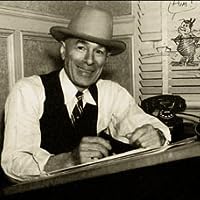
George Herriman
Author · 21 books

George Herriman was born August 2nd, 1880. He was an African-American cartoonist whose comic strip Krazy Kat has been said by many to be America’s greatest cartoon. Herriman was born in New Orleans, but his Creole family soon moved to California. As a teenager, he contributed drawings to local newspapers. In his early 20s, he moved to New York City and freelanced until newspaper mogul William Randolph Hearst hired him for the New York Evening Journal. During the first decade of the 20th century, Herriman’s first success was called The Family Upstairs. Krazy Kat gained independence on October 28, 1913 as a cartoon character of his own, and ran until George Herriman died in 1944. Krazy Kat never achieved wide popularity among newspaper readers, though it attracted a highbrow following. Fans included Pablo Picasso, Charlie Chaplin, Walt Disney, F. Scott Fitzgerald, Frank Capra, H. L. Mencken, and Ernest Hemingway. Krazy Kat's lengthy tenure owed much to Hearst's personal love of the strip. Acceptance by the cultural mainstream grew after Herriman's death, as Krazy Kat appeared in an animated series by Paramount Studios and even in a novel. Throughout the 20th century, cartoonists have considered Krazy Kat the founding father (or mother) of sophisticated comic strips.

548 Market St PMB 65688, San Francisco California 94104-5401 USA
© 2025 Paratext Inc. All rights reserved