Margins
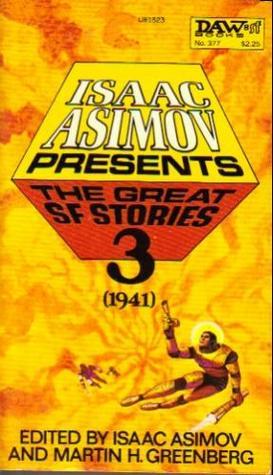
La Edad de Oro. 1939-1940 book cover
La Edad de Oro. 1939-1940
1979
First Published
4.08
Average Rating
432
Number of Pages

Part of Series

Isaac Asimov presenta La Edad de Oro de la Ciencia Ficción Volumen 1 Los mejores relatos del período histórico mas importante de la ciencia ficción, cuando los grandes maestros configuraron los temas clasicos del género. Primer volumen de una esmeradísima selección en la que Asimov presenta cronológicamente los relatos que marcaron la evolución del género. Catorce relatos ubicados originalmente durante los años 1939 y 1940 de los mejores escritores del momento. Lester del Rey, Sprague de Camp, A. E. van Vogt, Henry Kuttner, Theodore Sturgeon, Nelson Bond, Jack Williamson, Robert A. Heinlein, Fritz Leiber, Robert Arthur, Osar J. Friend..., son los autores de un conjunto de relatos inolvidables. Isaac Asimov, con la colaboración de Martin H. Greenberg, ha emprendido uno de los más ambiciosos proyectos que se hayan llevado a la práctica en el terreno de las antologías: la reconstrucción de la historia de la ciencia ficción a través de sus mejores relatos presentados en orden cronológico. Año por año, Asimov y Greenberg presentan al lector los relatos más influyentes de los mejores autores del momento. La distancia histórica contribuye a dar un carácter definitivo a la selección, superando con creces cualquier proyecto anterior de características similares debido particularmente a la información vertida en cada presentación sobre los autores y su obra. Y como punto de partida, el acontecimiento más importante ocurrido en el seno del género cuando éste era conocido por pocos y su historial se forjaba en las revistas especializadas: el principio de la carrera de John W. Campbell como editor de Astounding Science Fiction, momento en que se inicia la Edad de Oro de la Ciencia Ficción. Los relatos en este volumen son los siguientes: El día ha muerto, por Lester del Rey. Una visión poética del destino del hombre de Neanderthal en un mundo dominado por los hombres de Cromañón. El hombre deforme, por Sprague de Camp. De nuevo el tema del hombre de Neanderthal, en este caso con un representante de la especie que ha sido testigo de la historia de la humanidad. Destructor negro, por A. E. van Vogt. Un gran clásico en el que se narra la historia de un alienígena destructivo e implacable, y en el que se inspiró el film Alien. El halo equivocado, por Henry Kuttner. Los problemas que puede acarrear el que un ángel se equivoque de destinatario al entregar un halo de santidad. Respirador de éter, por Theodore Sturgeon. El primer relato publicado del maestro del cuento corto: las emisiones en color para la televisión son misteriosamente interferidas con resultados ciertamente cómicos. Peregrinación, por Nelson Bond. Uno de los primeros relatos del género con personaje femenino; el nacimiento de un romance en un mundo de «después» de la catástrofe. Oh, estrella brillante, por Jack Williamson. El hombre que podía hacer milagros… Inadaptado, por Robert A. Heinlein. Un genio intuitivo de las matemáticas en la construcción de una colonia espacial. La pistola automática, por Fritz Leiber. La extraña fascinación que una pistola ejerce sobre su poseedor. Franqueo pagado al paraíso, por Robert Arthur. Un descabellado servicio de correos… It (Ello), por Theodore Sturgeon. Horror psicológico con la presencia de un monstruo aterrador. La carretera imposible, por Oscar J. Friend. Un museo imposible que muestra el proceso evolutivo de la Tierra. Butilo para el respirador, por Theodore Sturgeon. Secuela de Respirador de éter, y una obra maestra del relato de humor. Su eminencia, por Sprague de Camp. Un científico al que se le aumenta artificialmente la inteligencia…

Avg Rating
4.08
Number of Ratings
284
5 STARS
34%
4 STARS
42%
3 STARS
22%
2 STARS
1%
1 STARS
0%
goodreads

Authors

Jack Williamson
Jack Williamson
Author · 60 books
John Stewart Williamson who wrote as Jack Williamson (and occasionally under the pseudonym Will Stewart) was a U.S. writer often referred to as the "Dean of Science Fiction".
Isaac Asimov
Isaac Asimov
Author · 510 books

Isaac Asimov was a Russian-born, American author, a professor of biochemistry, and a highly successful writer, best known for his works of science fiction and for his popular science books. Professor Asimov is generally considered one of the most prolific writers of all time, having written or edited more than 500 books and an estimated 90,000 letters and postcards. He has works published in nine of the ten major categories of the Dewey Decimal System (lacking only an entry in the 100s category of Philosophy). Asimov is widely considered a master of the science-fiction genre and, along with Robert A. Heinlein and Arthur C. Clarke, was considered one of the "Big Three" science-fiction writers during his lifetime. Asimov's most famous work is the Foundation Series; his other major series are the Galactic Empire series and the Robot series, both of which he later tied into the same fictional universe as the Foundation Series to create a unified "future history" for his stories much like those pioneered by Robert A. Heinlein and previously produced by Cordwainer Smith and Poul Anderson. He penned numerous short stories, among them "Nightfall", which in 1964 was voted by the Science Fiction Writers of America the best short science fiction story of all time, a title many still honor. He also wrote mysteries and fantasy, as well as a great amount of nonfiction. Asimov wrote the Lucky Starr series of juvenile science-fiction novels using the pen name Paul French. Most of Asimov's popularized science books explain scientific concepts in a historical way, going as far back as possible to a time when the science in question was at its simplest stage. He often provides nationalities, birth dates, and death dates for the scientists he mentions, as well as etymologies and pronunciation guides for technical terms. Examples include his Guide to Science, the three volume set Understanding Physics, and Asimov's Chronology of Science and Discovery. Asimov was a long-time member and Vice President of Mensa International, albeit reluctantly; he described some members of that organization as "brain-proud and aggressive about their IQs" He took more joy in being president of the American Humanist Association. The asteroid 5020 Asimov, the magazine Asimov's Science Fiction, a Brooklyn, NY elementary school, and two different Isaac Asimov Awards are named in his honor.

Fritz Leiber
Fritz Leiber
Author · 111 books

Fritz Reuter Leiber Jr. was one of the more interesting of the young writers who came into HP Lovecraft's orbit, and some of his best early short fiction is horror rather than sf or fantasy. He found his mature voice early in the first of the sword-and-sorcery adventures featuring the large sensitive barbarian Fafhrd and the small street-smart-ish Gray Mouser; he returned to this series at various points in his career, using it sometimes for farce and sometimes for gloomy mood pieces—The Swords of Lankhmar is perhaps the best single volume of their adventures. Leiber's science fiction includes the planet-smashing The Wanderer in which a large cast mostly survive flood, fire, and the sexual attentions of feline aliens, and the satirical A Spectre is Haunting Texas in which a gangling, exo-skeleton-clad actor from the Moon leads a revolution and finds his true love. Leiber's late short fiction, and the fine horror novel Our Lady of Darkness, combine autobiographical issues like his struggle with depression and alcoholism with meditations on the emotional content of the fantastic genres. Leiber's capacity for endless self-reinvention and productive self-examination kept him, until his death, one of the most modern of his sf generation. Used These Alternate Names: Maurice Breçon, Fric Lajber, Fritz Leiber, Jr., Fritz R. Leiber, Fritz Leiber Jun., Фриц Лейбер, F. Lieber, フリッツ・ライバー

Robert A. Heinlein
Robert A. Heinlein
Author · 133 books

Works of American science-fiction writer Robert Anson Heinlein include Stranger in a Strange Land (1961) and The Moon Is a Harsh Mistress (1966). People often call this novelist "the dean of science fiction writers", one of the most popular, influential, and controversial authors of "hard science fiction." He set a high standard for science and engineering plausibility and helped to raise the standards of literary quality of the genre. He was the first science-fiction writer to break into mainstream, general magazines such as The Saturday Evening Post, in the late 1940s. He was also among the first authors of bestselling, novel-length science fiction in the modern, mass-market era. Also wrote under Pen names: Anson McDonald, Lyle Monroe, Caleb Saunders, John Riverside and Simon York.

L. Sprague de Camp
L. Sprague de Camp
Author · 92 books
Lyon Sprague de Camp, (Pseudonym: Lyman R. Lyon) was an American science fiction and fantasy author and biographer. In a writing career spanning fifty years he wrote over one hundred books, including novels and notable works of nonfiction, such as biographies of other important fantasy authors. He was widely regarded as an imaginative and innovative writer and was an important figure in the heyday of science fiction, from the late 1930s through the late 1940s.
Oscar J. Friend
Oscar J. Friend
Author · 1 book

Aka Owen Fox Jerome, Owen F. Jerome. Oscar Jerome Friend began his career primarily as a pulp fiction author in various genres including horror, Westerns, science fiction, and detective fiction. As a pulp writer he worked with Wonder Stories, Startling Stories, Strange Stories, Captain Future and Thrilling Wonder Stories. He was also co-editor for several anthologies.

A.E. van Vogt
A.E. van Vogt
Author · 70 books

Alfred Elton van Vogt was a Canadian-born science fiction author regarded by some as one of the most popular and complex science fiction writers of the mid-twentieth century—the "Golden Age" of the genre. van Vogt was born to Russian Mennonite family. Until he was four years old, van Vogt and his family spoke only a dialect of Low German in the home. He began his writing career with 'true story' romances, but then moved to writing science fiction, a field he identified with. His first story was Black Destroyer, that appeared as the front cover story for the July 1939 edtion of the popular "Astounding Science Fiction" magazine.

Theodore Sturgeon
Theodore Sturgeon
Author · 62 books

Theodore Sturgeon (1918–1985) is considered one of the godfathers of contemporary science fiction and dark fantasy. The author of numerous acclaimed short stories and novels, among them the classics More Than Human, Venus Plus X, and To Marry Medusa, Sturgeon also wrote for television and holds among his credits two episodes of the original 1960s Star Trek series, for which he created the Vulcan mating ritual and the expression “Live long and prosper.” He is also credited as the inspiration for Kurt Vonnegut’s recurring fictional character Kilgore Trout. Sturgeon is the recipient of the Hugo Award, the Nebula Award, and the International Fantasy Award. In 2000, he was posthumously honored with a World Fantasy Award for Life Achievement.

Lester del Rey
Lester del Rey
Author · 53 books

Lester del Rey was an American science fiction author and editor. Del Rey is especially famous for his juvenile novels such as those which are part of the Winston Science Fiction series, and for Del Rey Books, the fantasy and science fiction branch of Ballantine Books edited by Lester del Rey and his fourth wife Judy-Lynn del Rey. Also published as: Philip St. John Eric van Lihn Erik van Lhin Kenneth Wright Edson McCann (with Frederik Pohl)

548 Market St PMB 65688, San Francisco California 94104-5401 USA
© 2026 Paratext Inc. All rights reserved