Margins
Margins
Sign in
Margins
Subscribe to our newsletter
548 Market St PMB 65688, San Francisco California 94104-5401 USA
hello@margins.app
·
+1 (650) 223-5283
Privacy Policy
·
Terms of Use
© 2026 Paratext Inc. All rights reserved
Language and Globalization
Books in series
#1
Challenges in the Social Life of Language
2011
The first book to highlight the most pressing sociology-of-language themes of our times. All of which have to do with the twin issues of
power
and
identity
. Important evidence and illustrations bearing upon these matters are provided and supplemented by an extensive bibliography.
#2
Discourse and Transformation in Central and Eastern Europe
2008
This volume explores the discursive nature of post-1989 social change in Central and Eastern Europe. Through a set of national case studies, the construction of post-communist transformation is explored from the point of view of accelerating and unique dynamics of linguistic and discursive practices.
#3
Discursive Constructions of Identity in European Politics
2007
In the study of European politics and society ever-greater importance is attached to the role of ideational factors such as identity and discourse. The editor brings together specialists from critical discourse analysis and critical approaches to communications, history, literature, cultural studies, media, sociology, politics and International Relations to discuss the discursive construction of ethnic, national and regional identities and analyse how specific identity discourses condition and constrain knowledge and action with regard to various socio-political issues in Europe.
#4
From Migrant to Citizen
2010
Citizenship is highly topical and relevant to a number of disciplines including law, politics and sociology. What can a linguistic study contribute to the debate? In this impressive volume a combination of theorists—linguists, historians and lawyers—address the subject of citizenship testing in language proficiency and 'cultural' knowledge.
#5
Globalization and Language in the Spanish Speaking World
2006
This volume considers, at global and at local levels, the spread of Spanish today and particularly its role in the face of processes of globalization. Spanish is frequently the dominant language in this contact situation. But how contested is its hegemony; and how far does contact with it threaten other languages? How are these other, weaker, minoritized languages prospering in a world where a few strong, global languages may be taking over their linguistic domains?
#6
Intercultural Journeys
2010
Focusing on the actual experiences of L2 students who travelled from their homes to foreign lands as part of a faculty-led, short-term SA program, the author explores the linkage between intercultural awareness and sensitivity, language development (e.g., sociopragmatic awareness), and identity reconstruction in young adult L2 learners.
#7
Language and the City
2007
Language and the City
shows how the contemporary form of globalization has certain effects on language in social context and identifies the city as the most important site for the realization of these effects. The book challenges a set of assumptions that hold sustainable linguistic diversity to be inherently non-urban while regarding the city as an unproblematic site for understanding the social function of language. The central purpose of the work is to construct a fresh conceptual framework for understanding language-city relationships.
#9
Language, Citizenship and Identity in Quebec
2007
Awarded the 2008 Pierre Savard prize by the International Council for Canadian Studies! 'The Pierre Savard Awards are designed to recognize and promote each year outstanding scholarly monographs on a Canadian topic. The awards form part of a strategy that is aimed at promoting, especially throughout the Canadian academic community, works that have been written by members of the Canadian Studies international network. The awards are intended to designate exceptional books, which, being based on a Canadian topic, contribute to a better understanding of Canada.' Globalization is calling for new conceptualizations of belonging within culturally diverse communities. This book takes Quebec as a case study and examines how it fosters a sense of belonging through a common citizenship with French as the key element. As a nation without a state, Quebec is driven by two distinct imperatives: the need to affirm a robust Francophone identity within Anglophone North America, and the civic obligation to accommodate an increasingly diverse range of migrant groups, as well as demands for recognition by Aboriginal and Anglophone minorities.
#10
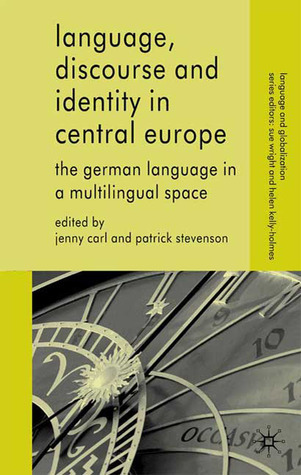
Language, Discourse and Identity in Central Europe
2009
Focusing on contact between German and other languages, the contributors in this book analyze the ways in which language practices and discourses on language have changed since the end of the Cold War.
#11
Language Ideologies, Policies and Practices
2006
The contributors to
Language Ideologies, Policies and Practices
investigate the workings of language ideologies in relation to other social processes in a globalizing world. They explore in detail the specific ways in which language ideologies underpin language policy and the relationship between public policies and individual practices. Particular attention is given to Europe, where the impetus to social transformation within and across national boundaries is in renewed tension with conflicting national and supra-national interests, with these tensions reflected in the complex issues of language choice and language policy.
Authors
John R. Edwards
Author · 4 books
Jane Jackson
Author · 1 book
Diarmait Mac
Author · 1 book
Leigh Oakes
Author · 1 book
Jane Warren
Author · 2 books
Ulrike Hanna Meinhof
Author · 1 book
Colin H. Williams
Author · 1 book
David Block
Author · 5 books
Máiréad Nic Craith
Author · 1 book
Roxy Harris
Author · 1 book
Mario Saraceni
Author · 3 books
Language and Globalization
Series ·
17
books · 1991-2012
By
John R. Edwards
,
Jane Jackson
,
Diarmait Mac
, and more
#12
The Language of Belonging
2005
The authors address one of the most significant aspects of social life in our times: that of cultural identities and identifications, and of the ways we construct them through our speech and the narrative of ourselves and others. They combine a theoretical re-assessment of how we understand, study, and analyze processes of identification with detailed case studies of the discourses of three-generation families living in split-border communities along the former "Iron Curtain," talking about themselves and other social groups, about their way of life and their experiences past and present.
#13
Linguistic Minorities in Democratic Context
1991
Colin Williams argues that recent transformations in the organization of nation-states: decentralization, devolution, new regionalism, deliberative democracy, European integration, and horizontal governance, constitute new political opportunities for linguistic minorities, notably, the possibility of innovation and engagement in the language planning and policy making arenas.
#14
Multilingual Identities in a Global City
2005
This book begins with a discussion of the key issues of globalization, migration, multiculturalism, multilingualism and global cities. It then turns to four detailed case studies and through them explores the ambivalent and multi-layered identitites of individuals who have crossed geographical and psychological borders during the course of their lifetimes and settled in London.
#15
Narratives of Place, Belonging and Language
2012
Examining identity in relation to globalization and migration, this book uses narratives and memoirs from contemporary authors who have lived 'in-between' two or more languages. It explores the human desire to find one's 'own place' in new cultural contexts, and looks at the role of language in shaping a sense of belonging in society.
#16
New Ethnicities and Language Use
2006
The children and grandchildren of South Asian migrants to the UK are living out British identities which go largely unrecognized. This book emphasizes their everyday low-key Britishness, albeit a Britishness with new inflections. It is this sensibility that marks them as Brasians .
#17
(Re)Locating TESOL in an Age of Empire
2006
Are TESOL professionals now fairly seen as agents of a new English-speaking empire? Or, if they wish to distance themselves from this role, are there ways of working and living that would make this differentiation clear? An international group of authors put forward their differing proposals for the development of TESOL.
#18
The Relocation of English
2010
In this book, Mario Saraceni argues for the need to redefine the manner in which we study English and the forces that are contributing to its constant evolution. Breaking away from existing academic paradigms, he seeks instead to understand how new rules and new practices are burgeoning around the world.