Margins
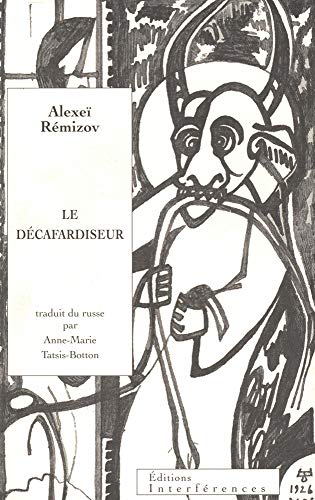
Le Décafardiseur book cover
Le Décafardiseur
traduit du russe par Anne-Marie Tatsis-Botton
2011
First Published
4.00
Average Rating
78
Number of Pages
«Le diabolique m'attirait par le merveilleux : toutes les normes étaient renversées - la tête en bas, les pieds en l'air.» . Les Yeux tondus. La magie et l'art de Rémizov, qui se décrivait lui-même comme un «automneux, solitaire et sans pareil, égaré parmi les hommes», tiennent autant à sa façon de regarder le monde de ses yeux tondus de myope qu'à sa façon de le raconter. Né d'images surgies tout droit de son enfance (un inquiétant décafardiseur adepte de la Vieille Foi persécutée, des scènes d'exorcismes dans un monastère hanté par des possédés et décoré d'une grenouille géante changée en pierre), ce petit conte démoniaque et néanmoins malicieux nous entraîne dans un univers fantasmagorique. Qui sont les habitants de cette étrange maison ? Invoquent-ils le Malin, s'adonnent-ils à la sorcellerie ? Et quel sort attend les polissons qui les espionnent ? En fouillant dans les recoins ténébreux d'une ville de province russe et de ses croyances cachées, Rémizov nous livre peut-être ici une des clés de cette Russie éternelle dont l'énigme continue encore à nous fasciner. Mais pour pénétrer dans ce monde tissé de sortilèges, il faut accepter de «perdre l'esprit» et de faire basculer sa raison... «la tête en bas, les pieds en l'air» !

Avg Rating
4.00
Number of Ratings
1
5 STARS
0%
4 STARS
100%
3 STARS
0%
2 STARS
0%
1 STARS
0%
goodreads

Author

Aleksey Remizov
Aleksey Remizov
Author · 4 books

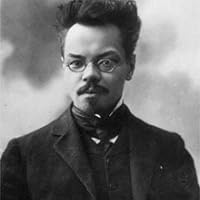
Aleksei Mikhailovich Remizov (Russian: Алексей Михайлович Ремизов; 6 July 1877, Moscow—November 26, 1957, Paris) was a Russian modernist writer whose creative imagination veered to the fantastic and bizarre. Apart from literary works, Remizov was an expert calligrapher who sought to revive this medieval art in Russia. Remizov was reared in the merchant milieu of Moscow. As a student of the Moscow University, he was involved in the radical politics and spent eight years in prison and Siberian exile. At that time, he developed a keen interest in Russian folklore and married a student of ancient Russian art, who brought him in contact with the Roerichs. In 1905, he settled in Saint Petersburg and started to imitate medieval folk tales. His self-professed ambition was to catch "the bitterness and absurdity of folklore imagination". Remizov's whimsical stylizations of the saints' lives were ignored at first, partly due to their florid and turgid language, but his more traditional prose works set in the underworld of Russian cities gained him a great deal of publicity. In his satirical novel The Indefatigable Cymbal (1910) Remizov depicted the eccentricities and superstitions of rural sectarians. Another striking work of this period is The Sacrifice, a Gothic horror story in which "a ghostly double of a father comes to kill his innocent daughter in the mistaken belief that she is a chicken". By the time of the Russian Revolution, Remizov had concentrated on imitating more or less obscure works of medieval Russian literature. He responded to the revolution by the Lay of the Ruin of the Russian Land, a paraphrase of the 13th-century work bemoaning the Mongol invasion of Russia. In 1921 he moved to Berlin and then in 1923 - to Paris, where he published an account of his attitudes towards the revolution under the title Whirlwind Russia (1927). During his years in exile, Remizov brought out a number of bizarre works, featuring demons and nightmare creatures. The writer also developed a keen interest in dreams and wrote a few works on the subject that involved prominent figures of Russian literature (Gogol, Dostoyevsky and others). Although he was so prolific that many of his works failed to find a publisher (in fact, from 1931 to 1952 there was not a single book published), Remizov was also the first Russian modernist author to attract the attention of the luminaries of the Parisian literary world, such as James Joyce. His reputation suffered a decline when, following World War II, he announced his interest in returning to the Soviet Union and even obtained a Soviet passport (which he did not have a chance to use). After that, Remizov was abhorred by the émigré litterateurs, the most famous of whom, Vladimir Nabokov, used to say that the only nice thing about Remizov was that he really lived in the world of literature. 1952-1957 saw a number of Remizov's books published, though only a very limited number of copies was printed.

548 Market St PMB 65688, San Francisco California 94104-5401 USA
© 2026 Paratext Inc. All rights reserved