Margins
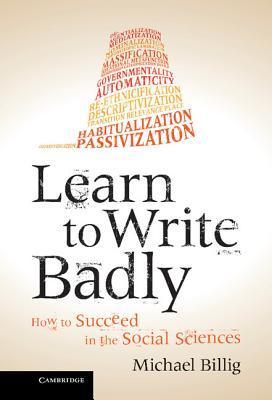
Learn to Write Badly book cover
Learn to Write Badly
How to Succeed in the Social Sciences
2013
First Published
3.96
Average Rating
243
Number of Pages
Modern academia is increasingly competitive yet the writing style of social scientists is routinely poor and continues to deteriorate. Are social science postgraduates being taught to write poorly? What conditions adversely affect the way they write? And which linguistic features contribute towards this bad writing? Michael Billig's witty and entertaining book analyses these questions in a quest to pinpoint exactly what is going wrong with the way social scientists write. Using examples from diverse fields such as linguistics, sociology and experimental social psychology, Billig shows how technical terminology is regularly less precise than simpler language. He demonstrates that there are linguistic problems with the noun-based terminology that social scientists habitually use – 'reification' or 'nominalization' rather than the corresponding verbs 'reify' or 'nominalize'. According to Billig, social scientists not only use their terminology to exaggerate and to conceal, but also to promote themselves and their work.

Avg Rating
3.96
Number of Ratings
92
5 STARS
37%
4 STARS
37%
3 STARS
15%
2 STARS
7%
1 STARS
4%
goodreads

Author

Michael Billig
Michael Billig
Author · 10 books

Michael Billig is Professor of Social Sciences at Loughborough University . Working in contemporary social psychology, he trained in Bristol with Henri Tajfel as an experimental psychologist and helped design the so called minimal group experiments which were foundational to the social identity approach. He moved away from experimental work to considering issues of power, political extremism and ideology in a series of important books. His Social Psychology and Intergroup Relations (1976) offered a trenchant critique of orthodox approaches to prejudice in psychology. Fascists (1979) helped reveal the classic fascist and anti-semitic ideology underlying the UK's National Front at a time when it was bidding for political legitimacy and electoral success. In the 1980s his focus shifted to everyday thinking and the relationship between ideology and common sense. This strand of work is shown in the collectively written work Ideological Dilemmas (1988 - with Condor, Edwards, Gane, Middleton and Radley), Banal Nationalism, and in his major study of ideology and the UK royal family, Talking of the Royal Family (1998, 2nd Edition). His influence runs across the social sciences and he has been one of the key figures highlighting and reinvigorating the use of classic rhetorical thinking in the context of social issues. For example, he shows that attitudes are best understood not as individual positions on topics, but as emergent in contexts where there is a potential argument. This perspective is introduced in his book Arguing and Thinking (2nd Edition, 1996) and has been the basis for innovative approaches to topics as diverse as psychoanalysis, humour and nationalism. It is also an important element to discursive psychology. Billig is Professor of Social Sciences at Loughborough University where he has worked since 1985. He is a member of the internationally influential Discourse and Rhetoric Group, working with figures such as Derek Edwards and Jonathan Potter.

548 Market St PMB 65688, San Francisco California 94104-5401 USA
© 2026 Paratext Inc. All rights reserved