Margins
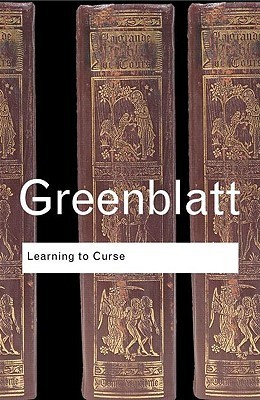
Learning to Curse book cover
Learning to Curse
Essays in Early Modern Culture
1990
First Published
3.90
Average Rating
276
Number of Pages
Stephen Greenblatt argued in these celebrated essays that the art of the Renaissance could only be understood in the context of the society from which it sprang. His approach - 'New Historicism' - drew from history, anthropology, Marxist theory, post-structuralism, and psychoanalysis and in the process, blew apart the academic boundaries insulating literature from the world around it. Learning to Curse charts the evolution of that approach and provides a vivid and compelling exploration of a complex and contradictory epoch.

Avg Rating
3.90
Number of Ratings
80
5 STARS
26%
4 STARS
50%
3 STARS
14%
2 STARS
8%
1 STARS
3%
goodreads

Author

Stephen Greenblatt
Stephen Greenblatt
Author · 23 books

Stephen Greenblatt (Ph.D. Yale) is Cogan University Professor of English and American Literature and Language at Harvard University. Also General Editor of The Norton Anthology of English Literature, Eighth Edition, he is the author of nine books, including Will in the World: How Shakespeare Became Shakespeare; Hamlet in Purgatory; Practicing New Historicism; Marvelous Possessions: The Wonder of the New World; Learning to Curse: Essays in Early Modern Culture; and The Swerve: How the World Became Modern. He has edited six collections of criticism, is the co-author (with Charles Mee) of a play, Cardenio, and is a founding coeditor of the journal Representations. He honors include the MLA's James Russell Lowell Prize, for Shakespearean Negotiations: The Circulation of Social Energy in Renaissance England, the Distinguished Humanist Award from the Mellon Foundation, the Distinguished Teaching Award from the University of California, Berkeley. He is a fellow of the American Academy of Arts and Sciences and the American Philosophical Society. He lives in Cambridge, Massachusetts, and in Vermont. Stephen Jay Greenblatt is a Pulitzer Prize winning American literary critic, theorist and scholar. Greenblatt is regarded by many as one of the founders of New Historicism, a set of critical practices that he often refers to as "cultural poetics"; his works have been influential since the early 1980s when he introduced the term. Greenblatt has written and edited numerous books and articles relevant to new historicism, the study of culture, Renaissance studies and Shakespeare studies and is considered to be an expert in these fields. He is also co-founder of the literary-cultural journal Representations, which often publishes articles by new historicists. His most popular work is Will in the World, a biography of Shakespeare that was on the New York Times Best Seller List for nine weeks.

548 Market St PMB 65688, San Francisco California 94104-5401 USA
© 2026 Paratext Inc. All rights reserved