Margins
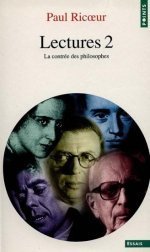
Lectures, tome 2 book cover
Lectures, tome 2
La contrée des philosophes
1999
First Published
4.33
Average Rating
514
Number of Pages
Essais Après la publication de Soi-même comme un autre en 1990, l'œuvre maîtresse qui mène à terme le projet philosophique d'une herméneutique du soi, Paul Ricœur publie dans une série de volumes intitulés Lectures les principaux articles ou préfaces qu'il a consacrés aux figures philosophiques avec lesquelles il a conversé pendant plus d'un demi-siècle. Si Lectures 1 regroupait les textes relatifs à la pensée politique, Lectures 2 rassemble les articles qui portent sur les grandes figures de la pensée existentialiste (de Kierkegaard à Sartre et Merleau-Ponty), sur les philosophes qui sont à l'origine de sa vocation philosophique (Gabriel Marcel, Jean Nabert...), mais aussi ses discussions - dont beaucoup sont devenues classiques - avec les représentants du courant structuraliste (Claude Lévi-Strauss, A.-J. Greimas).

Avg Rating
4.33
Number of Ratings
3
5 STARS
33%
4 STARS
67%
3 STARS
0%
2 STARS
0%
1 STARS
0%
goodreads

Author

Paul Ricoeur
Paul Ricoeur
Author · 31 books

Paul Ricoeur (1913–2005) is widely recognized as one of the most distinguished philosophers of the twentieth century. In the course of his long career he wrote on a broad range of issues. His books include a multi-volume project on the philosophy of the will: Freedom and Nature: The Voluntary and the Involuntary (1950, Eng. tr. 1966), Fallible Man (1960, Eng. tr. 1967), and The Symbolism of Evil (1960, Eng. tr. 1970); a major study of Freud: Freud and Philosophy: An Essay on Interpretation (1965, Eng. tr. 1970); The Rule of Metaphor (1975, Eng. tr. 1977); Interpretation Theory: Discourse and the Surplus of Meaning (1976); the three-volume Time and Narrative (1983-85, Eng. tr. 1984–88); Lectures on Ideology and Utopia (1986); the published version of his Gifford lectures: Oneself as Another (1990, Eng. tr. 1992); Memory, History, Forgetting (2000, Eng. tr. 2004); and The Course of Recognition (2004, Eng. tr. 2005). In addition to his books, Ricoeur published more than 500 essays, many of which appear in collections in English: History and Truth (1955, Eng. tr. 1965); Husserl: An Analysis of His Phenomenology (1967); The Conflict of Interpretations: Essays in Hermeneutics (1969, Eng. tr. 1974); Political and Social Essays (1974); Essays on Biblical Interpretation (1980); Hermeneutics and the Human Sciences (1981); From Text to Action (1986, Eng. tr. 1991); Figuring the Sacred: Religion, Narrative, and Imagination (1995); The Just (1995, Eng. tr. 2000); On Translation (2004, Eng. tr. 2004); and Reflections on the Just (2001, Eng. tr. 2007). The major theme that unites his writings is that of a philosophical anthropology. This anthropology, which Ricoeur came to call an anthropology of the “capable human being,” aims to give an account of the fundamental capabilities and vulnerabilities that human beings display in the activities that make up their lives. Though the accent is always on the possibility of understanding the self as an agent responsible for its actions, Ricoeur consistently rejects any claim that the self is immediately transparent to itself or fully master of itself. Self-knowledge only comes through our relation to the world and our life with and among others in that world. In the course of developing his anthropology, Ricoeur made a major methodological shift. His writings prior to 1960 were in the tradition of existential phenomenology. But during the 1960s Ricoeur concluded that properly to study human reality he had to combine phenomenological description with hermeneutic interpretation. For this hermeneutic phenomenology, whatever is intelligible is accessible to us in and through language and all deployments of language call for interpretation. Accordingly, “there is no self-understanding that is not mediated by signs, symbols, and texts; in the final analysis self-understanding coincides with the interpretation given to these mediating terms” (Oneself as Another, 15, translation corrected). This hermeneutic or linguistic turn did not require him to disavow the basic results of his earlier investigations. It did, however, lead him not only to revisit them but also to see more clearly their implications.

548 Market St PMB 65688, San Francisco California 94104-5401 USA
© 2026 Paratext Inc. All rights reserved