1926
First Published
4.35
Average Rating
376
Number of Pages
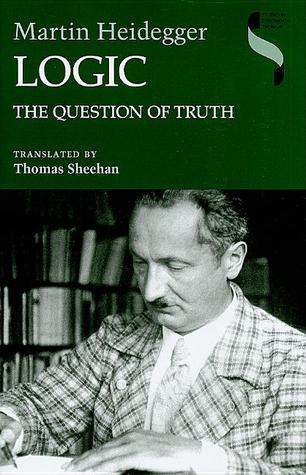
Martin Heidegger's 1925–26 lectures on truth and time provided much of the basis for his momentous work, Being and Time. Not published until 1976 as volume 21 of the Complete Works, three months before Heidegger's death, this work is central to Heidegger's overall project of reinterpreting Western thought in terms of time and truth. The text shows the degree to which Aristotle underlies Heidegger's hermeneutical theory of meaning. It also contains Heidegger’s first published critique of Husserl and takes major steps toward establishing the temporal bases of logic and truth. Thomas Sheehan's elegant and insightful translation offers English-speaking readers access to this fundamental text for the first time.

Avg Rating
4.35
Number of Ratings
34
5 STARS
59%
4 STARS
21%
3 STARS
18%
2 STARS
3%
1 STARS
0%
goodreads
Author

Martin Heidegger
Author · 91 books
Martin Heidegger (1889-1976) was a German philosopher whose work is perhaps most readily associated with phenomenology and existentialism, although his thinking should be identified as part of such philosophical movements only with extreme care and qualification. His ideas have exerted a seminal influence on the development of contemporary European philosophy. They have also had an impact far beyond philosophy, for example in architectural theory (see e.g., Sharr 2007), literary criticism (see e.g., Ziarek 1989), theology (see e.g., Caputo 1993), psychotherapy (see e.g., Binswanger 1943/1964, Guignon 1993) and cognitive science (see e.g., Dreyfus 1992, 2008; Wheeler 2005; Kiverstein and Wheeler forthcoming).