Margins
Margins
Sign in
Margins
Subscribe to our newsletter
548 Market St PMB 65688, San Francisco California 94104-5401 USA
hello@margins.app
·
+1 (650) 223-5283
Privacy Policy
·
Terms of Use
© 2026 Paratext Inc. All rights reserved
📚 Medieval
📚
Medieval
Beowulf
900
New York Times bestseller and winner of the Costa Book Award. Composed toward the end of the first millennium, Beowulf is the elegiac narrative of the adventures of Beowulf, a Scandinavian hero who saves the Danes from the seemingly invincible monster Grendel and, later, from Grendel's mother. He then returns to his own country and dies in old age in a vivid fight against a dragon. The poem is about encountering the monstrous, defeating it, and then having to live on in the exhausted aftermath. In the contours of this story, at once remote and uncannily familiar at the beginning of the twenty-first century, Nobel laureate Seamus Heaney finds a resonance that summons power to the poetry from deep beneath its surface. Drawn to what he has called the "four-squareness of the utterance" in Beowulf and its immense emotional credibility, Heaney gives these epic qualities new and convincing reality for the contemporary reader.
Revelations of Divine Love
1393
Julian of Norwich
One of the first woman authors, Julian of Norwich produced in Revelations of Divine Love a remarkable work of revelatory insight, that stands alongside The Cloud of Unknowing and Piers Plowman as a classic of Medieval religious literature After fervently praying for a greater understanding of Christ's passion, Julian of Norwich, a fourteenth-century anchorite and mystic, experienced a series of divine revelations. Through these 'showings', Christ's sufferings were revealed to her with extraordinary intensity, but she also received assurance of God's unwavering love for man and his infinite capacity for forgiveness. Written in a vigorous English vernacular, the Revelations are one of the most original works of medieval mysticism and have had a lasting influence on Christian thought. This edition of the Revelations contains both the short text, which is mainly an account of the 'showings' themselves and Julian's initial interpretation of their meaning, and the long text, completed some twenty years later, which moves from vision to a daringly speculative theology. Elizabeth Spearing's translation preserves Julian's directness of expression and the rich complexity of her thought. An introduction, notes and appendices help to place the works in context for modern readers.
The Decameron
1349
Giovanni Boccaccio
The Decameron (c.1351) is an entertaining series of one hundred stories written in the wake of the Black Death. The stories are told in a country villa outside the city of Florence by ten young noble men and women who are seeking to escape the ravages of the plague. Boccaccio's skill as a dramatist is masterfully displayed in these vivid portraits of people from all stations in life, with plots that revel in a bewildering variety of human reactions. Translated with an Introduction and Notes by G. H. McWilliam
The Wake
2014
In the aftermath of the Norman Invasion of 1066, William the Conqueror was uncompromising and brutal. English society was broken apart, its systems turned on their head. What is little known is that a fractured network of guerrilla fighters took up arms against the French occupiers. In The Wake, a postapocalyptic novel set a thousand years in the past, Paul Kingsnorth brings this dire scenario back to us through the eyes of the unforgettable Buccmaster, a proud landowner bearing witness to the end of his world. Accompanied by a band of like-minded men, Buccmaster is determined to seek revenge on the invaders. But as the men travel across the scorched English landscape, Buccmaster becomes increasingly unhinged by the immensity of his loss, and their path forward becomes increasingly unclear. Written in what the author describes as “a shadow tongue”—a version of Old English updated so as to be understandable to the modern reader—The Wake renders the inner life of an Anglo-Saxon man with an accuracy and immediacy rare in historical fiction. To enter Buccmaster’s world is to feel powerfully the sheer strangeness of the past. A tale of lost gods and haunted visions, The Wake is both a sensational, gripping story and a major literary achievement.
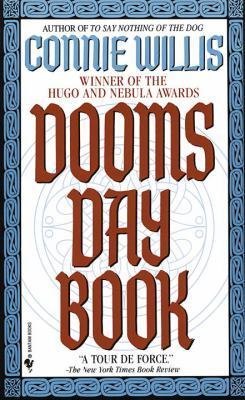
Doomsday Book
1992
Connie Willis
For Kivrin, preparing an on-site study of one of the deadliest eras in humanity's history was as simple as receiving inoculations against the diseases of the fourteenth century and inventing an alibi for a woman traveling alone. For her instructors in the twenty-first century, it meant painstaking calculations and careful monitoring of the rendezvous location where Kivrin would be received. But a crisis strangely linking past and future strands Kivrin in a bygone age as her fellows try desperately to rescue her. In a time of superstition and fear, Kivrin—barely of age herself—finds she has become an unlikely angel of hope during one of history's darkest hours. Connie Willis draws upon her understanding of the universalities of human nature to explore the ageless issues of evil, suffering, and the indomitable will of the human spirit.