Margins




548 Market St PMB 65688, San Francisco California 94104-5401 USA
© 2026 Paratext Inc. All rights reserved
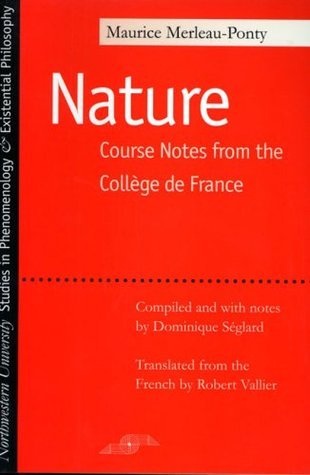
Collected here are the written traces of courses on the concept of nature given by Maurice Merleau-Ponty at the Collège de France in the 1950s-notes that provide a window on the thinking of one of the most influential philosophers of the twentieth century. In two courses distilled by a student and in a third composed of Merleau-Ponty's own notes, the ideas that animated the philosopher's lectures and that informed his later publications emerge in an early, fluid form in the process of being elaborated, negotiated, critiqued, and reconsidered. Merleau-Ponty's project in these courses is an interrogation of nature, a task at the center of his investigation of perception, truth, and subjectivity. The first course, a survey of the historical elements in our concept of nature, examines first the Cartesian concept of nature and then historical and contemporary responses to Descartes, all with an eye toward developing a vision of nature more consistent with the findings of contemporary science. In the second course, Merleau-Ponty takes up the problem of the relation of nature to ontology in general. Here, the key question is how the animal finds itself in its world. Because the human body is ultimately "an animal of movements and perceptions," humanity is intertwined with animality. In the third course, "Nature and Logos: The Human Body," Merleau-Ponty assesses his previous findings and examines the emergence of the human body at the intersection of nature and Logos. This course, contemporaneous with the working notes for The Visible and the Invisible, allows us to observe the evolution of that work as well as to revisit the research he had begun in Primacy of Perception. In these traces: a new reading of Descartes; a measured appreciation of Schelling; an assessment of recent developments in the sciences (both physical and biological) that leads to the notion of the body as a "system of equivalencies"; and an examination of the phenomenon of life. We have a wealth of material that allows us to reconsider Merleau-Ponty's thinking and to engage his philosophical project anew.