Margins
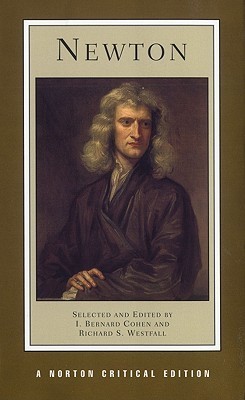
Newton book cover
Newton
A Norton Critical Edition
1995
First Published
3.75
Average Rating
434
Number of Pages
At last―an illuminating and accessible edition of Isaac Newton's writings, intended for nonspecialist readers. I. Bernard Cohen and Richard S. Westfall have meticulously collected representative works from every major aspect of Newton's intellectual life. The book is divided into nine parts―Natural Philosophy, Scientific Method, Experimental Procedure, Optics, Rational Mechanics, Systems of the World, Alchemy and Theory of Matter, Theology, and Mathematics. Text and commentary are woven together, enabling readers to concentrate on the aspects of Newton's astoundingly diverse career they prefer. For each part, the editors provide an introductory essay and textual annotation. In addition, the text is amply illustrated. The General Introduction to the book sketches Newton's life and offers an interpretation of his scientific achievements. The Biographical Register identifies the many people Newton cites in his writings. The Glossary and Glossary of Chemical Terms explicate scientific terms and concepts. Finally, the Selected Bibliography offers suggestions for further readings of and about Newton.

Avg Rating
3.75
Number of Ratings
20
5 STARS
5%
4 STARS
70%
3 STARS
20%
2 STARS
5%
1 STARS
0%
goodreads

Author

Isaac Newton
Isaac Newton
Author · 16 books

Sir Isaac Newton, FRS, was an English physicist, mathematician, astronomer, natural philosopher, and alchemist. His Philosophiæ Naturalis Principia Mathematica, published in 1687, is considered to be the most influential book in the history of science. In this work, Newton described universal gravitation and the three laws of motion, laying the groundwork for classical mechanics, which dominated the scientific view of the physical universe for the next three centuries and is the basis for modern engineering. Newton showed that the motions of objects on Earth and of celestial bodies are governed by the same set of natural laws by demonstrating the consistency between Kepler's laws of planetary motion and his theory of gravitation, thus removing the last doubts about heliocentrism and advancing the scientific revolution. In mechanics, Newton enunciated the principles of conservation of momentum and angular momentum. In optics, he invented the reflecting telescope and developed a theory of colour based on the observation that a prism decomposes white light into a visible spectrum. He also formulated an empirical law of cooling and studied the speed of sound. In mathematics, Newton shares the credit with Gottfried Leibniz for the development of the differential and integral calculus. He also demonstrated the generalised binomial theorem, developed the so-called "Newton's method" for approximating the zeroes of a function, and contributed to the study of power series. Newton was also highly religious (though unorthodox), producing more work on Biblical hermeneutics than the natural science he is remembered for today. In a 2005 poll of the Royal Society asking who had the greater effect on the history of science, Newton was deemed much more influential than Albert Einstein.

548 Market St PMB 65688, San Francisco California 94104-5401 USA
© 2025 Paratext Inc. All rights reserved