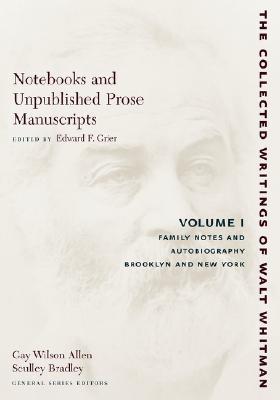



General Series Gay Wilson Allen and Sculley Bradley Originally published between 1961 and 1984, and now available in paperback for the first time, the critically acclaimed Collected Writings of Walt Whitman captures every facet of one of America’s most important poets. Notebooks and Unpublished Prose Manuscripts gathers Whitman’s autobiographical notes, his views on contemporary politics, and the writings he made as he educated himself in ancient history, religion and mythology, health (including phrenology), and word-study. Included is material on his Civil War experiences, his love of Abraham Lincoln, his descriptions of various trips to the West and South and of the cities in which he resided, his generally pessimistic view of America’s prospects in the Reconstruction and the Gilded Age, and his reminiscences during his final years and his preoccupation with the increasing ailments that came with old age. Many of these notes served as sources for his poetry—first drafts of some of the poems are included as they appear in the notes—and as the basis for his lectures.
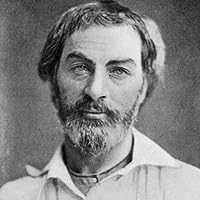
Author

Walter Whitman (1819-1892) was an American poet, essayist, journalist, and humanist. He was a part of the transition between Transcendentalism and realism, incorporating both views in his works. Whitman is among the most influential poets in the American canon, often called the father of free verse. Born on Long Island, Whitman worked as a journalist, a teacher, a government clerk, and a volunteer nurse during the American Civil War in addition to publishing his poetry. Early in his career, he also produced a temperance novel, Franklin Evans (1842). After working as clerk, teacher, journalist and laborer, Whitman wrote his masterpiece, Leaves of Grass, pioneering free verse poetry in a humanistic celebration of humanity, in 1855. Emerson, whom Whitman revered, said of Leaves of Grass that it held "incomparable things incomparably said." During the Civil War, Whitman worked as an army nurse, later writing Drum Taps (1865) and Memoranda During the War (1867). His health compromised by the experience, he was given work at the Treasury Department in Washington, D.C. After a stroke in 1873, which left him partially paralyzed, Whitman lived his next 20 years with his brother, writing mainly prose, such as Democratic Vistas (1870). Leaves of Grass was published in nine editions, with Whitman elaborating on it in each successive edition. In 1881, the book had the compliment of being banned by the commonwealth of Massachusetts on charges of immorality. A good friend of Robert Ingersoll, Whitman was at most a Deist who scorned religion. D. 1892. More: http://www.whitmanarchive.org/ http://philosopedia.org/index.php/Wal... http://www.poets.org/poet.php/prmPID/126 http://www.poetryfoundation.org/bio/w... http://en.wikipedia.org/wiki/Walt\_Whi... http://www.poemhunter.com/walt-whitman/