Margins




548 Market St PMB 65688, San Francisco California 94104-5401 USA
© 2026 Paratext Inc. All rights reserved
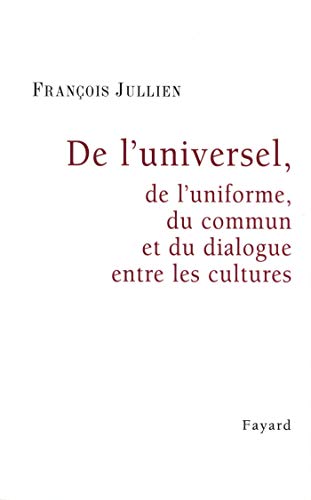
Francois Jullien, the leading philosopher and specialist in Chinese thought, has always aimed at building on inter-cultural relations between China and the West. In this new book he focuses on the following questions: Do universal values exist? Is dialogue between cultures possible? To answer these questions, he retraces the history of the concept of the universal from its invention as an aspect of Roman citizenship, through its neutralization in the Christian idea of salvation, to its present day manifestations. This raises the question of whether the search for the universal is a uniquely Western preoccupation: do other cultures, like China, even have a notion of the universal, and if so, how does it differ from ours? Having considered the meaning of the concept in the East and West, Jullien argues that, if communication between cultures is to be meaningful, facile assumptions of universal values and complacent relativism need to be examined. It follows, therefore, that dialogue between cultures should not begin with issues of identity and difference, but rather by considering divergence and profusion. By no longer simply assuming universality, we allow for greater self-reflection. This wide-ranging and engaging study will be of particular interest to students and scholars of philosophy and of Chinese culture and society. It will also appeal to a wider readership interested in contemporary thought and the challenges of communication between East and West.