


Margins
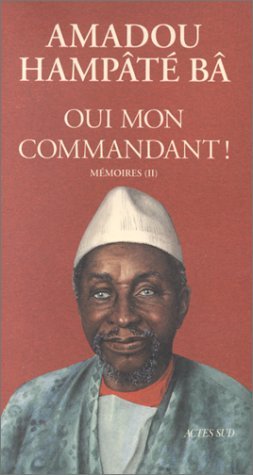
Oui, mon commandant ! book cover
Oui, mon commandant !
1994
First Published
4.28
Average Rating
494
Number of Pages

Amkoullel l'enfant peul, maintenant âgé de vingt-deux ans, entame dans ce deuxième volume de Mémoires sa carrière de jeune fonctionnaire de l'administration coloniale en Haute-Volta (Burkina-Faso). Après un long voyage au cours duquel il commence à noter tous les récits oraux dont il deviendra le dépositaire, le jeune homme un peu naïf du début se marie, fonde une famille, et devient peu à peu, à travers mille aventures cocasses, émouvantes ou dramatiques, un homme sage capable de porter sur le monde qui l'entourait un regard à la fois perspicace, subtil et rigoureux. Mais c'est la formidable énergie de ce récit qui frappe le plus : par-delà son caractère autobiographique, c'est un vaste tableau, fascinant et vivant, de l'Afrique coloniale de cette époque qu'il nous offre. On se délecte des anecdotes rapportées avec cette verve et cet humour inimitable dont l'auteur a le secret, on savoure l'extraordinaire galerie de portraits de chefs coloniaux aux surnoms évocateurs ― les commandants Porte-baobab, Diable boiteux ou Boule d'épines ― croqués avec lucidité et tendresse à la fois... et l'on en apprend plus que dans bien des traités. Au fil du récit se dessine une évolution spirituelle qui trouve son accomplissement à la fin de l'ouvrage, en 1933, lorsque l'auteur, de retour au Mali, reçoit de son maître spirituel Tierno Bokar les enseignements d'amour et de tolérance qui, dit-il, vont féconder le reste de sa vie.

Avg Rating
4.28
Number of Ratings
137
5 STARS
46%
4 STARS
39%
3 STARS
12%
2 STARS
3%
1 STARS
0%
goodreads

Author

Amadou Hampâté Bâ
Author · 2 books

Amadou Hampâté Bâ was born to an aristocratic Fula family in Bandiagara, the largest city in Dogon territory and the capital of the precolonial Masina Empire. After his father's death, he was adopted by his mother's second husband, Tidjani Amadou Ali Thiam of the Toucouleur ethnic group. He first attended the Qur'anic school run by Tierno Bokar, a dignitary of the Tijaniyyah brotherhood, then transferred to a French school at Bandiagara, then to one at Djenné. In 1915, he ran away from school and rejoined his mother at Kati, where he resumed his studies. In 1921, he turned down entry into the école normale in Gorée. As a punishment, the governor appointed him to Ouagadougou with the role he later described as that of "an essentially precarious and revocable temporary writer". From 1922 to 1932, he filled several posts in the colonial administration in Upper Volta, now Burkina Faso and from 1932 to 1942 in Bamako. In 1933, he took a six month leave to visit Tierno Bokar, his spiritual leader.(see also:Sufi studies) In 1942, he was appointed to the Institut Français d’Afrique Noire (IFAN, French Institute of Black Africa) in Dakar thanks to the benevolence of Théodore Monod, its director. At IFAN, he made ethnological surveys and collected traditions. For 15 years he devoted himself to research, which would later lead to the publication of his work L'Empire peul de Macina (The Peul Empire of Macina). In 1951, he obtained a UNESCO grant, allowing him to travel to Paris and meet with intellectuals from Africanist circles, notably Marcel Griaule. With Mali's independence in 1960, Bâ founded the Institute of Human Sciences in Bamako, and represented his country at the UNESCO general conferences. In 1962, he was elected to UNESCO's executive council, and in 1966 he helped establish a unified system for the transcription of African languages. His term in the executive council ended in 1970, and he devoted the remaining years of his life to research and writing. He moved to Abidjan, and worked on classifying the archives of West African oral tradition that he had accumulated throughout his lifetime, as well as writing his memoirs (Amkoullel l'enfant peul and Oui mon commandant!, both published posthumously). (source: Wikipedia)

548 Market St PMB 65688, San Francisco California 94104-5401 USA
© 2026 Paratext Inc. All rights reserved