Part of Series
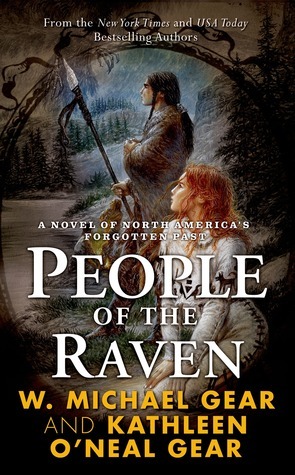
In People of the Raven, award-winning archaeologists and New York Times and USA Today bestselling authors W. Michael Gear and Kathleen O'Neal Gear spin a vivid and captivating tale around one of the most controversial archaeological discoveries in the world, the Kennewick Man—-a Caucasoid male mummy dating back more than 9,000 years—-found in the Pacific Northwest on the banks of the Columbia River. A white man in North America more than 9,000 years ago? What was he doing there? With the terrifying grandeur of melting glaciers as a backdrop, People of the Raven shows animals and humans struggling for survival amidst massive environmental change. Mammoths, mastodons, and giant lions have become extinct, and Rain Bear, the chief of Sandy Point Village, knows his struggling Raven People may be next.
Author
W. Michael Gear was born in Colorado Springs, Colorado, on the twentieth of May, 1955. A fourth generation Colorado native, his family had been involved in hard-rock mining, cattle ranching, and journalism. After his father's death in 1959, Michael's mother received her Master's degree in journalism and began teaching. In 1962 she married Joseph J. Cook, who taught tool and die making, and the family lived in Lakewood, Colorado, until 1968. At that time they moved to Fort Collins so that Joe could pursue his Ph.D.. During those years the family lived in the foothills above Horsetooth Reservoir. It was there that Mike developed a love of history, anthropology, and motorcycles. They would color his future and fill his imagination for the rest of his life. During summers he volunteered labor on local ranches or at the farm east of Greeley and landed his first real job: picking up trash at the lake and cleaning outhouses. It has been said that his exposure to trash led him into archaeology. We will not speculate about what cleaning the outhouses might have led him to. On his first dig as a professional archaeologist in 1976 he discovered that two thousand year old human trash isn't nearly as obnoxious as the new stuff. Michael graduated from Fort Collins High School in 1972 and pursued both his Bachelor's (1976) and Master's (1979) degrees at Colorado State University. Upon completion of his Master's - his specialty was in physical anthropology - he went to work for Western Wyoming College in Rock Springs as a field archaeologist. It was in the winter of 1978 that he wrote his first novel. Irritated by historical inaccuracies in Western fiction, he swore he could do better. He was "taking retirement in installments," archaeology being a seasonal career, in the cabin his great uncle Aubrey had built. One cold January night he read a Western novel about a trail drive in which steers (castrated males) had calves. The historical inaccuracies of the story bothered him all night. The next morning, still incensed, he chunked wood into the stove and hunkered over the typewriter. There, on the mining claim, at nine thousand feet outside of Empire, Colorado he hammered out his first five hundred and fifty page novel. Yes, that first manuscript still exists, but if there is justice in the universe, no one will ever see it. It reads wretchedly - but the historical facts are correct! Beginning in 1981, Michael, along with two partners, put together his own archaeological consulting company. Pronghorn Anthropological Associates began doing cultural resource management studies in 1982, and, although Michael sold his interest in 1984, to this day the company remains in business in Casper, Wyoming. During the years, Michael has worked throughout the western United States doing archaeological surveys, testing, and mitigation for pipelines, oil wells, power lines, timber sales, and highway construction. He learned the value of strong black coffee, developed a palate for chocolate donuts, and ferreted out every quality Mexican restaurant in eight states. He spent nine months of the year traveling from project to project with his trowel and dig kit, a clapped-out '72 Wonder Blazer, and his boon companion, Tedi, a noble tri-color Sheltie. That fateful day in November, 1981, was delightfully clear, cold, and still in Laramie, Wyoming. Archaeologists from all over the state had arrived at the University of Wyoming for the annual meetings of the Wyoming Association of Professional Archaeologists. It was there, in the meeting room, way too early after a much too long night, that Mike first laid eyes on the most beautiful woman in the world: Kathleen O'Neal Gear. The BLM State Archaeologist, Ray Leicht, introduced him to the pretty anthropologist and historian, and best of all, Ray invited Mike to lunch with Kathleen. It was the perfect beginning for a long and wondrous relationship. http://us.macmillan.com/author/wmicha...