2003
First Published
3.92
Average Rating
221
Number of Pages
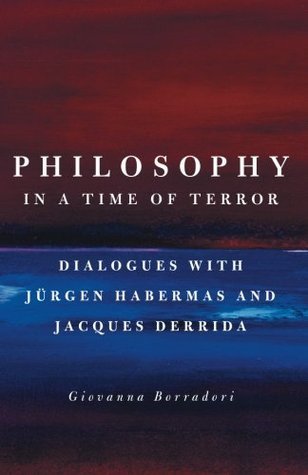
The idea for Philosophy in a Time of Terror was born hours after the attacks on 9/11 and was realized just weeks later when Giovanna Borradori sat down with Jürgen Habermas and Jacques Derrida in New York City, in separate interviews, to evaluate the significance of the most destructive terrorist act ever perpetrated. This book marks an unprecedented encounter between two of the most influential thinkers of our age as here, for the first time, Habermas and Derrida overcome their mutual antagonism and agree to appear side by side. As the two philosophers disassemble and reassemble what we think we know about terrorism, they break from the familiar social and political rhetoric increasingly polarized between good and evil. In this process, we watch two of the greatest intellects of the century at work.

Avg Rating
3.92
Number of Ratings
550
5 STARS
31%
4 STARS
37%
3 STARS
24%
2 STARS
6%
1 STARS
1%
goodreads
Author

Jurgen Habermas
Author · 40 books
Jürgen Habermas is a German sociologist and philosopher in the tradition of critical theory and American pragmatism. He is perhaps best known for his work on the concept of the public sphere, the topic of his first book entitled The Structural Transformation of the Public Sphere. His work focuses on the foundations of social theory and epistemology, the analysis of advanced capitalistic societies and democracy, the rule of law in a critical social-evolutionary context, and contemporary politics—particularly German politics. Habermas' theoretical system is devoted to revealing the possibility of reason, emancipation, and rational-critical communication latent in modern institutions and in the human capacity to deliberate and pursue rational interests.