Margins


548 Market St PMB 65688, San Francisco California 94104-5401 USA
© 2026 Paratext Inc. All rights reserved

Gaius Plinius Secundus (23 AD – August 25, 79 AD), better known as Pliny the Elder, was a Roman author, naturalist, and natural philosopher, as well as naval and army commander of the early Roman Empire, and personal friend of the emperor Vespasian. Spending most of his spare time studying, writing or investigating natural and geographic phenomena in the field, he wrote an encyclopedic work, Naturalis Historia, which became a model for all such works written subsequently. Pliny the Younger, his nephew, wrote of him in a letter to the historian Tacitus: "For my part I deem those blessed to whom, by favour of the gods, it has been granted either to do what is worth writing of, or to write what is worth reading; above measure blessed those on whom both gifts have been conferred. In the latter number will be my uncle, by virtue of his own and of your compositions." Pliny the Younger is referring to the fact that Tacitus relied on his uncle's now missing work on the History of the German Wars. Pliny the Elder died on August 25, 79 AD, while attempting the rescue by ship of a friend and his family from the eruption of Mount Vesuvius that had just destroyed the cities of Pompeii and Herculaneum. The prevailing wind would not allow his ship to leave the shore. His companions attributed his collapse and death to toxic fumes; but they were unaffected by the fumes, suggesting natural causes.

2025
La Peinture
1997
Bks.I-II v. 1
1944
Bks.XXVIII-XXXII v. 8
1963

Bks.XXIV-XXVII v. 7
1956

Bks.XVII-XIX v. 5
1950
Bks.XXXIII-XXXV v. 9
1952

Bks.XXXVI-XXXVII v. 10
1962

Books 1-2
1938

Books 3-7
1942

Books 8–11
1940

Books 33–35
1952
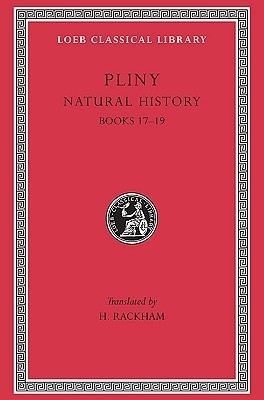
Books 17-19
2010

Books 20–23
1951

Books 36–37
1962

2012
Natural History IV
2026

Natural History, Volume VIII: Books 28-32. Index of Fishes.
1963
Natural History III
1940

Medicina e farmacologia
1986