
Margins
Poemi dalla negritudine book cover
Poemi dalla negritudine
2013
First Published
3.51
Average Rating
61
Number of Pages

Scrollarsi di dosso secoli di assimilazione culturale all'Europa: a questo mirava il rovesciamento di valori per il quale tre ragazzi neri, Senghor, Césaire e Damas, coniarono la parola "Negritudine". Il movimento, nato nella Parigi degli anni '30, già affascinata dalle maschere africane di Picasso e ubriaca di jazz, si diffuse poi grazie ad una prefazione di Jean-Paul Sartre, "L'Orfeo Nero", suscitando simpatie e reazioni avverse in tutto il mondo. I versi scelti di "Poemi dalla Negritudine", intrisi di rivolta, lirismo e sensualità, restituiscono il clima degli anni che precedettero l'indipendenza dei paesi africani, come pure il disincanto del "poi". Testi in francesi con traduzione in italiano

Avg Rating
3.51
Number of Ratings
47
5 STARS
9%
4 STARS
40%
3 STARS
45%
2 STARS
6%
1 STARS
0%
goodreads

Authors

David Diop
David Diop
Author · 1 book

David Léon Mandessi Diop was a French West African poet known for his contribution to the Négritude literary movement. His work reflects his anti-colonial stance. Diop started writing poems while he was still in school, and his poems started appearing in Présence Africaine since he was just 15. Diop lived his life transitioning constantly between France and West Africa, from childhood onwards. While in Paris, Diop became a prominent figure in Négritude literature. His work is seen as a condemnation of colonialism, and detest towards colonial rule. Like many Négritude authors of the time, Diop hoped for an independent Africa. Within the movement he was recognized as "the voice of the people without voice". He died in the crash of Air France Flight 343 in the Atlantic Ocean off Dakar, Senegal, at the age of 33 on 29 August 1960. His one small collection of poetry, Coups de pilon, came out from Présence Africaine in 1956; it was posthumously published in English as Hammer Blows, translated and edited by Simon Mondo and Frank Jones (African Writers Series, 1975).

Birago Diop
Birago Diop
Author · 4 books

Diop, Birago (1906-1989), écrivain sénégalais d'expression française, qui rendit hommage à la tradition orale de son pays en publiant des contes, notamment ses Contes d'Amadou Koumba. Né près de Dakar, il reçut une formation coranique et suivit simultanément les cours de l'école française. Pendant ses études de médecine vétérinaire à Toulouse, il resta à l'écoute des travaux des africanistes, et s'associa à la fin des années 1930 au mouvement de la Négritude qui comptait alors Senghor, Césaire. C'est à Paris qu'il composa en 1942 les Contes d'Amadou Koumba (publiés en 1947), marquant dès ce premier livre sa prédilection pour la tradition orale des griots, ces conteurs populaires dont il ne cessa jamais d'écouter la voix. Respectueux de l'oralité, il affina un talent original d'écrivain dans les Nouveaux Contes d'Amadou Koumba (1958) et Contes et Lavanes (1963); son recueil de poèmes Leurres et Lueurs (1960) est profondément imprégné de culture française alliée aux sources d'une inspiration purement africaine. Sa carrière diplomatique, après l'indépendance de son pays, et son retour à son premier métier de vétérinaire à Dakar n'entravèrent pas son exploration de la littérature traditionnelle africaine, mais il déclara avoir « cassé sa plume ». Il publia néanmoins la Plume raboutée et quatre autres volumes de mémoires de 1978 à 1989.

Léon-Gontran Damas
Léon-Gontran Damas
Author · 3 books
Léon-Gontran Damas was a French poet and politician. He was one of the founders of the Négritude movement.
Aime Cesaire
Aime Cesaire
Author · 15 books

Martinique-born poet, playwright, and politician Aimé Fernand Césaire contributed to the development of the concept of negritude; his primarily surrealist works include The Miracle Weapons (1946) and A Tempest (1969). A francophone author of African descent. His books of include Lost Body, with illustrations by Pablo Picasso, Aimé Césaire: The Collected Poetry, and Return to My Native Land. He is also the author of Discourse on Colonialism, a book of essays which has become a classic text of French political literature and helped establish the literary and ideological movement Negritude, a term Césaire defined as “the simple recognition of the fact that one is black, the acceptance of this fact and of our destiny as blacks, of our history and culture.” Césaire is a recipient of the International Nâzim Hikmet Poetry Award, the second winner in its history. He served as Mayor of Fort-de-France as a member of the Communist Party, and later quit the party to establish his Martinique Independent Revolution Party. He was deeply involved in the struggle for French West Indian rights and served as the deputy to the French National Assembly. He retired from politics in 1993. Césaire died in Martinique.

Leopold Sedar Senghor
Author · 5 books
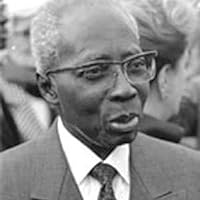
Léopold Sédar Senghor was a Senegalese poet, politician, and cultural theorist who served as the first president of Senegal (1960–1980). Senghor was the first African to sit as a member of the Académie française. He was also the founder of the political party called the Senegalese Democratic Bloc. He is regarded by many as one of the most important African intellectuals of the 20th century.
548 Market St PMB 65688, San Francisco California 94104-5401 USA
© 2026 Paratext Inc. All rights reserved