Margins




548 Market St PMB 65688, San Francisco California 94104-5401 USA
© 2026 Paratext Inc. All rights reserved
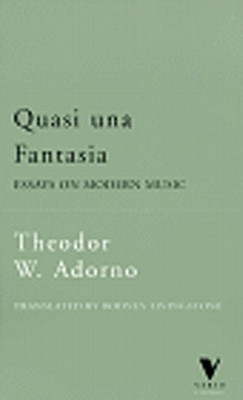
Quasi una Fantasia contains Adorno’s own selection from his essays and journalism over more than three decades. In its analytical profundity it can be compared to his Philosophy of Modern Music, but in the range of its topics and the clarity of its arguments it stands alone among Adorno’s writings on music. At the book’s core are illuminating studies of the founders of modern Mahler, Schoenberg and Berg, as well as sympathetic rediscoveries of Alexander Zemlinsky and Franz Schreker. Especially significant is Adorno’s “dialectical portrait” of Stravinsky in which he both reconsiders and refines the damning indictment he gave in Philosophy on Modern Music . In ‘Vers une musique informelle’, an influential essay, he plots a course for a music of the future ‘which takes up the challenge of an unrevised, unrestricted freedom’. More unexpectedly, there are moving accounts of earlier works, including Bizet’s Carmen and Weber’s Der Freischutz, along with an entertainingly caustic “Natural History of the Theatre.” Which explores the hierarchies of the auditorium, from upper circle to foyer. ‘The positive element of kitsch’, Adorno remarks, ‘lies in the fact that it sets free for a moment the glimmering realization that you have wasted your life.’ Musical kitsch is the target of several of the shorter on Gounod’s Ave Maria or Tchaikovsky’s ‘clumsy naivety’; on the ‘Penny Serenade’ of the transformation of Mozart into chocolate-box rococo. Yet even while Adorno demolishes ‘commodity music’ he is sustained by the conviction that music is supremely human because it retains the capacity to speak of inhumanity and to resist it. It is a conviction which reverberates throughout these writings. For Adorno, music and philosophy were inextricably Quasi una Fantasia will enlarge our understanding of both.