Margins
Margins
Sign in
Margins
Subscribe to our newsletter
548 Market St PMB 65688, San Francisco California 94104-5401 USA
hello@margins.app
·
+1 (650) 223-5283
Privacy Policy
·
Terms of Use
© 2026 Paratext Inc. All rights reserved
📅
Read 2012
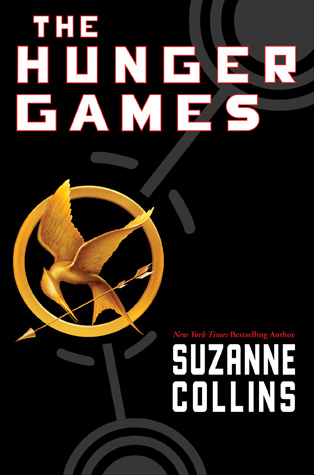
The Hunger Games
2008
Suzanne Collins
Could you survive on your own in the wild, with every one out to make sure you don't live to see the morning? In the ruins of a place once known as North America lies the nation of Panem, a shining Capitol surrounded by twelve outlying districts. The Capitol is harsh and cruel and keeps the districts in line by forcing them all to send one boy and one girl between the ages of twelve and eighteen to participate in the annual Hunger Games, a fight to the death on live TV. Sixteen-year-old Katniss Everdeen, who lives alone with her mother and younger sister, regards it as a death sentence when she steps forward to take her sister's place in the Games. But Katniss has been close to dead before—and survival, for her, is second nature. Without really meaning to, she becomes a contender. But if she is to win, she will have to start making choices that weight survival against humanity and life against love.
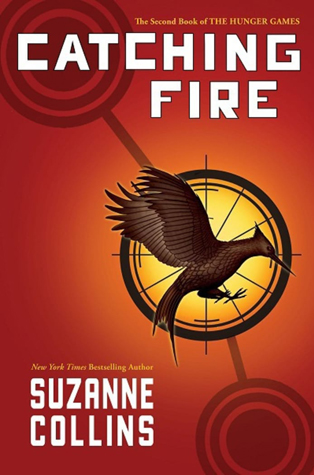
Catching Fire
2009
Suzanne Collins
Sparks are igniting. Flames are spreading. And the Capitol wants revenge. Against all odds, Katniss Everdeen has won the Hunger Games. She and fellow District 12 tribute Peeta Mellark are miraculously still alive. Katniss should be relieved, happy even. After all, she has returned to her family and her longtime friend, Gale. Yet nothing is the way Katniss wishes it to be. Gale holds her at an icy distance. Peeta has turned his back on her completely. And there are whispers of a rebellion against the Capitol—a rebellion that Katniss and Peeta may have helped create. Much to her shock, Katniss has fueled an unrest that she's afraid she cannot stop. And what scares her even more is that she's not entirely convinced she should try. As time draws near for Katniss and Peeta to visit the districts on the Capitol's cruel Victory Tour, the stakes are higher than ever. If they can't prove, without a shadow of a doubt, that they are lost in their love for each other, the consequences will be horrifying. In Catching Fire, the second novel of the Hunger Games trilogy, Suzanne Collins continues the story of Katniss Everdeen, testing her more than ever before . . . and surprising readers at every turn.
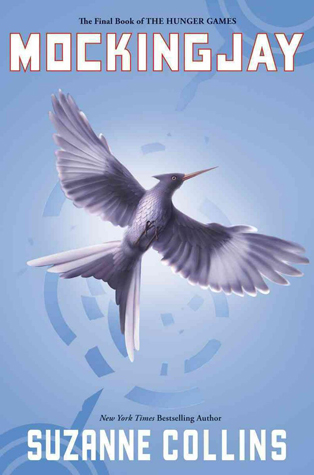
Mockingjay
2010
Suzanne Collins
My name is Katniss Everdeen. Why am I not dead? I should be dead. Katniss Everdeen, girl on fire, has survived, even though her home has been destroyed. Gale has escaped. Katniss' family is safe. Peeta has been captured by the Capitol. District 13 really does exist. There are rebels. There are new leaders. A revolution is unfolding. It is by design that Katniss was rescued from the arena in the cruel and haunting Quarter Quell, and it is by design that she has long been part of the revolution without knowing it. District 13 has come out of the shadows and is plotting to overthrow the Capitol. Everyone, it seems, has had a hand in the carefully laid plans—except Katniss. The success of the rebellion hinges on Katniss' willingness to be a pawn, to accept responsibility for countless lives, and to change the course of the future of Panem. To do this, she must put aside her feelings of anger and distrust. She must become the rebels' Mockingjay—no matter what the personal cost.
Deadlocked
2012
Charlaine Harris
Growing up with telepathic abilities, Sookie Stackhouse realized early on that there are things she'd rather not know. An now that she's an adult, she also realizes that some things she knows about, she'd rather not see—like Eric Northman feeding off another woman. A younger one. There's a thing or two she'd like to say about that, but she has to keep quiet—Felipe de Castro, the vampire king of Louisiana (and Arkansas and Nevada), is in town. It's the worst possible time for a human body to show up in Eric's front yard—especially the body of the woman whose blood he just drank. Now it's up to Sookie and Bill, the official Area Five investigator, to solve the murder. Sookie thinks that, at least this time, the dead girl's fate has nothing to do with her. But she is wrong. She has an enemy, one far more devious than she would ever suspect, who's set out to make Sookie's world come crashing down.
Never Let Me Go
2005
Kazuo Ishiguro
Hailsham seems like a pleasant English boarding school, far from the influences of the city. Its students are well tended and supported, trained in art and literature, and become just the sort of people the world wants them to be. But, curiously, they are taught nothing of the outside world and are allowed little contact with it. Within the grounds of Hailsham, Kathy grows from schoolgirl to young woman, but it’s only when she and her friends Ruth and Tommy leave the safe grounds of the school (as they always knew they would) that they realize the full truth of what Hailsham is. Never Let Me Go breaks through the boundaries of the literary novel. It is a gripping mystery, a beautiful love story, and also a scathing critique of human arrogance and a moral examination of how we treat the vulnerable and different in our society. In exploring the themes of memory and the impact of the past, Ishiguro takes on the idea of a possible future to create his most moving and powerful book to date.
Remember Me
2003
Lesley Pearse
How far must you go to find love? The Queen of Storytellers is back - with a triumphant tale of one woman's struggle over adversity. In 1786 a fisherman's daughter from Cornwall called Mary Broad was sentenced to be hung for theft. But her sentence was commuted, and she was transported to Australia, one of the first convicts to arrive there. How Mary escaped the harsh existence of the colony and found true love, and how she was captured and taken back to London in chains, only to be released after a trial where she was defended by no less than James Boswell, is one of the most gripping and moving stories of human endeavour (based on an amazing true story) you will ever read
Rosie's War
2011
Rosemary Say
This is the extraordinary true story of a plucky young woman and her dramatic escape from a German-run internment camp in Occupied France. Written in Rosemary's own words and completed by her daughter and son-in-law after her death, it includes photographs and documents from Rosie's incredible journey. Rosie's story moves from artistic circles in Avignon, through occupied Paris and the privations of prison camp, and across war-ravaged Europe. A tale of remarkable courage: not only of Rosie herself, but also of the many people who helped and harboured her at huge personal risk. Rosie's story sheds light on the little-known story of the thousands of British women trapped in Occupied France. Moving, enthralling, and inspirational, 'Rosie's War' is a book for all to enjoy.
Assassin's Apprentice
1995
Robin Hobb
alternate cover for ISBN 0006480098 Fitz is a royal bastard, cast out into the world with only his magical link with animals for solace and companionship. But when Fitz is adopted into the royal household, he must give up his old ways and learn a new life: weaponry, scribing, courtly manners; and how to kill a man secretly. Meanwhile, raiders ravage the coasts, leaving the people Forged and soulless. As Fitz grows towards manhood, he will have to face his first terrifying mission, a task that poses as much a risk to himself as it does to his target: Fitz is a threat to the throne… but he may also be the key to the future of the kingdom. Cover illustration by John Howe
Royal Assassin
1996
Robin Hobb
The legend continues… Regal’s treasonous attempt to usurp the Six Duchies throne from his half-brother Verity has been foiled. Now, as Fitz recovers slowly from the foul poison administered to him, the King’s Fool prophesies: ‘We are here, Fitz, you and I, to change the future and the world…’ Cover illustration by John Howe
Assassin's Quest
1997
Robin Hobb
King Shrewd is dead at the hands of his son Regal. As is Fitz—or so his enemies and friends believe. But with the help of his allies and his beast magic, he emerges from the grave, deeply scarred in body and soul. The kingdom also teeters toward ruin: Regal has plundered and abandoned the capital, while the rightful heir, Prince Verity, is lost to his mad quest—perhaps to death. Only Verity's return—or the heir his princess carries—can save the Six Duchies. But Fitz will not wait. Driven by loss and bitter memories, he undertakes a quest: to kill Regal. The journey casts him into deep waters, as he discovers wild currents of magic within him—currents that will either drown him or make him something more than he was.
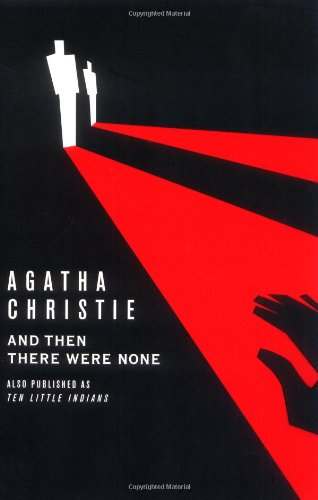
And Then There Were None
1939
Agatha Christie
First, there were ten—a curious assortment of strangers summoned as weekend guests to a little private island off the coast of Devon. Their host, an eccentric millionaire unknown to all of them, is nowhere to be found. All that the guests have in common is a wicked past they're unwilling to reveal—and a secret that will seal their fate. For each has been marked for murder. A famous nursery rhyme is framed and hung in every room of the mansion: "Ten little boys went out to dine; One choked his little self and then there were nine. Nine little boys sat up very late; One overslept himself and then there were eight. Eight little boys traveling in Devon; One said he'd stay there then there were seven. Seven little boys chopping up sticks; One chopped himself in half and then there were six. Six little boys playing with a hive; A bumblebee stung one and then there were five. Five little boys going in for law; One got in Chancery and then there were four. Four little boys going out to sea; A red herring swallowed one and then there were three. Three little boys walking in the zoo; A big bear hugged one and then there were two. Two little boys sitting in the sun; One got frizzled up and then there was one. One little boy left all alone; He went out and hanged himself and then there were none." When they realize that murders are occurring as described in the rhyme, terror mounts. One by one they fall prey. Before the weekend is out, there will be none. Who has choreographed this dastardly scheme? And who will be left to tell the tale? Only the dead are above suspicion.
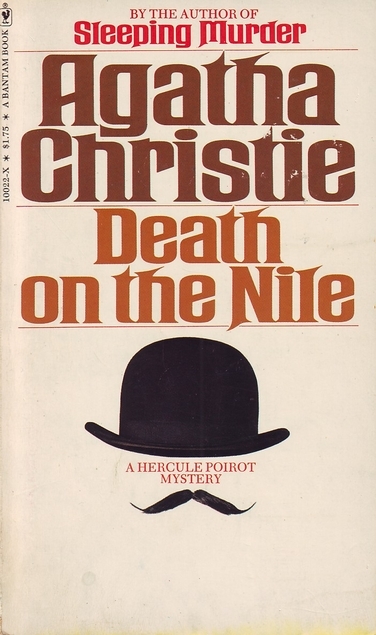
Death on the Nile
1937
Agatha Christie
Agatha Christie's most daring travel mystery. The tranquility of a lovely cruise along the Nile is shattered by the discovery that Linnet Ridgeway has been shot. She was young, stylish and beautiful, a girl who had everything – until she lost her life. Who is also on board? Christie's great detective Hercule Poirot is on holiday. He recalls an earlier outburst by a fellow passenger: ‘I’d like to put my dear little pistol against her head and just press the trigger.’ Despite the exotic setting, nothing is ever quite what it seems…
Candide
1759
Voltaire
Candide is the story of a gentle man who, though pummeled and slapped in every direction by fate, clings desperately to the belief that he lives in "the best of all possible worlds." On the surface a witty, bantering tale, this eighteenth-century classic is actually a savage, satiric thrust at the philosophical optimism that proclaims that all disaster and human suffering is part of a benevolent cosmic plan. Fast, funny, often outrageous, the French philosopher's immortal narrative takes Candide around the world to discover that—contrary to the teachings of his distinguished tutor Dr. Pangloss—all is not always for the best. Alive with wit, brilliance, and graceful storytelling, Candide has become Voltaire's most celebrated work.
The Duchess of Malfi
1614
John Webster
More widely studied and more frequently performed than ever before, John Webster's The Duchess of Malfi is here presented in an accessible and thoroughly up-to-date edition. Based on the Revels Plays text, the notes have been augmented to cast further light both on Webster's amazing dialogue and on the stage action. An entirely new introduction sets the tragedy in the context of pre-Civil War England and gives a revealing view of its imagery and dramatic action. From its well-documented early performances to the two productions seen in the West End of London in the 1995-96 season, a stage history gives an account of the play in performance. Students, actors, directors and theatre-goers will all find here a reappraisal of Webster's artistry in the greatest age of English theatre, which highlights why it has lived on stage with renewed force in the last decades of the twentieth century.
📅 Read 2012