Margins
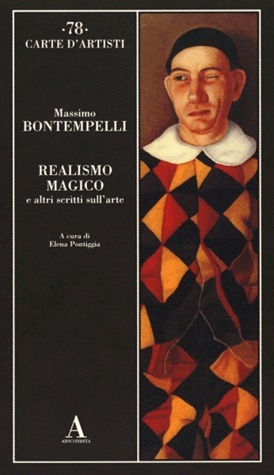
Realismo magico e altri scritti sull'arte book cover
Realismo magico e altri scritti sull'arte
2006
First Published
3.00
Average Rating
157
Number of Pages
«Massimo Bontempelli (Como 1878-Roma 1960) è stato il maggior non-critico d'arte italiano del Novecento. Infatti, pur tenendosi accuratamente lontano dai Critici Autentici, come lui stesso li chiamava ironicamente, anzi rivendicando una "appassionata incompetenza" nelle cose d'arte, ha definito, attraverso la teoria del realismo magico messa a punto alla metà degli anni venti, una poetica che rispecchia gran parte, e potremmo dire la miglior parte, della pittura e della scultura del suo tempo. Tante visioni smaltate, in cui tutto è così evidente da risultare inspiegabile; tante composizioni in cui non c'è nulla da capire e dove per questo non si capisce l'essenziale; tante immagini indimenticabili, insomma, dell'arte italiana fra le due guerre trovano un titolo, una definizione, un'interpretazione insuperata nel credo di Bontempelli: un "realismo preciso, avvolto in una atmosfera di stupore lucido". "Realismo magico e altri scritti sull'arte" raccoglie organicamente, per la prima volta, i suoi interventi, riunendo i testi più significativi sul realismo magico (usciti nel 1938 col titolo di "L'avventura novecentista") e su protagonisti dell'arte moderna come De Chirico, Carrà, Severini, Sironi, Morandi, De Pisis, Cagli, Arturo Martini e altri (apparsi nel 1950 in "Appassionata incompetenza. Note su cose d'arte"). Comun denominatore della poetica di Bontempelli è la volontà di evocare il mito e il mistero indagando la realtà, non eludendola. Perché la realtà ha già in sé l'oltre e l'altrove.»

Avg Rating
3.00
Number of Ratings
7
5 STARS
0%
4 STARS
43%
3 STARS
29%
2 STARS
14%
1 STARS
14%
goodreads

Author

Massimo Bontempelli
Massimo Bontempelli
Author · 10 books

Massimo Bontempelli was an Italian novelist, short story and theater writer, literary and art theorist and critic. Best known for coining the literary term Magical Realism and creating its theoretical framework. His efforts to implement this specific poetics in his writings begin after his initial experiments, first with traditional poetry (Carduccian classicism), then humorist, ironic stories (influenced by Pirandello) and short escapades in surrealism and futurism. Despite forming a literary model for Magic Realism with his own novels and short stories, Bontempelli's importance as a Magic Realist writer is mainly neglected and overthrown in contemporary theories on Magic Realism. Only few authors (mostly Italian authors but A. C. Hegerfeldt, A. B. Chanady, I. Guenther as well) acknowledge Bontempelli's significant role for the development of Magic Realism, but unfortunately, not all of them manage to go further then Franz Roh's and Alejo Carpentier's theories in the debate over the origin and literary use of the term. Bontempelli graduated from the University of Turin gaining two diplomas, in Classical Studies and in Philosophy. He worked as a journalist, teacher and served as an artillery officer during the First World War. In 1924 Bontempelli entered Mussolini's fascist movement and in the same year, together with his friend Luigi Pirandello, he founded Teatro degli Undici. In 1926, co-founded the literary review 900: Cahiers d'Italie en d'Europe with Curzio Malaparte. Despite Malaparte's abandoning the review even before the first issue was published, Bontempelli had succeeded, with the help of Nino Frank, to form an impressive editorial committee which included Max Jacob, André Malraux, Rainer Maria Rilke, and James Joyce and contributions from Pierre Mac Orlan, Philippe Soupault, Georg Kaiser, Ivan Goll and Ramòn Gomez de la Serna. In the first issue Bontempelli presented his theory of Novecentismo and Magic Realism and articulated literary positions that became points of reference in literature. In 1930 Bontempelli becomes a member of the Italian Academy. In 1938 Bontempelli was offered Attilio Momigliano' chair at the department for Italian Literature at the Florence University (which Momigliano was forced to give up because of the anti-Semitic legislation) but refused the position and was subsequently banished to Venice and censored by the regime because of his critic towards fascist leaders. In 1953 Massimo Bontempelli is awarded with Italy's highest literary award, the Strega Prize, for his collection of short stories L'amante fedele (The Faithful Lover).

548 Market St PMB 65688, San Francisco California 94104-5401 USA
© 2026 Paratext Inc. All rights reserved