Margins




548 Market St PMB 65688, San Francisco California 94104-5401 USA
© 2026 Paratext Inc. All rights reserved
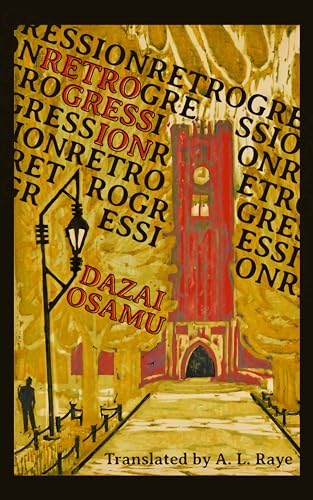
"Major credit must go to A. L. Raye for rendering Dazai’s Japanese in a vivid, sparking English." - Asymptote Journal “I’ll stab him! I thought. What an absolute scoundrel!” So Dazai wrote to Yasunari Kawabata, one of the judges for the first Akutagawa Prize, when his story Retrogression failed to win. Thus began what came to be known as the Akutagawa Prize Incident, which culminated in Dazai being forcibly hospitalised by one of the judges. A collection of intertwined autobiographical tales from the author’s life, Retrogression starts with the protagonist’s death as an ‘old man’ of twenty-five and regresses back through a life of sin and decadence.This book pieces together the fractured and disorderly lifestyle of one of history’s greatest romantics and pairs it with a particular moment in his life; losing the Akutagawa Prize. The ensuing drama that unfolded through private letters, newspaper articles, diaries, obituaries and fiction created a scandal that disturbed the early Shōwa literati with its coarse and indecent honesty. Dazai’s fiction, fiction written about Dazai, speculation and reality intertwined to create an explosive event that not only changed the desired trajectory of his life but also raised issues of discrimination within prominent literary circles and the treatment of mental illness in 1930s Japan. Retrogression Diary of My Distress Human Lost Various letters written both to and from Dazai Two articles written about Dazai by his mentor, Satō Haruo Excerpts from the Akutagawa Prize selection committee ...As well as extensive cultural notes and annotations. ——- Osamu Dazai was born in Aomori prefecture, Japan, in 1909. After dropping out of Tokyo Imperial University and eloping with a geisha, Oyama Hatsuyo, he was disowned by his family. Having been accustomed to a generous stipend as a student (a monthly payment of 150 yen, the same as the salary of one of his professors), his newly reduced income drove him into a crisis. He attempted a double suicide with his lover Shimeko Tanabe. She died, he survived, and just a few years later he wrote 'Retrogression', a short collection of four intertwining stories_. Autobiographical in nature, it gives us a glimpse into his life until that point. Infamously, he submitted 'Retrogression' for the first Akutagawa Prize and lost, subsequently sending the judges – including the Nobel prize-winning Yasunari Kawabata – several letters begging for both the award and for money.A. L. Raye is a Fellow of the Royal Asiatic Society and Editor of the bilingual Welsh and English literary magazine Gwyllion. They run YobanashiCafé_, an open access translation project creating English translations of public domain Japanese classics under a Creative Commons licence. They obtained an MPhil in Classical Indian Religion from the University of Oxford.