


Margins
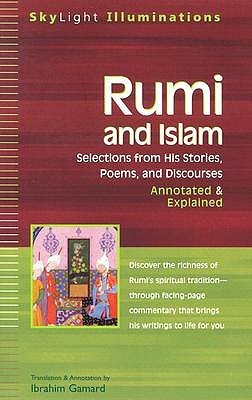
Rumi and Islam book cover
Rumi and Islam
Selections from His Stories, Poems, and Discourses--Annotated & Explained
2004
First Published
4.05
Average Rating
240
Number of Pages

Discover the richness of Rumi's spiritual tradition―through facing-page commentary that brings his writings to life for you. "This book you are now holding is a selection of what I believe are the best of Rumi’s accounts of the compassionate actions, sayings, and qualities of the Prophet, which include Rumi’s own inspired comments and explanations. It is my hope that you will be surprised and uplifted by the profound wisdom that Jalaluddin Rumi conveys through these stories and sayings." ―from the Preface This great Sufi poet and teacher can become a companion for your own spiritual journey. The lyric and wisdom poetry of Mawlana Jalaluddin Rumi has been an inspiration throughout the Middle East and Asia for over seven hundred years. Recently, it has also become popular in Western countries through translations and interpretive poetic versions in English. But while popular renderings have created the appreciation of Rumi the mystic, there is little understanding today of the religious and spiritual traditions from which the great mystic came. Rumi and Islam―Selections from His Stories, Poems, and Discourses examines not the popularized Rumi of universal love but the Sufi disciple whose works express deep reverence for the Prophet Muhammad. Ibrahim Gamard focuses on Rumi’s place within the Sufi tradition of Islam, as one of the greatest Muslim followers of the Prophet Muhammed, and on the Islamic foundations of his lover-Beloved mystical poetry. By probing verse by verse Rumi’s spiritual teachings, Gamard provides insight into the mystical side of the Qur’an and Islam, a religion that holds a deep love of God at its core. Now you can experience the profound and uplifting wisdom of Rumi even if you have no previous knowledge of Sufism or Islam. This SkyLight Illuminations edition presents the most important of Rumi’s writings, mainly from the Mathnawi, with insightful yet unobtrusive commentary that conveys how his teachings about the nature of love for God and God’s love for us can increase our understanding of Islamic wisdom in the West.
Avg Rating
4.05
Number of Ratings
22
5 STARS
45%
4 STARS
32%
3 STARS
14%
2 STARS
0%
1 STARS
9%
goodreads

Authors

Rumi
Rumi
Author · 119 books

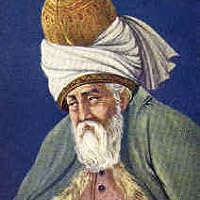
Sufism inspired writings of Persian poet and mystic Jalal ad-Din Muhammad ar-Rumi; these writings express the longing of the soul for union with the divine. Jalāl ad-Dīn Muhammad Rūmī - also known as Jalāl ad-Dīn Muhammad Balkhī, Mevlânâ/Mawlānā (مولانا, "our master"), Mevlevî/Mawlawī (مولوی, "my master") and more popularly simply as Rumi - was a 13th-century Persian poet, jurist, Islamic scholar, theologian and Sufi mystic who lived in Konya, a city of Ottoman Empire (Today's Turkey). His poems have been widely translated into many of the world's languages, and he has been described as the most popular poet and the best-selling poet in the United States. His poetry has influenced Persian literature, but also Turkish, Ottoman Turkish, Azerbaijani, Punjabi, Hindi, and Urdu, as well as the literature of some other Turkic, Iranian, and Indo-Aryan languages including Chagatai, Pashto, and Bengali. Due to quarrels between different dynasties in Khorāṣān, opposition to the Khwarizmid Shahs who were considered devious by his father, Bahā ud-Dīn Wālad or fear of the impending Mongol cataclysm, his father decided to migrate westwards, eventually settling in the Anatolian city Konya, where he lived most of his life, composed one of the crowning glories of Persian literature, and profoundly affected the culture of the area. When his father died, Rumi, aged 25, inherited his position as the head of an Islamic school. One of Baha' ud-Din's students, Sayyed Burhan ud-Din Muhaqqiq Termazi, continued to train Rumi in the Shariah as well as the Tariqa, especially that of Rumi's father. For nine years, Rumi practised Sufism as a disciple of Burhan ud-Din until the latter died in 1240 or 1241. Rumi's public life then began: he became an Islamic Jurist, issuing fatwas and giving sermons in the mosques of Konya. He also served as a Molvi (Islamic teacher) and taught his adherents in the madrassa. During this period, Rumi also travelled to Damascus and is said to have spent four years there. It was his meeting with the dervish Shams-e Tabrizi on 15 November 1244 that completely changed his life. From an accomplished teacher and jurist, Rumi was transformed into an ascetic. On the night of 5 December 1248, as Rumi and Shams were talking, Shams was called to the back door. He went out, never to be seen again. Rumi's love for, and his bereavement at the death of, Shams found their expression in an outpouring of lyric poems, Divan-e Shams-e Tabrizi. He himself went out searching for Shams and journeyed again to Damascus. Rumi found another companion in Salaḥ ud-Din-e Zarkub, a goldsmith. After Salah ud-Din's death, Rumi's scribe and favourite student, Hussam-e Chalabi, assumed the role of Rumi's companion. Hussam implored Rumi to write more. Rumi spent the next 12 years of his life in Anatolia dictating the six volumes of this masterwork, the Masnavi, to Hussam. In December 1273, Rumi fell ill and died on the 17th of December in Konya.

548 Market St PMB 65688, San Francisco California 94104-5401 USA
© 2026 Paratext Inc. All rights reserved