Margins
Margins
Sign in
Margins
Subscribe to our newsletter
548 Market St PMB 65688, San Francisco California 94104-5401 USA
hello@margins.app
·
+1 (650) 223-5283
Privacy Policy
·
Terms of Use
© 2026 Paratext Inc. All rights reserved
📚 Russia
📚
Russia
A Hero of Our Time
1839
Mikhail Lermontov
In its adventurous happenings, its abductions, duels, and sexual intrigues, A Hero of Our Time looks backward to the tales of Sir Walter Scott and Lord Byron, so beloved by Russian society in the 1820s and '30s. In the character of its protagonist, Pechorin, the archetypal Russian antihero, Lermontov's novel looks forward to the subsequent glories and passion of Russian literature that it helped, in great measure, to make possible.
What Men Live By
1885
Leo Tolstoy
Websters paperbacks take advantage of the fact that classics are frequently assigned readings in English courses. By using a running English-to-French thesaurus at the bottom of each page, this edition of What Men Live By by Leo Tolstoy was edited for three audiences. The first includes French-speaking students enrolled in an English Language Program (ELP), an English as a Foreign Language (EFL) program, an English as a Second Language Program (ESL), or in a TOEFL or TOEIC preparation program. The second audience includes English-speaking students enrolled in bilingual education programs or French speakers enrolled in English-speaking schools. The third audience consists of students who are actively building their vocabularies in French in order to take foreign service, translation certification, Advanced Placement (AP) or similar examinations. By using the Webster's French Thesaurus Edition when assigned for an English course, the reader can enrich their vocabulary in anticipation of an examination in French or English.TOEFL, TOEIC, AP and Advanced Placement are trademarks of the Educational Testing Service which has neither reviewed nor endorsed this book. All rights reserved.Websters edition of this classic is organized to expose the reader to a maximum number of difficult and potentially ambiguous English words. Rare or idiosyncratic words and expressions are given lower priority compared to difficult, yet commonly used words. Rather than supply a single translation, many words are translated for a variety of meanings in French, allowing readers to better grasp the ambiguity of English, and avoid them using the notes as a pure translation crutch. Having the reader decipher a wordsmeaning within context serves to improve vocabulary retention and understanding. Each page covers words not already highlighted on previous pages. If a difficult word is
The Overcoat
1842
Nikolai Gogol
The Overcoat which is generally acknowledged as the finest of Gogol's memorable Saint Petersburg stories, is a tale of the absurd and misplaced obsessions.
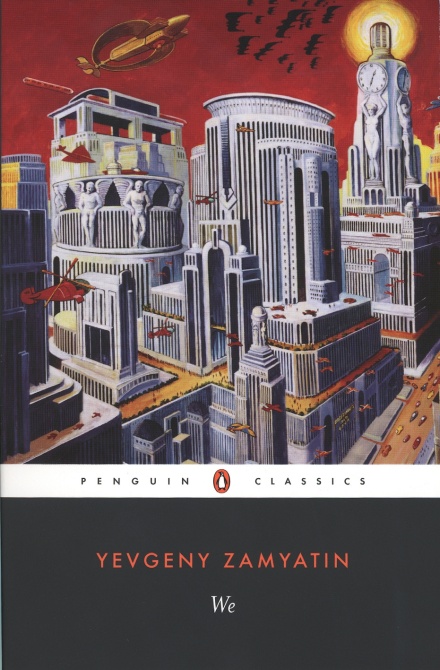
We
1924
Yevgeny Zamyatin
The exhilarating dystopian novel that inspired George Orwell's 1984 and foreshadowed the worst excesses of Soviet Russia Yevgeny Zamyatin's We is a powerfully inventive vision that has influenced writers from George Orwell to Ayn Rand. In a glass-enclosed city of absolute straight lines, ruled over by the all-powerful 'Benefactor', the citizens of the totalitarian society of OneState live out lives devoid of passion and creativity - until D-503, a mathematician who dreams in numbers, makes a discovery: he has an individual soul. Set in the twenty-sixth century AD, We is the classic dystopian novel and was the forerunner of works such as George Orwell's 1984 and Aldous Huxley's Brave New World. It was suppressed for many years in Russia and remains a resounding cry for individual freedom, yet is also a powerful, exciting and vivid work of science fiction. Clarence Brown's brilliant translation is based on the corrected text of the novel, first published in Russia in 1988 after more than sixty years' suppression.
The Amphibian
1928
Alexander Belyaev
The Amphibian will throw you back to a time when skin and deep-sea diving had not yet made the Silent World begin yielding up its secrets on a really big scale, as aqualung and snorkel are doing today, and present to you Alexander Belayev's 1928 prevision of the ocean mastered by mankind. Sea-devil has appeared in the Rio de la Plata. Weird cries out at sea, slashed fishermen's nets, glimpses of a most queer creature astride a dolphin leave no room for doubt. The Spaniard Zurita, greed overcoming his superstition, tries to catch Sea-devil and force it to pearl-dive for him but fails. On a lonely stretch of shore, not far from Buenos Aires, Dr. Salvator lives in seclusion behind a high wall, whose steel-plated gates only open to let in his Indian patients. The Indians revere him as a God but Zurita has a hunch that the God on land and the devil in the sea have something in common. Enlisting the help of two wily Araucanian brothers he sets out to probe the mystery. As action shifts from the bottom of the sea to the Spaniard's schooner The Jellyfish and back again, with interludes in sun-drenched Buenos Aires and countryside, the mystery of Ichthyander the sea-devil is unfolded before the reader in a narrative as gripping as it informative.
White Nights
1848
Fyodor Dostoevsky
White Nights is a short story by Fyodor Dostoevsky that was published in 1848. Set in St. Petersburg, it is the story of a young man fighting his inner restlessness. A light and tender narrative, it delves into the torment and guilt of unrequited love. Both protagonists suffer from a deep sense of alienation that initially brings them together. A blend of romanticism and realism, the story appeals gently to the senses and feelings.