Margins
Margins
Sign in
Margins
Subscribe to our newsletter
548 Market St PMB 65688, San Francisco California 94104-5401 USA
hello@margins.app
·
+1 (650) 223-5283
Privacy Policy
·
Terms of Use
© 2026 Paratext Inc. All rights reserved
📚
Russian Literature
La muerte de Iván Ilich
1886
León Tolstói
Hailed as one of the world's supreme masterpieces on the subject of death and dying, The Death of Ivan Ilyich is the story of a worldly careerist, a high court judge who has never given the inevitability of his dying so much as a passing thought. But one day, death announces itself to him, and to his shocked surprise, he is brought face to face with his own mortality. How, Tolstoy asks, does an unreflective man confront his one and only moment of truth? This short novel was an artistic culmination of a profound spiritual crisis in Tolstoy's life, a nine-year period following the publication of Anna Karenina during which he wrote not a word of fiction. A thoroughly absorbing, and, at times, terrifying glimpse into the abyss of death, it is also a strong testament to the possibility of finding spiritual salvation.
Anna Karenina
1878
León Tolstói
Von vielen als der größte Roman der Welt gefeiert, bietet Anna Karenina ein weites Panorama des zeitgenössischen Lebens in Russland und der Menschheit im Allgemeinen. Darin nutzt Tolstoi seine intensive Vorstellungskraft, um einige der unvergesslichsten Figuren der gesamten Literatur zu schaffen. Anna ist eine kultivierte Frau, die ihre leere Existenz als Frau Karenins aufgibt und sich Graf Wronski zuwendet, um ihre leidenschaftliche Natur zu erfüllen – mit tragischen Folgen. Lewin spiegelt Tolstoi selbst wider und bringt oft die eigenen Ansichten und Überzeugungen des Autors zum Ausdruck. Durchgehend zieht Tolstoi keine moralische Lehre, sondern lädt uns lediglich ein, nicht zu urteilen, sondern zuzusehen. Wie Rosemary Edmonds bemerkt: „Er überlässt die wechselnden Muster des Kaleidoskops, um die Bedeutung der düsteren Worte nach dem Titel zur Geltung zu bringen: ‚Mein ist die Rache, ich will vergelten.‘“
Guerra y paz
1867
León Tolstói
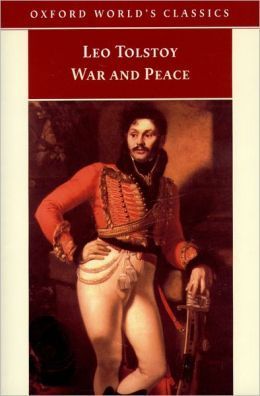
In Russia's struggle with Napoleon, Tolstoy saw a tragedy that involved all mankind. War and Peace broadly focuses on Napoleon’s invasion of Russia in 1812 and follows three of the most well-known characters in literature: Pierre Bezukhov, the illegitimate son of a count who is fighting for his inheritance and yearning for spiritual fulfillment; Prince Andrei Bolkonsky, who leaves his family behind to fight in the war against Napoleon; and Natasha Rostov, the beautiful young daughter of a nobleman who intrigues both men. As Napoleon’s army invades, Tolstoy brilliantly follows characters from diverse backgrounds—peasants and nobility, civilians and soldiers—as they struggle with the problems unique to their era, their history, and their culture. And as the novel progresses, these characters transcend their specificity, becoming some of the most moving—and human—figures in world literature. Tolstoy gave his personal approval to this translation, published here in a new single volume edition, which includes an introduction by Henry Gifford, and Tolstoy's important essay `Some Words about War and Peace'.
The Overcoat
1842
Nikolai Gogol
The Overcoat which is generally acknowledged as the finest of Gogol's memorable Saint Petersburg stories, is a tale of the absurd and misplaced obsessions.
Misdaad en straf
1866
Fjodor Dostojevskij
Raskolnikov, a destitute and desperate former student, wanders through the slums of St Petersburg and commits a random murder without remorse or regret. He imagines himself to be a great man, a Napoleon: acting for a higher purpose beyond conventional moral law. But as he embarks on a dangerous game of cat and mouse with a suspicious police investigator, Raskolnikov is pursued by the growing voice of his conscience and finds the noose of his own guilt tightening around his neck. Only Sonya, a downtrodden sex worker, can offer the chance of redemption.
Pères et fils
1862
Ivan Turguêniev
Bazarov—a gifted, impatient, and caustic young man—has journeyed from school to the home of his friend Arkady Kirsanov. But soon Bazarov’s outspoken rejection of authority and social conventions touches off quarrels, misunderstandings, and romantic entanglements that will utterly transform the Kirsanov household and reflect the changes taking place across all of nineteenth-century Russia. Fathers and Sons enraged the old and the young, reactionaries, romantics, and radicals alike when it was first published. At the same time, Turgenev won the acclaim of Flaubert, Maupassant, and Henry James for his craftsmanship as a writer and his psychological insight. Fathers and Sons is now considered one of the greatest novels of the nineteenth century. A timeless depiction of generational conflict during social upheaval, it vividly portrays the clash between the older Russian aristocracy and the youthful radicalism that foreshadowed the revolution to come—and offers modern-day readers much to reflect upon as they look around at their own tumultuous, ever changing world. Introduction by Jane Costlow
The Brothers Karamazov
1992
Fyodor Dostoyevsky
Notes from Underground & The Double
1864
Fjodor Dostojevskij
‘It is best to do nothing! The best thing is conscious inertia! So long live the underground!’Alienated from society and paralysed by a sense of his own insignificance, the anonymous narrator of Dostoyevsky’s groundbreaking Notes from Underground tells the story of his tortured life. With bitter sarcasm, he describes his refusal to become a worker in the ‘ant-hill’ of society and his gradual withdrawal to an existence ‘underground’. The seemingly ordinary world of St Petersburg takes on a nightmarish quality in The Double when a government clerk encounters a man who exactly resembles him – his double perhaps, or possibly the darker side of his own personality. Like Notes from Underground, this is a masterly study of human consciousness.Jessie Coulson’s introduction discusses the stories’ critical reception and the themes they share with Dostoyevksy’s great novels.
L'idiota
1869
Fjodor Dostojevskij
Returning to Russia from a sanitarium in Switzerland, the Christ-like epileptic Prince Myshkin finds himself enmeshed in a tangle of love, torn between two women—the notorious kept woman Nastasya and the pure Aglaia—both involved, in turn, with the corrupt, money-hungry Ganya. In the end, Myshkin’s honesty, goodness, and integrity are shown to be unequal to the moral emptiness of those around him. In her revision of the Garnett translation, Anna Brailovsky has corrected inaccuracies wrought by Garnett’s drastic anglicization of the novel, restoring as much as possible the syntactical structure of the original story.
📚 Russian Literature