Margins
Margins
Sign in
Margins
Subscribe to our newsletter
548 Market St PMB 65688, San Francisco California 94104-5401 USA
hello@margins.app
·
+1 (650) 223-5283
Privacy Policy
·
Terms of Use
© 2026 Paratext Inc. All rights reserved
📚 Russian
📚
Russian
Dead Souls
1842
Nikolai Gogol
Dead Souls is eloquent on some occasions, lyrical on others, and pious and reverent elsewhere. Nicolai Gogol was a master of the spoof. The American students of today are not the only readers who have been confused by him. Russian literary history records more divergent interpretations of Gogol than perhaps of any other classic. In a new translation of the comic classic of Russian literature, Chichikov, an enigmatic stranger and conniving schemer, buys deceased serfs' names from their landlords' poll tax lists hoping to mortgage them for profit and to reinvent himself as a likeable gentleman.
A Nasty Story
1862
Fyodor Dostoevsky
"A Nasty Story" (Russian: Скверный анекдот, Skverny anekdot), also translated as "A Disgraceful Affair", as well as "A Most Unfortunate Incident" and "An Unpleasant Predicament", is a satirical short story by Fyodor Dostoyevsky concerning the escapades of a Russian civil servant.
The Gambler
1866
Fyodor Dostoevsky
In this dark and compelling short novel, Dostoevsky tells the story of Alexey Ivanovitch, a young tutor working in the household of an imperious Russian general. Alexey tries to break through the wall of the established order in Russia, but instead becomes mired in the endless downward spiral of betting and loss. His intense and inescapable addiction is accentuated by his affair with the General’s cruel yet seductively adept niece, Polina. In The Gambler, Dostoevsky reaches the heights of drama with this stunning psychological portrait.
Stalingrad
1952
Vasily Grossman
Vasily Grossman’s Life and Fate has been hailed as a twentieth-century War and Peace. However, Life and Fate is only the second half of a two-part work, the first half of which was published in 1952. Grossman wanted to call this earlier work Stalingrad—as it will be in this first English translation—but it was published as For a Just Cause. The characters in both novels are largely the same and so is the story line; Life and Fate picks up where Stalingrad ends, in late September 1942. The first novel is in no way inferior to Life and Fate; the chapters about the Shaposhnikov family are both tender and witty, and the battle scenes are vivid and moving. One of the most memorable chapters of Life and Fate is the last letter written from a Jewish ghetto by Viktor Shtrum’s mother—a powerful lament for East European Jewry. The words of this letter do not appear in Stalingrad, yet the letter’s presence makes itself powerfully felt and it is mentioned many times. We learn who carries it across the front lines, who passes it on to whom, and how it eventually reaches Viktor. Grossman describes the difficulty Viktor experiences in reading it and his inability to talk about it even to his family. The absence of the letter itself is eloquent—as if its contents are too awful for anyone to take in.
Life and Fate
1960
Vasily Grossman
Life and Fate is an epic tale of a country told through the fate of a single family, the Shaposhnikovs. As the battle of Stalingrad looms, Grossman's characters must work out their destinies in a world torn apart by ideological tyranny and war. Completed in 1960 and then confiscated by the KGB, this sweeping panorama of Soviet society remained unpublished until it was smuggled into the West in 1980, where it was hailed as a masterpiece. Librarian's Note: This is an alternative cover edition of ISBN13: 9780099506164
White Nights
1848
Fyodor Dostoevsky
White Nights is a short story by Fyodor Dostoevsky that was published in 1848. Set in St. Petersburg, it is the story of a young man fighting his inner restlessness. A light and tender narrative, it delves into the torment and guilt of unrequited love. Both protagonists suffer from a deep sense of alienation that initially brings them together. A blend of romanticism and realism, the story appeals gently to the senses and feelings.
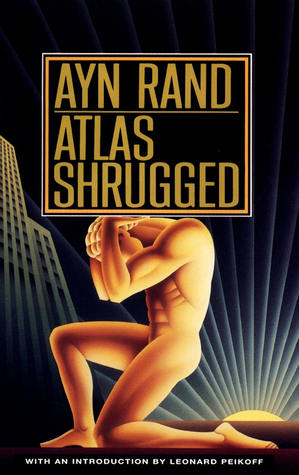
Atlas Shrugged
1957
Ayn Rand
This is the story of a man who said that he would stop the motor of the world and did. Was he a destroyer or the greatest of liberators? Why did he have to fight his battle, not against his enemies, but against those who needed him most, and his hardest battle against the woman he loved? What is the world’s motor—and the motive power of every man? You will know the answer to these questions when you discover the reason behind the baffling events that play havoc with the lives of the characters in this story. Tremendous in its scope, this novel presents an astounding panorama of human life—from the productive genius who becomes a worthless playboy—to the great steel industrialist who does not know that he is working for his own destruction—to the philosopher who becomes a pirate—to the composer who gives up his career on the night of his triumph—to the woman who runs a transcontinental railroad—to the lowest track worker in her Terminal tunnels. You must be prepared, when you read this novel, to check every premise at the root of your convictions. This is a mystery story, not about the murder—and rebirth—of man’s spirit. It is a philosophical revolution, told in the form of an action thriller of violent events, a ruthlessly brilliant plot structure and an irresistible suspense. Do you say this is impossible? Well, that is the first of your premises to check.
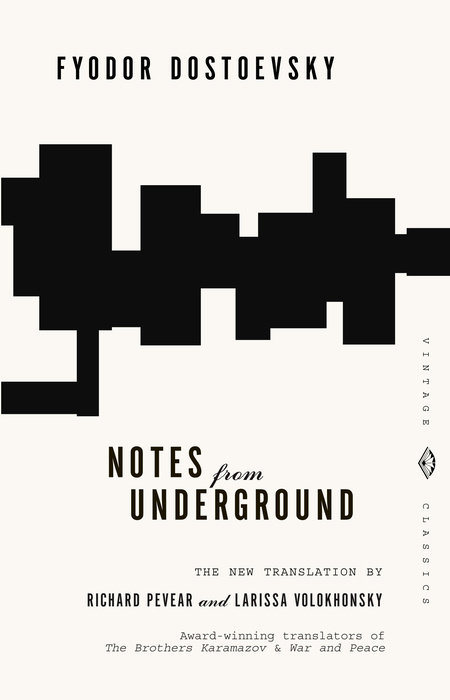
Notes from Underground
1864
Fyodor Dostoevsky
Dostoevsky’s most revolutionary novel, Notes from Underground marks the dividing line between nineteenth- and twentieth-century fiction, and between the visions of self each century embodied. One of the most remarkable characters in literature, the unnamed narrator is a former official who has defiantly withdrawn into an underground existence. In complete retreat from society, he scrawls a passionate, obsessive, self-contradictory narrative that serves as a devastating attack on social utopianism and an assertion of man’s essentially irrational nature. Richard Pevear and Larissa Volokhonsky, whose Dostoevsky translations have become the standard, give us a brilliantly faithful edition of this classic novel, conveying all the tragedy and tormented comedy of the original.
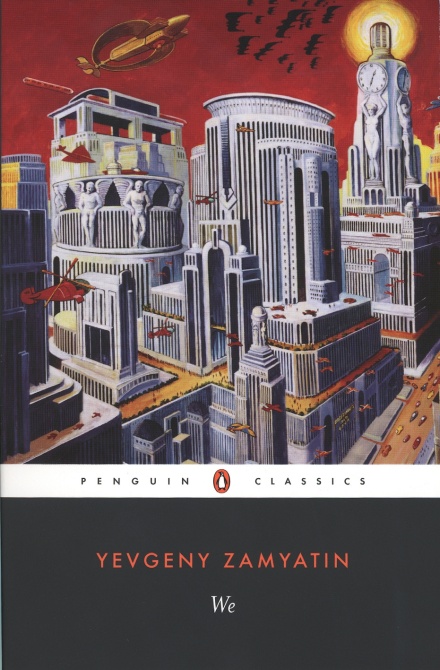
We
1924
Yevgeny Zamyatin
The exhilarating dystopian novel that inspired George Orwell's 1984 and foreshadowed the worst excesses of Soviet Russia Yevgeny Zamyatin's We is a powerfully inventive vision that has influenced writers from George Orwell to Ayn Rand. In a glass-enclosed city of absolute straight lines, ruled over by the all-powerful 'Benefactor', the citizens of the totalitarian society of OneState live out lives devoid of passion and creativity - until D-503, a mathematician who dreams in numbers, makes a discovery: he has an individual soul. Set in the twenty-sixth century AD, We is the classic dystopian novel and was the forerunner of works such as George Orwell's 1984 and Aldous Huxley's Brave New World. It was suppressed for many years in Russia and remains a resounding cry for individual freedom, yet is also a powerful, exciting and vivid work of science fiction. Clarence Brown's brilliant translation is based on the corrected text of the novel, first published in Russia in 1988 after more than sixty years' suppression.
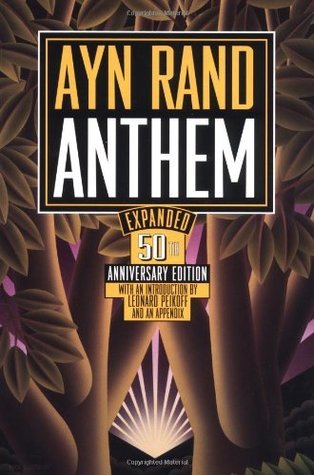
Anthem
1938
Ayn Rand
Anthem is Ayn Rand's classic tale of a dystopian future of the great "We"—a world that deprives individuals of a name or independence—that anticipates her later masterpieces, The Fountainhead and Atlas Shrugged. They existed only to serve the state. They were conceived in controlled Palaces of Mating. They died in the Home of the Useless. From cradle to grave, the crowd was one—the great WE. In all that was left of humanity, there was only one man who dared to think, seek, and love. He lived in the dark ages of the future. In a loveless world, he dared to love the woman of his choice. In an age that had lost all trace of science and civilization, he had the courage to seek and find knowledge. But these were not the crimes for which he would be hunted. He was marked for death because he had committed the unpardonable sin: He had stood forth from the mindless human herd. He was a man alone. He had rediscovered the lost and holy word—I. "I worship individuals for their highest possibilities as individuals, and I loathe humanity, for its failure to live up to these possibilities." —Ayn Rand