Margins
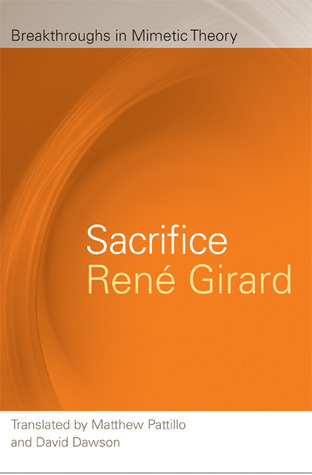
Sacrifice book cover
Sacrifice
2003
First Published
3.85
Average Rating
104
Number of Pages

In Sacrifice, René Girard interrogates the Brahmanas of Vedic India, exploring coincidences with mimetic theory that are too numerous and striking to be accidental. Even that which appears to be dissimilar fails to contradict mimetic theory, but instead corresponds to the minimum of illusion without which sacrifice becomes impossible. The Bible reveals collective violence, similar to that which generates sacrifice everywhere, but instead of making victims guilty, the Bible and the Gospels reveal the persecutors of a single victim. Instead of elaborating myths, they tell the truth absolutely contrary to the archaic sense. Once exposed, the single victim mechanism can no longer function as the model for would-be sacrificers. Recognizing that the Vedic tradition also converges on a revelation that discredits sacrifice, mimetic theory locates within sacrifice itself a paradoxical power of quiet reflection that leads, in the long run, to the eclipse of this institution which is violent but nevertheless fundamental to the development of human culture. Far from unduly privileging the Western tradition and awarding it a monopoly on the knowledge and repudiation of blood sacrifice, mimetic analysis recognizes comparable, but never truly identical, traits in the Vedic tradition.

Avg Rating
3.85
Number of Ratings
238
5 STARS
29%
4 STARS
36%
3 STARS
27%
2 STARS
6%
1 STARS
1%
goodreads

Author

Rene Girard
Rene Girard
Author · 25 books

René Girard was a French-born American historian, literary critic, and philosopher of social science whose work belongs to the tradition of anthropological philosophy. He was born in the southern French city of Avignon on Christmas day in 1923. Between 1943 and 1947, he studied in Paris at the École des Chartres, an institution for the training of archivists and historians, where he specialized in medieval history. In 1947 he went to Indiana University on a year’s fellowship and eventually made almost his entire career in the United States. He completed a PhD in history at Indiana University in 1950 but also began to teach literature, the field in which he would first make his reputation. He taught at Duke University and at Bryn Mawr before becoming a professor at Johns Hopkins in Baltimore. In 1971 he went to the State University of New York at Buffalo for five years, returned to Johns Hopkins, and then finished his academic career at Stanford University where he taught between 1981 and his retirement in 1995. Girard is the author of nearly thirty books, with his writings spanning many academic domains. Although the reception of his work is different in each of these areas, there is a growing body of secondary literature on his work and his influence on disciplines such as literary criticism, critical theory, anthropology, theology, psychology, mythology, sociology, economics, cultural studies, and philosophy.Girard’s fundamental ideas, which he has developed throughout his career and provide the foundation for his thinking, are that desire is mimetic (all of our desires are borrowed from other people), that all conflict originates in mimetic desire (mimetic rivalry), that the scapegoat mechanism is the origin of sacrifice and the foundation of human culture, and religion was necessary in human evolution to control the violence that can come from mimetic rivalry, and that the Bible reveals these ideas and denounces the scapegoat mechanism. In 1990, friends and colleagues of Girard’s established the Colloquium on Violence and Religion to further research and discussion about the themes of Girard’s work. The Colloquium meets annually either in Europe or the United States. René Girard died on November 4, 2015, at the age of 91 in Stanford.

548 Market St PMB 65688, San Francisco California 94104-5401 USA
© 2026 Paratext Inc. All rights reserved