Margins
Margins
Sign in
Margins
Subscribe to our newsletter
548 Market St PMB 65688, San Francisco California 94104-5401 USA
hello@margins.app
·
+1 (650) 223-5283
Privacy Policy
·
Terms of Use
© 2026 Paratext Inc. All rights reserved
📚 School reads
📚
School reads
Romeo and Juliet
1597
William Shakespeare
In Romeo and Juliet, Shakespeare creates a violent world, in which two young people fall in love. It is not simply that their families disapprove; the Montagues and the Capulets are engaged in a blood feud. In this death-filled setting, the movement from love at first sight to the lovers’ final union in death seems almost inevitable. And yet, this play set in an extraordinary world has become the quintessential story of young love. In part because of its exquisite language, it is easy to respond as if it were about all young lovers.
The Outsiders
1967
S.E. Hinton
The Outsiders is about two weeks in the life of a 14-year-old boy. The novel tells the story of Ponyboy Curtis and his struggles with right and wrong in a society in which he believes that he is an outsider. According to Ponyboy, there are two kinds of people in the world: greasers and socs. A soc (short for "social") has money, can get away with just about anything, and has an attitude longer than a limousine. A greaser, on the other hand, always lives on the outside and needs to watch his back. Ponyboy is a greaser, and he's always been proud of it, even willing to rumble against a gang of socs for the sake of his fellow greasers—until one terrible night when his friend Johnny kills a soc. The murder gets under Ponyboy's skin, causing his bifurcated world to crumble and teaching him that pain feels the same whether a soc or a greaser. Librarian note: This record is for one of the three editions published with different covers and with ISBN 0-140-38572-X / 978-0-14-038572-4. The records are for the 1988 cover (this record), the 1995 cover, and the 2008 cover which is also the current in-print cover.
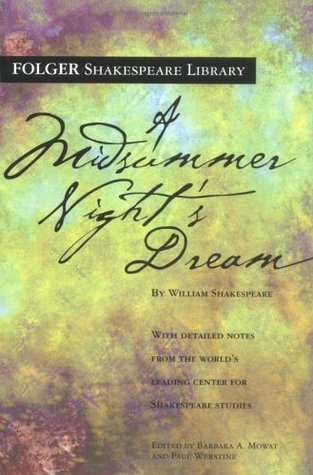
A Midsummer Night's Dream
1595
William Shakespeare
Shakespeare's intertwined love polygons begin to get complicated from the start—Demetrius and Lysander both want Hermia but she only has eyes for Lysander. Bad news is, Hermia's father wants Demetrius for a son-in-law. On the outside is Helena, whose unreturned love burns hot for Demetrius. Hermia and Lysander plan to flee from the city under cover of darkness but are pursued by an enraged Demetrius (who is himself pursued by an enraptured Helena). In the forest, unbeknownst to the mortals, Oberon and Titania (King and Queen of the faeries) are having a spat over a servant boy. The plot twists up when Oberon's head mischief-maker, Puck, runs loose with a flower which causes people to fall in love with the first thing they see upon waking. Throw in a group of labourers preparing a play for the Duke's wedding (one of whom is given a donkey's head and Titania for a lover by Puck) and the complications become fantastically funny.
The Tell-Tale Heart
1843
Edgar Allan Poe
A man confronts himself and an unknown listener with his desire to murder an old man. In this classic psychological thriller, the reader will find many more questions than answers. Even though this is one of Poe's shortest stories, nevertheless it has become one of his most highest regarded works. It is a profound and, at times, ambiguous investigation of the paranoia that may lie within the depths of one man's mind...
Lamb to the Slaughter
1953
Roald Dahl
"The room was warm and clean, the curtains drawn, the two table lamps alight – hers and the one by the empty chair opposite..." Lamb to the Slaughter (1953) is a short story by Roald Dahl. It was initially rejected, along with four other stories, by The New Yorker, but was ultimately published in Harper's Magazine in September 1953. It was adapted for an episode of Alfred Hitchcock Presents and starred Barbara Bel Geddes. Originally broadcast on April 13, 1958, it was one of only 17 AHP episodes directed by Hitchcock himself. The story was subsequently adapted for Dahl's British TV series Tales of the Unexpected. Dahl also included it in his short story compilation Someone Like You. Lamb to the Slaughter demonstrates Dahl's fascination with horror (including elements of black comedy), a theme that would influence both his in adult fiction as well as his children stories.
Fahrenheit 451
1953
Ray Bradbury
Sixty years after its original publication, Ray Bradbury’s internationally acclaimed novel Fahrenheit 451 stands as a classic of world literature set in a bleak, dystopian future. Today its message has grown more relevant than ever before. Guy Montag is a fireman. His job is to destroy the most illegal of commodities, the printed book, along with the houses in which they are hidden. Montag never questions the destruction and ruin his actions produce, returning each day to his bland life and wife, Mildred, who spends all day with her television “family.” But when he meets an eccentric young neighbor, Clarisse, who introduces him to a past where people didn’t live in fear and to a present where one sees the world through the ideas in books instead of the mindless chatter of television, Montag begins to question everything he has ever known.
The Raven
1845
Edgar Allan Poe
In Gustave Doré, one of the most prolific and successful book illustrators of the late 19h century, Edgar Allan Poe's renowned poem The Raven found perhaps its most perfect artistic interpreter. Doré's dreamlike, otherworldly style, tinged with melancholy, seems ideally matched to the bleak despair of Poe's celebrated work, among the most popular American poems ever written. This volume reprints all 26 of Doré's detailed, masterly engravings from a rare 19th-century edition of the poem. Relevant lines from the poem are printed on facing pages and the complete text is also included. Admirers of Doré will find ample evidence here of his characteristic ability to capture the mood and meaning of a work of literature in striking imagery; lovers of The Raven will delight in seeing its mournful musing on love and loss given dramatic pictorial form.
The Lottery
1948
Shirley Jackson
In a small American town, the local residents are abuzz with excitement and nervousness when they wake on the morning of the twenty-seventh of June. Everything has been prepared for the town’s annual tradition—a lottery in which every family must participate, and no one wants to win. “The Lottery” stands out as one of the most famous short stories in American literary history. Originally published in The New Yorker, the author immediately began receiving letters from readers who demanded an explanation of the story’s meaning. “The Lottery” has been adapted for stage, television, radio and film.
The Scarlet Ibis
1960
James Hurst
Our narrator, a grown man, tells us about his memories of Doodle, his younger brother. We jump into the past as the narrator begins his story about his brother. The narrator is six years old when Doodle is born. Doodle is a sickly child, and everyone but Aunt Nicey thinks he will die. Daddy even buys Doodle a coffin. When Doodle has lived for two months, Mama and Daddy name him William Armstrong. The narrator doesn't think the name suits him, so he nicknames him Doodle. This is a tragic short story following the narrator as he tries to teach his weak younger brother to walk and play like a normal boy. It was first published in The Atlantic Monthly and won the "Atlantic First" award.
The Crucible
1953
Arthur Miller
"I believe that the reader will discover here the essential nature of one of the strangest and most awful chapters in human history," Arthur Miller wrote of his classic play about the witch-hunts and trials in seventeenth-century Salem, Massachusetts. Based on historical people and real events, Miller's drama is a searing portrait of a community engulfed by hysteria. In the rigid theocracy of Salem, rumors that women are practicing witchcraft galvanize the town's most basic fears and suspicions; and when a young girl accuses Elizabeth Proctor of being a witch, self-righteous church leaders and townspeople insist that Elizabeth be brought to trial. The ruthlessness of the prosecutors and the eagerness of neighbor to testify against neighbor brilliantly illuminates the destructive power of socially sanctioned violence. Written in 1953, The Crucible is a mirror Miller uses to reflect the anti-communist hysteria inspired by Senator Joseph McCarthy's "witch-hunts" in the United States. Within the text itself, Miller contemplates the parallels, writing, "Political opposition... is given an inhumane overlay, which then justifies the abrogation of all normally applied customs of civilized behavior. A political policy is equated with moral right, and opposition to it with diabolical malevolence." WIth an introduction by Christopher Bigsby. (back cover)