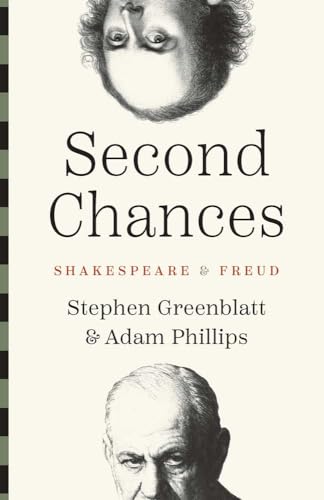



A powerful exploration of the human capacity for renewal, as seen through Shakespeare and Freud In this fresh investigation, Stephen Greenblatt and Adam Phillips explore how the second chance has been an essential feature of the literary imagination and a promise so central to our existence that we try to reproduce it again and again. Innumerable stories, from the Homeric epics to the New Testament, and from Oedipus Rex to Hamlet, explore the realization or failure of second chances—outcomes that depend on accident, acts of will, or fate. Such stories let us repeatedly rehearse the experience of loss and to know the joy that comes with a renewal of love and pleasure and to face the pain that comes with realizing that some damage can never be undone. Through a series of illuminating readings, the authors show how Shakespeare was the supreme virtuoso of the second chance and Freud was its supreme interpreter. Both Shakespeare and Freud believed that we can narrate our life stories as tales of transformation, of momentous shifts, constrained by time and place but often still possible. Ranging from The Comedy of Errors to The Winter’s Tale, and from D. W. Winnicott to Marcel Proust, the authors challenge readers to imagine how, as Phillips writes, “it is the mending that matters.”
Authors

Adam Phillips is a British psychotherapist and essayist. Since 2003 he has been the general editor of the new Penguin Modern Classics translations of Sigmund Freud. He is also a regular contributor to the London Review of Books. Phillips was born in Cardiff, Wales in 1954, the child of second-generation Polish Jews. He grew up as part of an extended family of aunts, uncles and cousins and describes his parents as "very consciously Jewish but not believing". As a child, his first interest was the study of tropical birds and it was not until adolescence that he developed an interest in literature. He went on to study English at St John's College, Oxford, graduating with a third class degree. His defining influences are literary – he was inspired to become a psychoanalyst after reading Carl Jung's autobiography and he has always believed psychoanalysis to be closer to poetry than medicine. Adapted from Wikipedia. Phillips is a regular contributor to the London Review of Books. He has been described by The Times as "the Martin Amis of British psychoanalysis" for his "brilliantly amusing and often profoundly unsettling" work; and by John Banville as "one of the finest prose stylists in the language, an Emerson of our time."

Stephen Greenblatt (Ph.D. Yale) is Cogan University Professor of English and American Literature and Language at Harvard University. Also General Editor of The Norton Anthology of English Literature, Eighth Edition, he is the author of nine books, including Will in the World: How Shakespeare Became Shakespeare; Hamlet in Purgatory; Practicing New Historicism; Marvelous Possessions: The Wonder of the New World; Learning to Curse: Essays in Early Modern Culture; and The Swerve: How the World Became Modern. He has edited six collections of criticism, is the co-author (with Charles Mee) of a play, Cardenio, and is a founding coeditor of the journal Representations. He honors include the MLA's James Russell Lowell Prize, for Shakespearean Negotiations: The Circulation of Social Energy in Renaissance England, the Distinguished Humanist Award from the Mellon Foundation, the Distinguished Teaching Award from the University of California, Berkeley. He is a fellow of the American Academy of Arts and Sciences and the American Philosophical Society. He lives in Cambridge, Massachusetts, and in Vermont. Stephen Jay Greenblatt is a Pulitzer Prize winning American literary critic, theorist and scholar. Greenblatt is regarded by many as one of the founders of New Historicism, a set of critical practices that he often refers to as "cultural poetics"; his works have been influential since the early 1980s when he introduced the term. Greenblatt has written and edited numerous books and articles relevant to new historicism, the study of culture, Renaissance studies and Shakespeare studies and is considered to be an expert in these fields. He is also co-founder of the literary-cultural journal Representations, which often publishes articles by new historicists. His most popular work is Will in the World, a biography of Shakespeare that was on the New York Times Best Seller List for nine weeks.