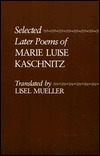
In spite of her renown in Germany: a distinguished poet as well as a writer of fiction and essays, Marie Luisc Kaschnitz (1901-1974) is scarcely recognized in the United States. This first book-length translation into English of her work makes available a selection of poems that date from the last two decades of her life and that articulate, in the translator's words, the slow, painful self-discoveries that come with time and suffering." Originally published in 1980. The Princeton Legacy Library uses the latest print-on-demand technology to again make available previously out-of-print books from the distinguished backlist of Princeton University Press. These editions preserve the original texts of these important books while presenting them in durable paperback and hardcover editions. The goal of the Princeton Legacy Library is to vastly increase access to the rich scholarly heritage found in the thousands of books published by Princeton University Press since its founding in 1905.
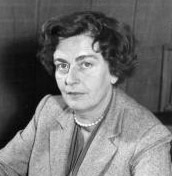
Author

Marie Luise Kaschnitz (born Marie Luise von Holzing-Berslett; 31 January 1901 – 10 October 1974) was a German short story writer, novelist, essayist and poet. She is considered to be one of the leading post-war German poets. She was born in Karlsruhe. She married archaeologist Guido Freiherr Von Kaschnitz-Weinberg (the author of The Mediterranean Foundations of Ancient Art) in 1925, and travelled with him on archaeological expeditions. She received high praise for her short stories, many of which were inspired by events in her life, complemented by her personal reminiscences. These stories were collected in books such as Orte and Engelsbrücke. She enjoyed travel greatly and her tales make use of diverse settings. They are thoughtful in nature, rather than eventful, often dealing with particular stages in a woman's life or a relationship. Her main collection is Lange Schatten ("Long Shadows"). Her favorite story was 1961's "Das dicke Kind". Her post-war essay collection in Menschen und Dinge 1945 established her reputation in Germany. Her poems dealt with the war and the early post-war period, often expressing a yearning for a peaceful past, but also hope for the future. In the volume Dein Schweigen - meine Stimme she dealt with the death of her husband. After 1960 she became influenced by Pablo Neruda. She briefly taught poetics at the University of Frankfurt. She was a member of PEN. She won many prizes, including the Georg Büchner Prize in 1955 and the Roswitha Prize in 1973. She died, aged 73, in Rome. The Marie Luise Kaschnitz Prize is named in her honor. (from Wikipedia)