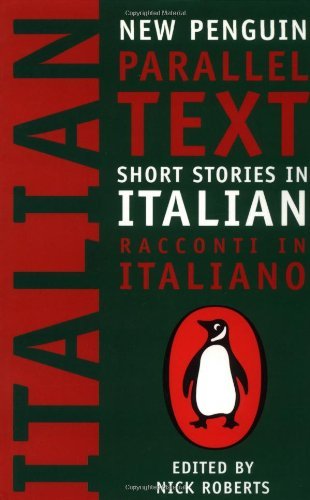

This is an all new version of the popular Parallel text series, containing nine pieces of contemporary fiction in the original Italian and in English translation. Including stories by Calvino, Benni, Sciascia and Levi, this volume gives a fascinating insight into Italian culture and literature as well as providing an invaluable educational tool. 1. The Long Crossing / Il lungo viaggio - Leonardo Sciascia 2. Italy / Italia - Goffredo Parise 3. The Girl with the Plait / La ragazza con la treccia - Dacia Marini 4. The Last Channel / L'ultimo canale - Italo Calvino 5. Lilith / Lilít - Primo Levi 6. The Island of Komodo / L'isola di Komodo - Susanna Tamaro
- Women by the Pool / Donne in piscina - Sandra Petrignani 8. A Naughty Schoolboy / Un cattivo scolaro - Stefano Benni 9. Saturday Afternoons / I pomeriggi del sabato - Antonio Tabucchi
Authors

Leonardo Sciascia (1921-1989) wrote of his unique Sicilian experience, linking families with political parties, the treachery of alliances and allegiances, and the calling of favours that resort in outcomes that are not for the benefit of society, but of those individuals who are in favour. Sciascia perhaps, in the end, wanted to prove that the corruption that was and is endemic in Italian society helps only those who are part of the secret societies and loyalties and the political classes.

Goffredo Parise è stato uno scrittore, giornalista, sceneggiatore, saggista e poeta italiano. Nasce a Vicenza l'8 dicembre del 1929; la mamma Ida Wanda Bertoli, ragazza madre, cerca con grandi sacrifici di riempire il vuoto della mancanza del padre. Nel 1937 muore il nonno e la madre sposa il giornalista Osvaldo Parise, direttore del «Giornale di Vicenza»; il piccolo Goffredo, sempre alla ricerca di una figura paterna, gli si affeziona ed è ricambiato e Parise dopo otto anni lo riconosce come figlio. Goffredo appena quindicenne partecipa alla resistenza in provincia di Vicenza; finita la guerra frequenta il liceo e in seguito si iscrive a vari indirizzi universitari senza arrivare mai ad una laurea (sarà laureato «ad honorem» solo nel 1986 dall'Università di Padova). Tramite alcune conoscenze il padre adottivo lo introduce al mondo della carta stampata. Goffredo incomincia a scrivere per quotidiani come «l'Alto Adige» di Bolzano, «l'Arena» di Verona e il «Corriere della Sera» e in questo periodo il giovane capisce la sua vera passione: l'inclinazione a scrivere storie. Parise nel 1950 si trasferisce a Venezia e in una stanza in affitto scrive il suo primo libro, il «cubista» Il ragazzo morto e le comete, pubblicato dall'amico Neri Pozza (il quale però suggerisce cambiamenti che Parise si rifiuta di fare). Dopo un'iniziale stroncatura sia dalla critica sia dal pubblico, Parise pubblica nel 1953 il libro La grande vacanza, con una lusinghiera recensione sul «Corriere della sera» di Eugenio Montale: «...affascinato dall'abilità di Parise e dal suo calarsi nell'infanzia senza modi nostalgici e crepuscolari»; questo libro viene definito nel 1968 da Carlo Bo autentica poesia. Nel 1953 si trasferisce a Milano, dove lavora alla casa editrice di Livio Garzanti, e dove conosce Leo Longanesi che lo incoraggia a continuare a scrivere. Con il romanzo Il prete bello (1954), lo scrittore acquisisce grande notorietà non solo in Italia, ma, con decine di traduzioni, anche all'estero. Intanto, è diventato amico di Eugenio Montale e Nico Naldini; si sposa il 29 agosto 1957 con Mariolina Sperotti, detta «Mariola», giovane vicentina. Testimone di nozze è l'amico Giovanni Comisso. Cominciano gli anni di spostamenti e viaggi. Tornando a Vicenza, incontra Guido Piovene, del quale diventa amico, scoprendo però di non voler più tornare nella sua città. Dopo una vacanza a Capri, è indeciso se tornare a Milano o a Venezia o andare a Roma, dove vive un altro amico, Carlo Emilio Gadda, del quale diventerà nel 1964 vicino di casa (in via della Camilluccia). Nel 1956 pubblica Il fidanzamento e nel 1959 Amore e fervore (che poi verrà intitolato Atti impuri). Nel 1961 fa un lungo viaggio in America, dove Dino De Laurentiis vorrebbe che scrivesse un film per il regista Gian Luigi Polidoro. È insieme colpito e deluso da New York, ma soprattutto è affascinato dai viaggi e, appena uscito Il padrone (1965), visita la Cina, il Laos, il Vietnam, la Malesia, e di nuovo New York, Londra, Parigi, Giacarta, Tokio, Mosca (reportage in parte raccolti postumi in Lontano). La "Casa delle Fate", nel Gonfo del Piave a Salgareda, è l'ultima dimora di Goffredo Parise. È ormai uno scrittore affermato e frequenta intellettuali, scrittori, registi e pittori nella Roma degli anni Sessanta. Ma i suoi punti di riferimento sono Gadda e Moravia, e poi nel 1963 ha incontrato Giosetta Fioroni che considera la sua nuova compagna (con la moglie il matrimonio è naufragato da tempo). In occasione de Il padrone è passato da Garzanti a Feltrinelli, e qui pubblica anche Il crematorio di Vienna (1969). Intanto ha scoperto una casa nel bosco di Salgareda, nel trevigiano, e riesce a trovare il modo per comprarla. Escono I sillabari, il primo volume nel 1972 presso Einaudi e il secondo nella collana «Medusa» di Arnoldo Mondadori Editore, che raramente pubblica italiani, ma nella quale Parise voleva essere incluso perché vi aveva letto i suoi amati Ernest Hemingway e William

Susanna Tamaro is an Italian novelist. Her second novel Per voce sola (Just For One Voice) won the International PEN Award and was translated into several languages. Her novel Va' dove ti porta il cuore (Follow your Heart) was an international bestseller and became the "Italian book most sold in the 20th century".

Primo Michele Levi (Italian: [ˈpriːmo ˈlɛːvi]) was a chemist and writer, the author of books, novels, short stories, essays, and poems. His unique 1975 work, The Periodic Table, linked to qualities of the elements, was named by the Royal Institution of Great Britain as the best science book ever written. Levi spent eleven months imprisoned at Monowitz, one of the three main camps in the Auschwitz concentration camp complex (record number: 174,517) before the camp was liberated by the Red Army on 18 January 1945. Of the 650 Italian Jews in his transport, Levi was one of only twenty who left the camps alive. The Primo Levi Center, dedicated "to studying the history and culture of Italian Jewry," was named in his honor.

Stefano Benni (born August 12, 1947 in Bologna) is an Italian satirical writer, poet and journalist. His books have been translated into around 20 foreign languages and scored notable commercial success. He sold 2,5 million copies of his books in Italy. He has contributed to Panorama (Italian magazine), Linus (magazine), La Repubblica, il manifesto among others. In 1989 he directed the film Musica per vecchi animali.

Italo Calvino was born in Cuba and grew up in Italy. He was a journalist and writer of short stories and novels. His best known works include the Our Ancestors trilogy (1952-1959), the Cosmicomics collection of short stories (1965), and the novels Invisible Cities (1972) and If On a Winter's Night a Traveler (1979). His style is not easy to classify; much of his writing has an air reminiscent to that of fantastical fairy tales (Our Ancestors, Cosmicomics), although sometimes his writing is more "realistic" and in the scenic mode of observation (Difficult Loves, for example). Some of his writing has been called postmodern, reflecting on literature and the act of reading, while some has been labeled magical realist, others fables, others simply "modern". He wrote: "My working method has more often than not involved the subtraction of weight. I have tried to remove weight, sometimes from people, sometimes from heavenly bodies, sometimes from cities; above all I have tried to remove weight from the structure of stories and from language."

Antonio Tabucchi was an Italian writer and academic who taught Portuguese language and literature at the University of Siena, Italy. Deeply in love with Portugal, he was an expert, critic and translator of the works of the writer Fernando Pessoa from whom he drew the conceptions of saudade, of fiction and of the heteronyms. Tabucchi was first introduced to Pessoa's works in the 1960s when attending the Sorbonne. He was so charmed that, back in Italy, he attended a course of Portuguese language for a better comprehension of the poet.