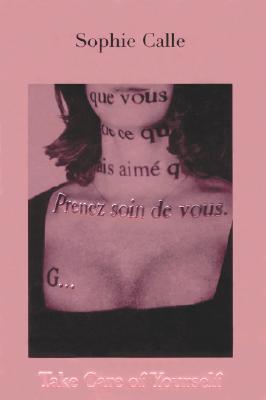
One hundred and seven women respond to Sophie Calle’s "breakup” email through the lens of their respective professions In this remarkable artist's book, French conceptual artist/provocateur Sophie Calle presents 107 outside interpretations of a "breakup" e-mail she received from her lover the day he ended their affair. Featuring a stamped pink metallic cover, multiple paper changes, special bound-in booklets, bright green envelopes containing DVDs and even Braille endpapers, it is a deeply poignant investigation of love and loss, published to coincide with the 2007 Venice Biennale—where Calle served as that fair's French representative. All of the interpreters of Calle's breakup letter were women, and each was asked to analyze the document according to her profession—so that a writer comments on its style, a justice issues judgment, a lawyer defends Calle's ex-lover, a psychoanalyst studies his psychology, a mediator tries to find a path towards reconciliation, a proofreader provides a literal edit of the text, etc. In addition, Calle asked a variety of performers, including Nathalie Dessay, Laurie Anderson and Carla Bruni, among others, to act the letter out. She filmed the singers and actresses and photographed the other contributors, so that each printed interpretation stands alongside at least one riveting image of its author, and some are also accompanied by digital documentation. The result is a fascinating study and a deeply moving experience—as well as an artwork in its own right. Already a collector's item, this is a universal document of how it feels to grieve for love.