Margins
Spheres book cover 1
Spheres book cover 2
Spheres book cover 3
Spheres
Series · 3 books · 1998-2004

Books in series

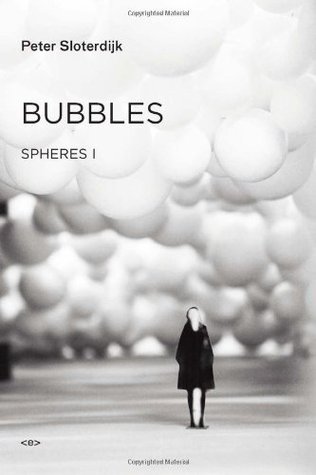
Bubbles book cover
#1

Bubbles

1998

An epic project in both size & purview, Sloterdijk's 3-volume, 2500-page Spheres is a late-20th-century bookend to Heidegger's Being & Time. Rejecting the century's predominant philosophical focus on temporality, Sloterdijk, self-described "student of the air," reinterprets the history of Western metaphysics as an inherently spatial & immunological project, from the discovery of self (bubble) to the exploration of world (globe) to the poetics of plurality (foam). Exploring macro- & micro-space from the Greek agora to contemporary urban apartments, he's able to synthesize, with immense erudition, the spatial theories of Aristotle, Descartes, Gaston Bachelard, Walter Benjamin & Georges Bataille into a morphology of shared, or multipolar, dwelling—identifying the question of being as one bound up with the aerial technology of architectonics & anthropogenesis. He describes Bubbles, Spheres' 1st volume, as a general theory of the structures that allow couplings—or as the book's original intended subtitle put it, an "archeology of the intimate." Bubbles includes a wide array of images, not to illustrate his discourse, but to offer a spatial & visual "parallel narrative" to his exploration of bubbles. Written over the course of a decade, the trilogy has waited another decade for its English translation from Semiotext(e). Volumes 2, Globes, & 3, Foam, will publish in coming seasons.

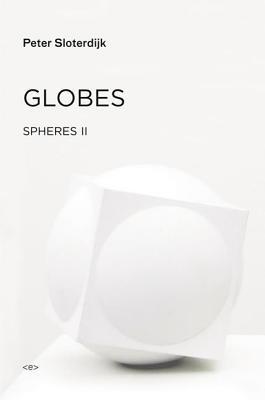
Globes book cover
#2

Globes

Spheres Volume II: Macrospherology (Semiotext

1999

The second, and longest, volume in Peter Sloterdijk's celebrated Spheres trilogy, on the world history and philosophy of globalization. All history is the history of struggles for spheric expansion.—from Globes In Globes—the second, and longest, volume in Peter Sloterdijk's celebrated magnum opus Spheres trilogy—the author attempts nothing less than to uncover the philosophical foundations of the political history—the history of humanity—of the last two thousand years. The first, well-received volume of the author's Spheres trilogy, Bubbles, dealt with microspheres: the fact that individuals, from the fetal stage to childhood, are never alone, because they always incorporate the Other into themselves and align themselves with it. With Globes, Sloterdijk opens up a history of the political world using the morphological models of the orb and the globe, and argues that all previous statements about globalization have suffered from shortsightedness. For him, globalization begins with the ancient Greeks, who represented the whole world through the shape of the orb. With the discovery of America and the first circumnavigations of the earth, the orb was replaced by the globe. This second globalization is currently giving way to the third, which we are living through today, as the general virtuality of all conditions leads to a growing spatial crisis. Peter Sloterdijk tells here the true story of globalization: from the geometrization of the sky in Plato and Aristotle to the circumnavigation of the last orb—the earth—by ships, capital, and signals.
Foams book cover
#3

Foams

Spheres Volume III: Plural Spherology (Semiotext

2004

The final volume in Peter Sloterdijk's celebrated Spheres trilogy, on the phenomenology of community and its spatial peripheries. “So the One Orb has imploded—now the foams are alive."—from Foams Foams completes Peter Sloterdijk's celebrated Spheres trilogy: his 2,500-page “grand narrative” retelling of the history of humanity, as related through the anthropological concept of the "Sphere." For Sloterdijk, life is a matter of form and, in life, sphere formation and thought are two different labels for the same thing. The trilogy also offers his corrective answer to Martin Heidegger's Being and Time, reformulating it into a lengthy meditation on Being and Space—a shifting of the question of who we are to a more fundamental question of where we are. In this final volume, Sloterdijk's “plural spherology” moves from the historical perspective on humanity of the preceding two volumes to a philosophical theory of our contemporary era, offering a view of life through a multifocal lens. If Bubbles was Sloterdijk's phenomenology of intimacy, and Globes his phenomenology of globalization, Foams could be described as his phenomenology of spatial plurality: how the bubbles that we form in our duality bind together to form what sociological tradition calls "society." Foams is an exploration of capsules, islands, and hothouses that leads to the discovery of the foam city. The Spheres trilogy ultimately presents a theology without a God—a spatial theology that requires no God, whose death therefore need not be of concern. As with the two preceding volumes, Foams can be read on its own or in relation to the rest of the trilogy.

Author

Peter Sloterdijk
Peter Sloterdijk
Author · 35 books

Peter Sloterdijk is a German philosopher, cultural theorist, television host and columnist. He is a professor of philosophy and media theory at the University of Art and Design Karlsruhe. Peter Sloterdijk studied philosophy, Germanistics and history at the University of Munich. In 1975 he received his Ph.D. from the University of Hamburg. Since 1980 he has published many philosophical works, including the Critique of Cynical Reason. In 2001 he was named president of the State Academy of Design, part of the Center for Art and Media in Karlsruhe. In 2002 he began to co-host Das Philosophische Quartett, a show on the German ZDF television channel devoted to discussing key issues affecting present-day society. The Kritik der Zynischen Vernunft (Critique of Cynical Reason), published by Suhrkamp in 1983, became the best-selling philosophical book in the German language since the Second World War and launched Sloterdijk's career as an author. The trilogy Spheres is the philosopher's magnum opus. The first volume was published in 1998, the second in 1999, and the last in 2004.

548 Market St PMB 65688, San Francisco California 94104-5401 USA
© 2026 Paratext Inc. All rights reserved
Spheres