


Margins
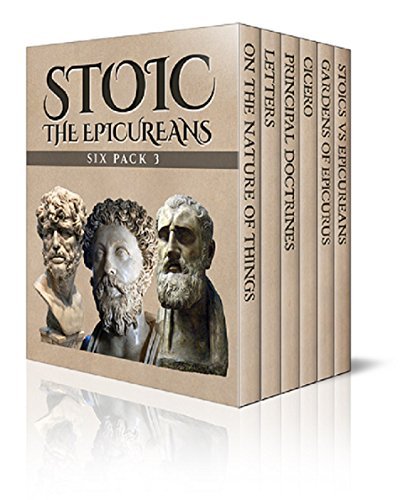
Stoic Six Pack 3 book cover
Stoic Six Pack 3
The Epicureans
2015
First Published
3.83
Average Rating
340
Number of Pages

“It is folly for a man to pray to the gods for that which he has the power to obtain by himself.” - Epicurus. Founded in the fourth century BC, Epicureanism was the main alternative philosophy to Stoicism. Based upon the teachings of Greek philosopher Epicurus, the philosophy propounded an ethic of individual pleasure as the sole or chief good in life. Epicurus advocated living in such a way as to derive the greatest amount of pleasure possible during one's lifetime, yet doing so moderately in order to avoid the suffering incurred by overindulgence in such pleasure. It is not the same as hedonism which advocates the partaking in fleeting pleasures such as constant partying, sexual excess and decadent food. Epicurus considered prudence an important virtue and perceived excess and overindulgence to be contrary to the attainment of true happiness. The emphasis was placed on pleasures of the mind rather than on physical pleasures. For Epicurus, who you dine with is more important than what you eat. Epicurus lived a celibate life but did not impose this restriction on his followers. He ran a school from his home called The Garden, a small but prestigious gathering that emphasized friendship as an important ingredient of happiness. It was a sophisticated place by Athenian standards, counting women and slaves among its members and it was the first recorded organization to make vegetarianism a way of life. The school's popularity grew and it became, along with Stoicism and Skepticism, one of the three dominant schools of Hellenistic Philosophy. Epicureanism flourished for seven centuries. toic Six Pack 3: The Epicureans brings together six Epicurean The Letters of Epicurus Principal Doctrines of Epicurus De Finibus Bonorum et Malorum by Cicero On The Nature of Things by Lucretius Upon The Gardens of Epicurus by William Temple Stoics vs Epicureans by Robert Drew Hicks These six texts provide a full introduction to Epicureanism from Epicurus himself in Letters and Principal Doctrines, perspective from perhaps the most articulate Roman of all, Cicero, in De Finibus Bonorum et Malorum, poetic elucidation from Lucretius in On The Nature of Things, analysis from English philosopher William Temple in Upon The Gardens of Epicurus and a direct comparison of Epicureanism with Stoicism in Robert Hicks’ lively essay Stoics vs Epicureans . Thomas Jefferson referred to himself as an Epicurean. It is reasonable to infer that Epicurus had an influence on the founding father when he penned the immortal phrase "… life, liberty and the pursuit of happiness." More recently, Stephen Greenblatt, in his best selling book The Swerve, identified himself as strongly sympathetic to Epicureanism.
Avg Rating
3.83
Number of Ratings
59
5 STARS
32%
4 STARS
32%
3 STARS
24%
2 STARS
10%
1 STARS
2%
goodreads

Author

Epicurus
Epicurus
Author · 24 books

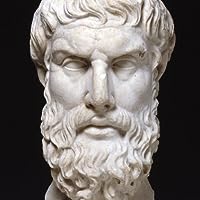
Epicurus (Greek: Ἐπίκουρος, Epikouros, "upon youth"; Samos, 341 BCE – Athens, 270 BCE; 72 years) was an ancient Greek philosopher and the founder of the school of philosophy called Epicureanism. Only a few fragments and letters remain of Epicurus' 300 written works. Much of what is known about Epicurean philosophy derives from later followers and commentators. For Epicurus, the purpose of philosophy was to attain the happy, tranquil life, characterized by aponia, the absence of pain and fear, and by living a self-sufficient life surrounded by friends. He taught that pleasure and pain are the measures of what is good and bad, that death is the end of the body and the soul and should therefore not be feared, that the gods do not reward or punish humans, that the universe is infinite and eternal, and that events in the world are ultimately based on the motions and interactions of atoms moving in empty space. His parents, Neocles and Chaerestrate, both Athenian citizens, had immigrated to the Athenian settlement on the Aegean island of Samos about ten years before Epicurus' birth in February 341 BCE. As a boy he studied philosophy for four years under the Platonist teacher Pamphilus. At the age of 18 he went to Athens for his two-year term of military service. The playwright Menander served in the same age-class of the ephebes as Epicurus. After the death of Alexander the Great, Perdiccas expelled the Athenian settlers on Samos to Colophon. After the completion of his military service, Epicurus joined his family there. He studied under Nausiphanes, who followed the teachings of Democritus. In 311/310 BC Epicurus taught in Mytilene but caused strife and was forced to leave. He then founded a school in Lampsacus before returning to Athens in 306 BC. There he founded The Garden, a school named for the garden he owned about halfway between the Stoa and the Academy that served as the school's meeting place. Even though many of his teachings were heavily influenced by earlier thinkers, especially by Democritus, he differed in a significant way with Democritus on determinism. Epicurus would often deny this influence, denounce other philosophers as confused, and claim to be "self-taught". Epicurus never married and had no known children. He suffered from kidney stones, to which he finally succumbed in 270 BCE at the age of 72, and despite the prolonged pain involved, he wrote to Idomeneus: "I have written this letter to you on a happy day to me, which is also the last day of my life. For I have been attacked by a painful inability to urinate, and also dysentery, so violent that nothing can be added to the violence of my sufferings. But the cheerfulness of my mind, which comes from the recollection of all my philosophical contemplation, counterbalances all these afflictions. And I beg you to take care of the children of Metrodorus, in a manner worthy of the devotion shown by the young man to me, and to philosophy." -http://en.wikipedia.org/wiki/Epicurus

548 Market St PMB 65688, San Francisco California 94104-5401 USA
© 2026 Paratext Inc. All rights reserved