Margins
Texas Film and Media Studies book cover 1
Texas Film and Media Studies book cover 2
Texas Film and Media Studies book cover 3
Texas Film and Media Studies
Series · 3 books · 1993-2009

Books in series

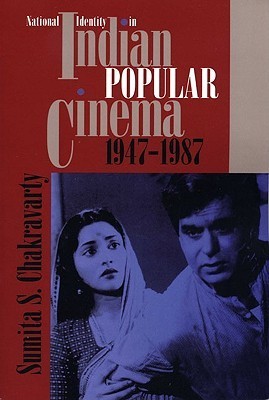
National Identity in Indian Popular Cinema, 1947-1987 book cover
#8

National Identity in Indian Popular Cinema, 1947-1987

1993

Although Indian popular cinema has a long history and is familiar to audiences around the world, it has rarely been systematically studied. This book offers the first detailed account of the popular film as it has grown and changed during the tumultuous decades of Indian nationhood. The study focuses on the cinema’s characteristic forms, its range of meanings and pleasures, and, above all, its ideological construction of Indian national identity. Informed by theoretical developments in film theory, cultural studies, postcolonial discourse, and “Third World” cinema, the book identifies the major genres and movements within Bombay cinema since Independence and uses them to enter larger cultural debates about questions of identity, authenticity, citizenship, and collectivity. Chakravarty examines numerous films of the period, including Guide (Vijay Anand, 1965), Shri 420 \[The gentleman cheat\] (Raj Kapoor, 1955), and Bhumika \[The role\] (Shyam Benegal, 1977). She shows how “imperso- nation,” played out in masquerade and disguise, has characterized the representation of national identity in popular films, so that concerns and conflicts over class, communal, and regional differences are obsessively evoked, explored, and neutralized. These findings will be of interest to film and area specialists, as well as general readers in film studies.

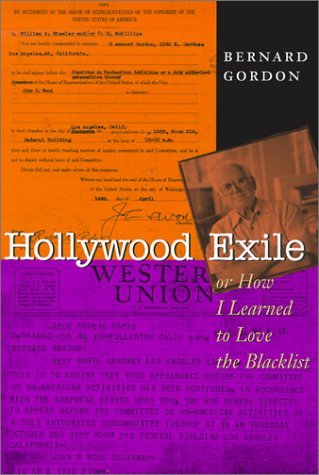
Hollywood Exile, or How I Learned to Love the Blacklist book cover
#15

Hollywood Exile, or How I Learned to Love the Blacklist

1999

The Hollywood blacklist, which began in the late 1940s and ran well into the 1960s, ended or curtailed the careers of hundreds of people accused of having ties to the Communist Party. Bernard Gordon was one of them. In this highly readable memoir, he tells a engrossing insider's story of what it was like to be blacklisted and how he and others continued to work uncredited behind the scenes, writing and producing many box office hits of the era. Gordon describes how the blacklist cut short his screenwriting career in Hollywood and forced him to work in Europe. Ironically, though, his is a success story that includes the films El Cid, 55 Days at Peking, The Thin Red Line, Krakatoa East of Java, Day of the Triffids, Earth vs. the Flying Saucers, Horror Express, and many others. He recounts the making of many movies for which he was the writer and/or producer, with wonderful anecdotes about stars such as Charlton Heston, David Niven, Sophia Loren, Ava Gardner, and James Mason; directors Nicholas Ray, Frank Capra, and Anthony Mann; and the producer-studio head team of Philip Yordan and Samuel Bronston.
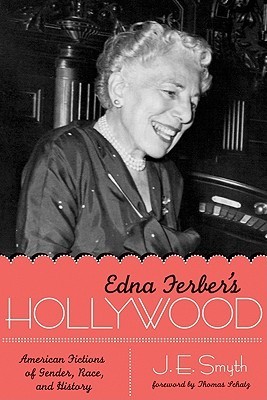
Edna Ferber's Hollywood book cover
#22

Edna Ferber's Hollywood

American Fictions of Gender, Race, and History

2009

Edna Ferber's Hollywood reveals one of the most influential artistic relationships of the twentieth century—the four-decade partnership between historical novelist Edna Ferber and the Hollywood studios. Ferber was one of America's most controversial popular historians, a writer whose uniquely feminist, multiracial view of the national past deliberately clashed with traditional narratives of white masculine power. Hollywood paid premium sums to adapt her novels, creating some of the most memorable films of the studio era—among them Show Boat, Cimarron, and Giant. Her historical fiction resonated with Hollywood's interest in prestigious historical filmmaking aimed principally, but not exclusively, at female audiences. In Edna Ferber's Hollywood, J. E. Smyth explores the research, writing, marketing, reception, and production histories of Hollywood's Ferber franchise. Smyth tracks Ferber's working relationships with Samuel Goldwyn, Leland Hayward, George Stevens, and James Dean; her landmark contract negotiations with Warner Bros.; and the controversies surrounding Giant's critique of Jim-Crow Texas. But Edna Ferber's Hollywood is also the study of the historical vision of an American outsider—a woman, a Jew, a novelist with few literary pretensions, an unashamed middlebrow who challenged the prescribed boundaries among gender, race, history, and fiction. In a masterful film and literary history, Smyth explores how Ferber's work helped shape Hollywood's attitude toward the American past.

Authors

J.E. Smyth
Author · 3 books

J. E. Smyth is a film critic and historian. She was born in New England and was educated at Wellesley College and Yale University. Smyth has written and edited several books about Hollywood, including a new edition of Jane Allen’s novel, I Lost My Girlish Laughter (Random House, 2019) and Nobody’s Girl Friday (Oxford University Press, 2018), a history of the many high-powered women who worked in the golden age of the Hollywood studio system (1924-1954). In 2021, she was named an Academy of Motion Picture Arts and Sciences film scholar for her latest project, a biography of Screen Writers Guild president, labor leader, and feminist, Mary C. McCall Jr.

548 Market St PMB 65688, San Francisco California 94104-5401 USA
© 2026 Paratext Inc. All rights reserved