Margins
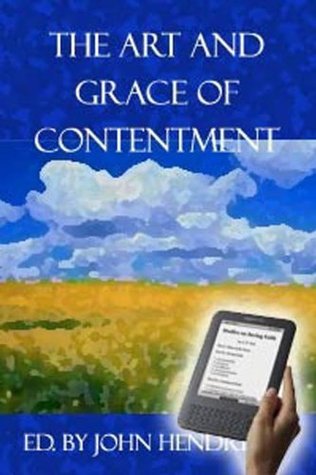
The Art and Grace of Contentment book cover
The Art and Grace of Contentment
2011
First Published
4.25
Average Rating
799
Number of Pages
This eBook comes complete with an active linked Table of Contents, making navigation quicker and easier. Table of ContentsPart ArticlesFull Contentment in Christ by Jonathan EdwardsThe Hellish Sin of Discontent by Thomas BostonContentment by John CalvinSecrets of Contentment by J. R. MillerCan We Learn to Be Contented? by J. R. MillerThe Blessing of Quietness by J. R. MillerContentment by William S. PlumerContentment by John MacDuffContentment by William A Rare Grace by J.C. RyleContentment by Arthur W. PinkI Will Never Leave Thee by Arthur W. PinkSubmission. Dependence. Contentment. by Harvey NewcombThe Tenth Commandment by Thomas WatsonWhat is required in the tenth commandment? by Thomas VincentWhat is forbidden in the tenth commandment? by Thomas VincentPsalm 23 by Charles SpurgeonBy the grace of God I am what I am! by John NewtonCovetousness by John NewtonBe Still by James SmithEverything short of Hell is mercy! by James SmithJesus Not Known by James SmithThe Complaining Christian by James SmithNo Reason for Discouragements by William A Great Help to Contentment by Thomas JacombeMy Times In God's Hand by Octavius WinslowPart BooksThe Art of Divine Contentment by Thomas WatsonThe Rare Jewel of Christian Contentment by Jeremiah BurroughsThe Crook in the Lot by Thomas Boston

Avg Rating
4.25
Number of Ratings
4
5 STARS
50%
4 STARS
25%
3 STARS
25%
2 STARS
0%
1 STARS
0%
goodreads

Authors

Thomas Watson
Thomas Watson
Author · 24 books

Librarian Note: There is more than one author in the Goodreads database with this name. Thomas Watson (c. 1620 - 1686) was an English, non-conformist, Puritan preacher and author. He was educated at Emmanuel College, Cambridge, where he was noted for remarkably intense study. In 1646 he commenced a sixteen year pastorate at St. Stephen's, Walbrook. He showed strong Presbyterian views during the civil war, with, however, an attachment to the king, and in 1651 he was imprisoned briefly with some other ministers for his share in Christopher Love's plot to recall Charles II of England. He was released on 30 June 1652, and was formally reinstated as vicar of St. Stephen's Walbrook. He obtained great fame and popularity as a preacher until the Restoration, when he was ejected for nonconformity. Not withstanding the rigor of the acts against dissenters, Watson continued to exercise his ministry privately as he found opportunity. Upon the Declaration of Indulgence in 1672 he obtained a license to preach at the great hall in Crosby House. After preaching there for several years, his health gave way, and he retired to Barnston, Essex, where he died suddenly while praying in secret. He was buried on 28 July 1686. (Information from wikipedia.org)

William Ames
William Ames
Author · 2 books
William Ames (/eɪmz/; Latin: Guilielmus Amesius; 1576 – 14 November 1633) was an English Protestant divine, philosopher, and controversialist. He spent much time in the Netherlands, and is noted for his involvement in the controversy between the Calvinists and the Arminians.
Jonathan Edwards
Author · 1 book
Librarian Note: There is more than one author in the Goodreads database named Jonathan Edwards. This entry is for Jonathan [2^] Edwards.
John Calvin
John Calvin
Author · 77 books

John Calvin, né Jehan Cauvin, re-translated from Latin Iohannes Calvinus into Jean Calvin in modern French, was an influential French theologian and pastor during the Protestant Reformation. He was a principal figure in the development of the system of Christian theology later called Calvinism. Originally trained as a humanist lawyer, he broke from the Roman Catholic Church around 1530. After religious tensions provoked a violent uprising against Protestants in France, Calvin fled to Basel, Switzerland, where in 1536 he published the first edition of his seminal work Institutes of the Christian Religion. In that year, Calvin was invited by William Farel to help reform the church in Geneva. The city council resisted the implementation of Calvin and Farel's ideas, and both men were expelled. At the invitation of Martin Bucer, Calvin proceeded to Strasbourg, where he became the minister of a church of French refugees. He continued to support the reform movement in Geneva, and was eventually invited back to lead its church. Following his return, he introduced new forms of church government and liturgy. Following an influx of supportive refugees and new elections to the city council, Calvin's opponents were forced out. Calvin spent his final years promoting the Reformation both in Geneva and throughout Europe. Calvin was a tireless polemic and apologetic writer. He also exchanged cordial and supportive letters with many reformers including Philipp Melanchthon and Heinrich Bullinger. In addition to the Institutes, he wrote commentaries on most books of the Bible as well as theological treatises and confessional documents, and he regularly gave sermons throughout the week in Geneva. Calvin was influenced by the Augustinian tradition, which led him to expound the doctrine of predestination and the absolute sovereignty of God in salvation. Calvin's writing and preaching provided the seeds for the branch of theology that bears his name. The Presbyterian and other Reformed churches, which look to Calvin as a chief expositor of their beliefs, have spread throughout the world. Calvin's thought exerted considerable influence over major religious figures and entire religious movements, such as Puritanism, and some have argued that his ideas have contributed to the rise of capitalism, individualism, and representative democracy in the West.

J.C. Ryle
J.C. Ryle
Author · 55 books
Ryle started his ministry as curate at the Chapel of Ease in Exbury, Hampshire, moving on to become rector of St Thomas', Winchester in 1843 and then rector of Helmingham, Suffolk the following year. While at Helmingham he married and was widowed twice. He began publishing popular tracts, and Matthew, Mark and Luke of his series of Expository Thoughts on the Gospels were published in successive years (1856-1858). His final parish was Stradbroke, also in Suffolk, where he moved in 1861, and it was as vicar of All Saints that he became known nationally for his straightforward preaching and firm defence of evangelical principles. He wrote several well-known and still-in-print books, often addressing issues of contemporary relevance for the Church from a biblical standpoint. He completed his Expository Thoughts on the Gospels while at Stradbroke, with his work on the Gospel of John (1869). His third marriage, to Henrietta Amelia Clowes in 1861, lasted until her death in 1889.
548 Market St PMB 65688, San Francisco California 94104-5401 USA
© 2026 Paratext Inc. All rights reserved