Margins




548 Market St PMB 65688, San Francisco California 94104-5401 USA
© 2026 Paratext Inc. All rights reserved
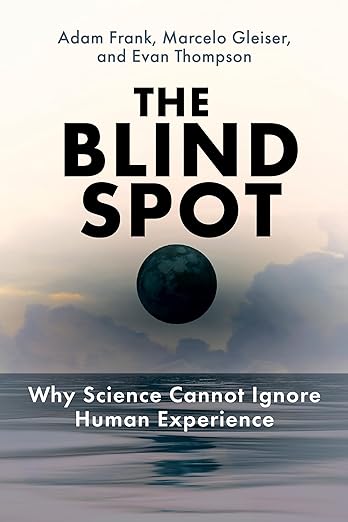
A compelling argument for including the human perspective within science, and for how human experience makes science possible. It’s tempting to think that science gives us a God’s-eye view of reality. But we neglect the place of human experience at our peril. In The Blind Spot, astrophysicist Adam Frank, theoretical physicist Marcelo Gleiser, and philosopher Evan Thompson call for a revolutionary scientific worldview, where science includes—rather than ignores or tries not to see—humanity’s lived experience as an inescapable part of our search for objective truth. The authors present science not as discovering an absolute reality but rather as a highly refined, constantly evolving form of human experience. They urge practitioners to reframe how science works for the sake of our future in the face of the planetary climate crisis and increasing science denialism. Since the dawn of the Enlightenment, humanity has looked to science to tell us who we are, where we come from, and where we’re going, but we’ve gotten stuck thinking we can know the universe from outside our position in it. When we try to understand reality only through external physical things imagined from this outside position, we lose sight of the necessity of experience. This is the Blind Spot, which the authors show lies behind our scientific conundrums about time and the origin of the universe, quantum physics, life, AI and the mind, consciousness, and Earth as a planetary system. The authors propose an alternative scientific knowledge is a self-correcting narrative made from the world and our experience of it evolving together. To finally “see” the Blind Spot is to awaken from a delusion of absolute knowledge and to see how reality and experience intertwine. The Blind Spot goes where no science book goes, urging us to create a new scientific culture that views ourselves both as an expression of nature and as a source of nature’s self-understanding, so that humanity can flourish in the new millennium.