


Margins
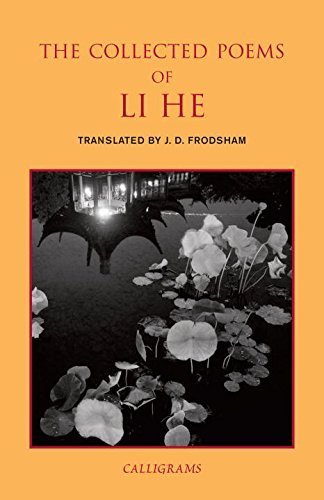
The Collected Poems of Li He book cover
The Collected Poems of Li He
Li He
2016
First Published
4.02
Average Rating
401
Number of Pages

The definitive collection of works by one of the Tang Dynasty's most eccentric (and badly-behaved) poets, now back in print for the first time in decades. Li He is the bad-boy poet of the late Tang dynasty. He began writing at the age of seven and died at twenty-six from alcoholism or, according to a later commentator, “sexual dissipation,” or both. An obscure and unsuccessful relative of the imperial family, he would set out at dawn on horseback, pause, write a poem, and toss the paper away. A servant boy followed him to collect these scraps in a tapestry bag. Long considered far too extravagant and weird for Chinese taste, Li He was virtually excluded from the poetic canon until the mid-twentieth century. Today, as the translator and scholar Anne M. Birrell, writes, “Of all the Tang poets, even of all Chinese poets, he best speaks for our disconcerting times.” Modern critics have compared him to Rimbaud, Baudelaire, Keats, and Trakl. The Collected Poems of Li He is the only comprehensive selection of his surviving work (most of his poems were reputedly burned by his cousin after his death, for the honor of the family), rendered here in crystalline translations by the noted scholar J. D. Frodsham.
Avg Rating
4.02
Number of Ratings
49
5 STARS
39%
4 STARS
35%
3 STARS
18%
2 STARS
6%
1 STARS
2%
goodreads

Author

Li He
Li He
Author · 3 books

Li He (c. 790–791 – c. 816–817) was a Chinese poet of the mid-Tang dynasty. His courtesy name was Changji, and he is also known as Guicai and Shigui. He was a native of Fuchang County (west of modern-day Yiyang County, Henan Province). His family were of distant royal descent (from the Li family who were the ruling dynastic family of the Tang Dynasty), but his branch's fortunes had declined early on, and by Li He's time they were of low rank. He started composing poetry at the age of 7, and by around 15 he was being compared to the yuefu master Li Yi. When Li was 20, he attempted to take the Imperial Examination, but was forbidden from doing so because of a naming taboo: the first character (晉 jin) of his father's given name (晉肅 Jinsu) was a homonym of the first character (進) of Jinshi (進士), the name of the degree that would have been conferred on him had he passed.[6] Ueki et al. (1999) speculate that this was a pretext devised by rivals who were jealous of his poetic skill to prevent him from sitting the examination. Han Yu, who admired his poetry, wrote Hui Bian (諱弁) to encourage him to take the exam, but Li was ultimately unsuccessful. He served only three years, in the low-ranking office of Fenglilang (奉禮郎) before returning to his hometown.

548 Market St PMB 65688, San Francisco California 94104-5401 USA
© 2026 Paratext Inc. All rights reserved