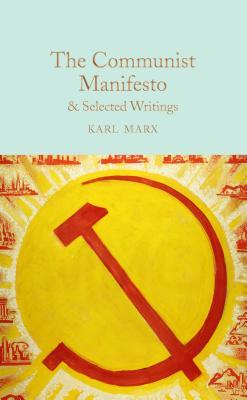



Designed to appeal to the book lover, the Macmillan Collector's Library is a series of beautifully bound pocket-sized gift editions of much loved classic titles. Bound in real cloth, printed on high quality paper, and featuring ribbon markers and gilt edges, Macmillan Collector's Library are books to love and treasure. Karl Marx’s Communist Manifesto, first printed just before the French revolution of 1848, is his most accessible and famous work. In his powerful call to arms, Marx expounds his famous theory that class struggle is the real determinant of historical change. Next in this volume comes his treatise, Wages, Price and Profit, written in 1865, which serves as an accessible introduction to the ideas which Marx went on to develop in Capital, his masterful, multi volume analysis of how the world was irreversibly changed by the industrial revolution. This Macmillan Collector’s Library edition contains the most salient extracts from his great work, selected and introduced by Hugh Griffith. Whilst old-style Marxism is now dead and buried, today's conflicts within capitalism are as sharp as ever and Marx’s brilliant, painstaking writings remain disturbingly relevant.
Author

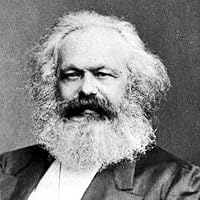
Karl Marx, Ph.D. (University of Jena, 1841) was a social scientist who was a key contributor to the development of Communist theory. Marx was born in Trier, a city then in the Kingdom of Prussia's Province of the Lower Rhine. His father, born Jewish, converted to Protestantism shortly before Karl's birth in response to a prohibition newly introduced into the Rhineland by the Prussian Kingdom on Jews practicing law. Educated at the Universities of Bonn, Jena, and Berlin, Marx founded the Socialist newspaper Vorwärts! in 1844 in Paris. After being expelled from France at the urging of the Prussian government, which "banished" Marx in absentia, Marx studied economics in Brussels. He and Engels founded the Communist League in 1847 and published the Communist Manifesto. After the failed revolution of 1848 in Germany, in which Marx participated, he eventually wound up in London. Marx worked as foreign correspondent for several U.S. publications. His Das Kapital came out in three volumes (1867, 1885 and 1894). Marx organized the International and helped found the Social Democratic Party of Germany. Although Marx was not religious, Bertrand Russell later remarked, "His belief that there is a cosmic force called Dialectical Materialism which governs human history independently of human volitions, is mere mythology" (Portraits from Memory, 1956). Marx once quipped, "All I know is that I am not a Marxist" (according to Engels in a letter to C. Schmidt; see Who's Who in Hell by Warren Allen Smith). D. 1883. Marx began co-operating with Bruno Bauer on editing Hegel's Philosophy of Religion in 1840. Marx was also engaged in writing his doctoral thesis, The Difference Between the Democritean and Epicurean Philosophy of Nature, which he completed in 1841. It was described as "a daring and original piece of work in which Marx set out to show that theology must yield to the superior wisdom of philosophy": the essay was controversial, particularly among the conservative professors at the University of Berlin. Marx decided, instead, to submit his thesis to the more liberal University of Jena, whose faculty awarded him his PhD in April 1841. As Marx and Bauer were both atheists, in March 1841 they began plans for a journal entitled Archiv des Atheismus (Atheistic Archives), but it never came to fruition. Marx has been described as one of the most influential figures in human history. Marx is typically cited, with Émile Durkheim and Max Weber, as one of the three principal architects of modern social science. More: http://en.wikipedia.org/wiki/Karl\_Marx http://plato.stanford.edu/entries/marx/ http://www.econlib.org/library/Enc/bi... http://www.marxists.org/archive/marx/... http://www.historyguide.org/intellect... http://www.bbc.co.uk/history/historic... http://www.spartacus.schoolnet.co.uk/... http://www.britannica.com/EBchecked/t...