Margins
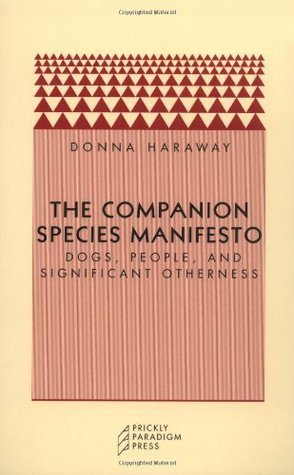
The Companion Species Manifesto book cover
The Companion Species Manifesto
2003
First Published
3.63
Average Rating
154
Number of Pages
The Companion Species Manifesto is about the implosion of nature and culture in the joint lives of dogs and people, who are bonded in "significant otherness." In all their historical complexity, Donna Haraway tells us, dogs matter. They are not just surrogates for theory, she says; they are not here just to think with. Neither are they just an alibi for other themes; dogs are fleshly material-semiotic presences in the body of technoscience. They are here to live with. Partners in the crime of human evolution, they are in the garden from the get-go, wily as Coyote. This pamphlet is Haraway's answer to her own Cyborg Manifesto, where the slogan for living on the edge of global war has to be not just "cyborgs for earthly survival" but also, in a more doggish idiom, "shut up and train."

Avg Rating
3.63
Number of Ratings
1,068
5 STARS
24%
4 STARS
33%
3 STARS
28%
2 STARS
10%
1 STARS
4%
goodreads

Author

Donna Haraway
Donna Haraway
Author · 17 books

Donna J. Haraway is an American Professor Emerita in the History of Consciousness Department and Feminist Studies Department at the University of California, Santa Cruz, United States. She is a prominent scholar in the field of science and technology studies, described in the early 1990s as a "feminist, rather loosely a postmodernist". Haraway is the author of numerous foundational books and essays that bring together questions of science and feminism, such as "A Cyborg Manifesto: Science, Technology, and Socialist-Feminism in the Late Twentieth Century" (1985) and "Situated Knowledges: The Science Question in Feminism and the Privilege of Partial Perspective". Additionally, for her contributions to the intersection of information technology and feminist theory, Haraway is widely cited in works related to Human Computer Interaction (HCI). Her Situated Knowledges and Cyborg Manifesto publications in particular, have sparked discussion within the HCI community regarding framing the positionality from which research and systems are designed. She is also a leading scholar in contemporary ecofeminism, associated with post-humanism and new materialism movements. Her work criticizes anthropocentrism, emphasizes the self-organizing powers of nonhuman processes, and explores dissonant relations between those processes and cultural practices, rethinking sources of ethics. Haraway has taught Women's Studies and the History of Science at the University of Hawaii and Johns Hopkins University. Haraway's works have contributed to the study of both human-machine and human-animal relations. Her works have sparked debate in primatology, philosophy, and developmental biology. Haraway participated in a collaborative exchange with the feminist theorist Lynn Randolph from 1990 to 1996. Their engagement with specific ideas relating to feminism, technoscience, political consciousness, and other social issues, formed the images and narrative of Haraway's book Modest_Witness for which she received the Society for Social Studies of Science's (4S) Ludwik Fleck Prize in 1999. In 2000, Haraway was awarded the Society for Social Studies of Science's John Desmond Bernal Prize for her distinguished contributions to the field of science and technology studies. Haraway serves on the advisory board for numerous academic journals, including differences, Signs: Journal of Women in Culture and Society, Contemporary Women's Writing, and Environmental Humanities.

548 Market St PMB 65688, San Francisco California 94104-5401 USA
© 2026 Paratext Inc. All rights reserved